
Axios Markets

June 17, 2024

Welcome back! Today we have some smart media analysis from our Axios Pro colleague Tim Baysinger. Subscribe here.
Today's newsletter is 824 words, a 3-minute read.
1 big thing: How is Paramount still alive
The latest drama enveloping Paramount Global will come as no surprise to anyone who has been paying attention to the once-storied Hollywood relic as it has lurched from crisis to catastrophe over the past 20 years.
Why it matters: The slow implosion of Paramount is easy to read as an inevitable byproduct of the bigger move from celluloid moguls to global streaming platforms. But it's also a classic case of old-fashioned all-American mismanagement.
Driving the news: The woman who controls the company, Shari Redstone, snatched defeat from the jaws of victory last week as she scuttled a planned merger with David Ellison's Skydance Media.
- Redstone had spent six months negotiating a complicated deal that would have given control of Paramount to Ellison and RedBird Capital, only to call it off as it neared the finish line.
- The chief reason for her decision: Her reluctance to let go of a family heirloom she fought very hard to get.
Catch up fast: Over the past two decades, Paramount (née ViacomCBS, née Viacom and CBS Corp.) has been a model of instability.
- In 2006, Viacom and CBS were split amid clashing cultures and a rivalry between their respective leaders, Tom Freston and Leslie Moonves.
- Redstone re-merged the two back together in 2019, a move Moonves vehemently opposed.
Between the lines: What was poised to turn into an ugly boardroom fight became even uglier when Moonves was accused by multiple women of sexual misconduct in one of the biggest scandals of the #MeToo era. He was eventually fired in 2018.
- The merger put Paramount Pictures and Viacom cable networks like MTV and Comedy Central under the same roof as broadcast network CBS and a streaming service that would become Paramount+.
- Redstone's decision to form what was then called ViacomCBS was seen as misguided: Too small to compete with growing giants like Netflix, yet big enough to make a sale complicated.
Flashback: Like many media companies, Paramount is controlled by a powerful minority investor — in this case, Shari Redstone, who inherited it from her father Sumner in a family drama that helped inspire HBO's "Succession."
- Before his health started to fail, Sumner Redstone was pretty adamant that his daughter should not inherit his empire.
- In 2007, he called his daughter a "credible candidate" to succeed him but said he preferred the board to choose his successor.
- The familial drama was not isolated to father-daughter. Shari's brother, Brent, sued their father in 2006, in an attempt to break up the company.
- Shari won a drawn out, and at times extremely ugly, boardroom battle after Sumner's mental capacity was questioned.
What's next: For the foreseeable future (which, this being Paramount, is measured more in weeks than in years) the company will be run by an unwieldy triumvirate of Brian Robbins, Chris McCarthy and George Cheeks.
- The three were elevated after Bob Bakish, Redstone's handpicked protege, was unceremoniously defenestrated after their relationship deteriorated.
- One big reason for that deterioration: Bakish was against the very Skydance deal that Redstone unilaterally abandoned.
2. Paramount's decline


When Shari Redstone announced the merger of Viacom with CBS in August 2019, the combined company was set to be worth some $30 billion.
Follow the money: By the time the merger closed four months later, the valuation had dropped to $25 billion. Today, the company is worth less than $7 billion.
- The company is also losing money: More than $500 million in the most recent quarter, and some $1.2 billion over the past five quarters.
- Its debt was downgraded to junk by S&P Global in March.
Flashback: For a hot minute during the meme-stock craziness of early 2021, Paramount's valuation spiked to more than $60 billion.
- That had nothing to do with its fundamentals and everything to do with share-price manipulation by Bill Hwang of Archegos Capital Management, who is now on trial for criminal racketeering.
3. Don't count Hollywood out
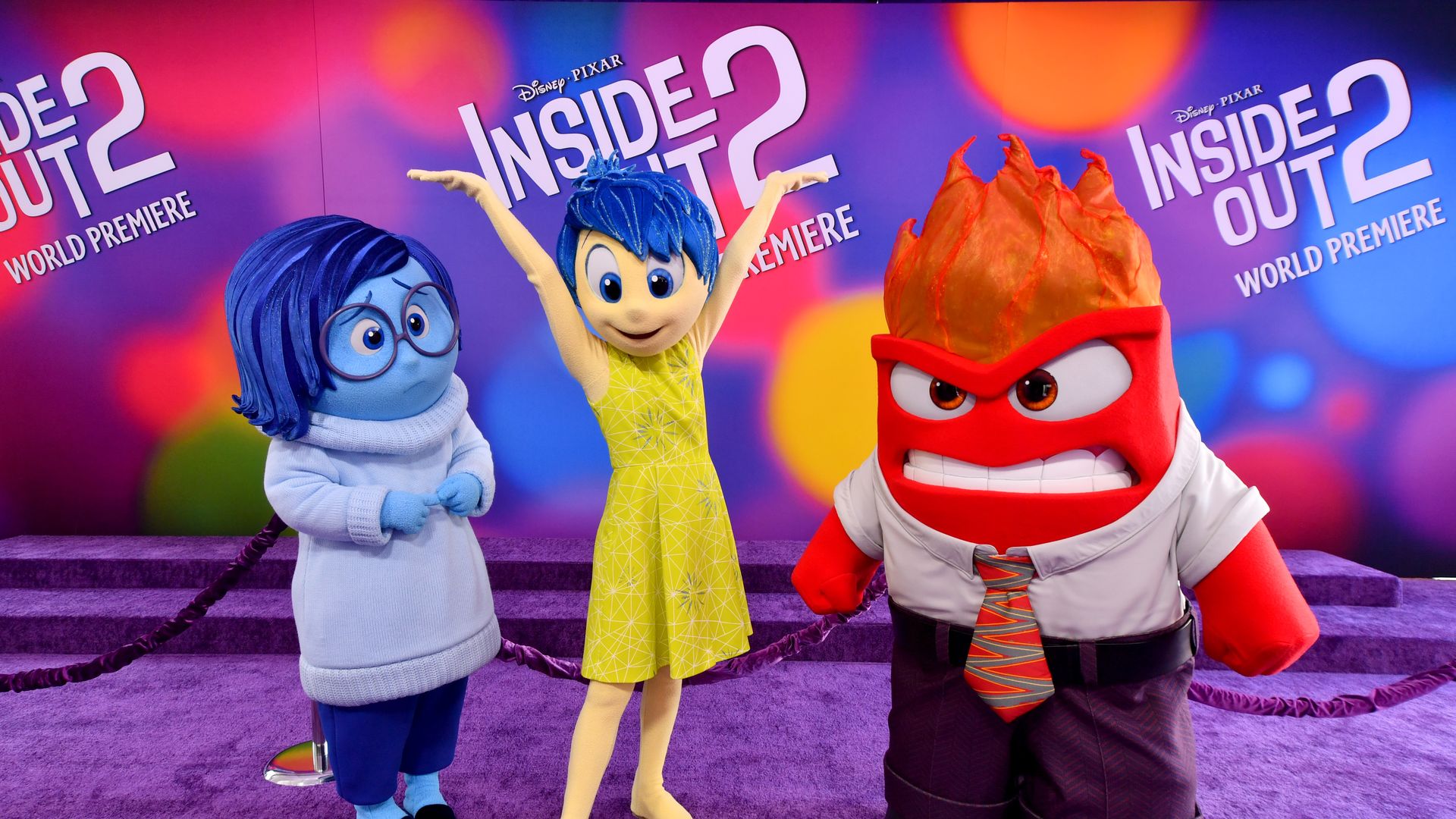
First came "Barbie," then came Pixar's "Inside Out 2." They represent a devastating 1-2 punch against the idea that family-friendly theatrical blockbusters are dead and that, in a streaming-dominated world, the only thing capable of getting butts in cinema seats is a big-screen spectacle like "Top Gun," "Dune," or (perhaps) "Oppenheimer."
Why it matters: The decline of once-great studios like Paramount should not be taken as a sign of Hollywood's global irrelevance. "Inside Out 2" is proof that Hollywood — and only Hollywood — can turn a movie into a must-see global event.
By the numbers: At current exchange rates, "Inside Out 2" scored the largest international opening weekend in history, bringing in $140 million on top of its domestic $155 million haul for a total of $295 million.
- It was the biggest opening of all time in markets including Colombia and Turkey, and the second-biggest of all time across Latin America as a whole, behind only "Avengers: Endgame."
The bottom line: Animated movies aren't just for keeping kids entertained on long car journeys. It turns out they can keep cinema owners happy, too.
Thanks to Kate Marino for editing this newsletter and to Carolyn DiPaolo for copy editing it.
Sign up for Axios Markets