Axios Markets

January 21, 2022
🌼 Rise and shine, buttercup. There's a market open somewhere.
⏰ Treasury Secretary Janet Yellen is speaking later today at virtual Davos.
🚨 ICYMI: Check out the livestream from yesterday’s Axios Pro Launch event featuring interviews with top business leaders. Get a 14-day free trial of our new subscription coverage here.
Today's newsletter is 1,160 words, 4.5 minutes.
1 big thing: The Fed's open to a digital dollar
Illustration: AĂŻda Amer/Axios
The Federal Reserve just weighed in on the potential for a digital dollar — sort of, Axios' Kate Marino writes.
- It finally released a much-delayed paper yesterday, opining on the pros and cons of developing its own central bank digital currency (CBDC) — but didn’t come to any firm conclusions.
Why it matters: Around the world, there are now 23 CBDCs either in pilot or formally launched. They have morphed from a theoretical concept into real-world digital cash, changing the way governments and millions of people use money — but not in the U.S.
Between the lines: Although the Fed's paper doesn't advocate one way or another on whether the U.S. should begin development, the language used in the paper indicates that it’s very open to the idea, Josh Lipsky, director at the Atlantic Council’s GeoEconomics Center, tells Axios.
The big picture: A digital dollar would be legal tender pegged to the value of the physical dollar and backed by the Fed.
- Central banks are considering CBDCs in order to retain control over monetary policy in the face of growing cryptocurrency adoption, and because they could enable more efficient government payments and financial inclusion.
- It's also a matter of international influence: Fed vice chair nominee Lael Brainard, for one, said last year that she couldn't “wrap [her] head around” the U.S. not having one, given the dollar's current dominance in international payments — and China's head-start on developing its own digital yuan.
China is the largest economy with a pilot, and as of November, about 140 million people had opened digital wallets, China's central bank said.
- For the upcoming Beijing Winter Olympics, Chinese authorities are encouraging athletes and companies to use the digital yuan, in an effort to showcase it internationally, Bloomberg reported.
How it works: Globally, central banks are so far using existing financial networks — like banks, fintechs, and even telecom companies — to distribute CBDCs to citizens, Jonathan Dharmapalan, CEO of eCurrency, tells Axios.
- That’s notable, because "if you go back a few years, there were these ideas out there that people were going to have Fed apps on their phone. But that's not happening,” adds Lipsky.
Still, consumer adoption has been slow — in part because existing electronic payments systems are pretty convenient, according to reports on China's efforts. Same in Nigeria, the largest economy to formally launch a CBDC.
What's next: In the U.S., there's a 120-day comment period on the new paper, after which the Fed may issue a follow-up.
- But the ball is effectively in Congress' court: The Fed said unequivocally that it wouldn't move forward on any CBDC development without legislative action granting it authority.
2. Catch up quick
JPMorgan Chase paid Jamie Dimon $34.5 million last year, amid record profits for the bank, the most he's made since 2008 (FT).
State revenues are booming thanks to a growing tax intake and federal aid — leading many to propose tax rebates and worker bonuses. (WSJ)
Home sales in the U.S. hit a 15-year high in 2021, but rising mortgage rates may slow activity this year. (WSJ)
3. Climbing crude heads for reckoning

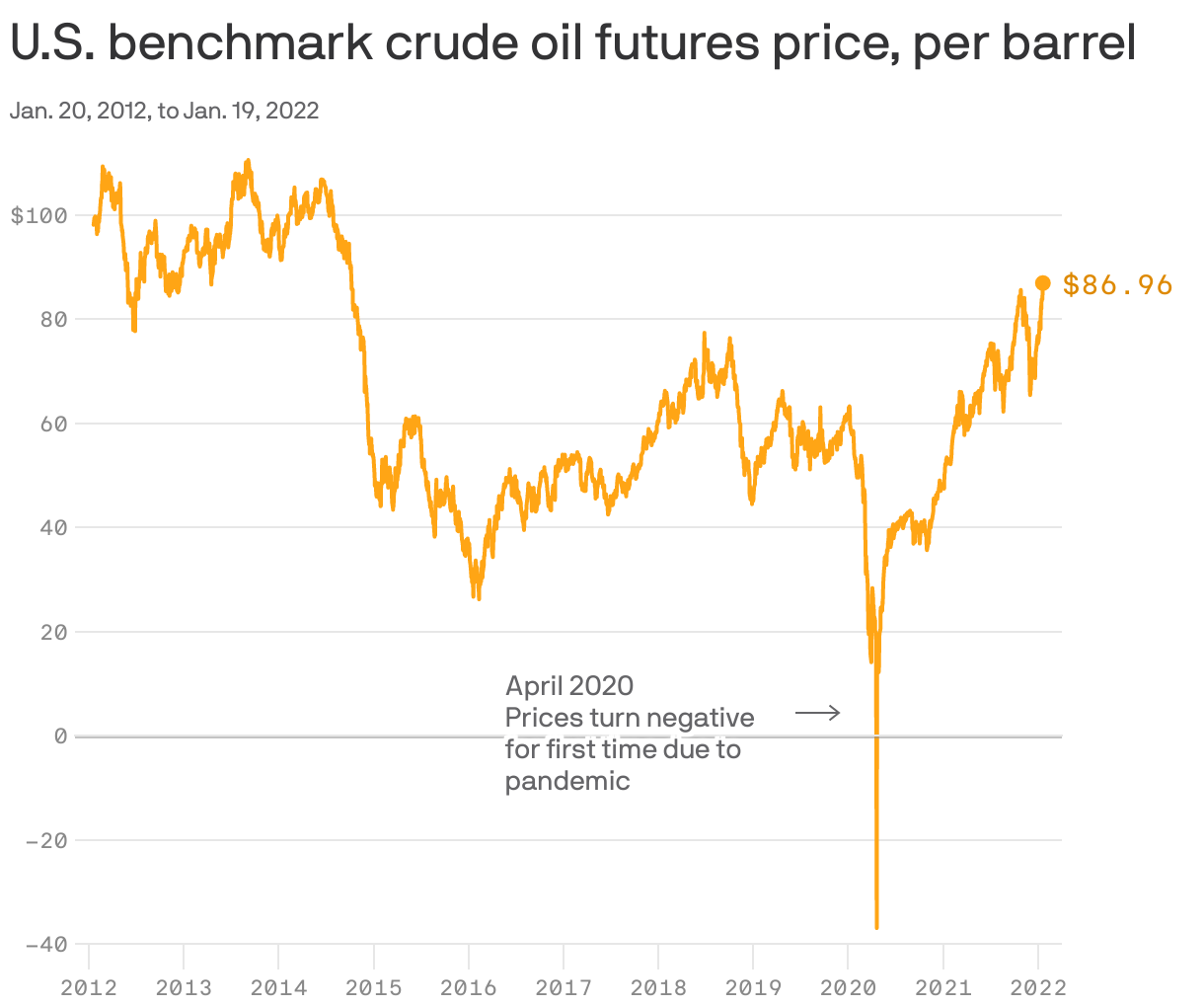
U.S. crude oil prices reached the highest level in seven years this week, amid supply disruptions and geopolitical jitters, Matt writes.
Why it matters: The climbing cost of crude — which is an input cost into virtually everything that is transported — will add to the inflationary pressures that are bedeviling politicians, policymakers and consumers.
What happened: On Monday, Yemen’s Houthi rebels used drones to destroy fuel tankers in the United Arab Emirates. The U.A.E. is OPEC’s third-largest producer.
- A fire-induced outage temporarily halted the flow of crude through a pipeline connecting Iraq to Turkey on Tuesday.
- Tensions between Russia — the world’s third-largest oil producer — and the west continue to build over Ukraine, with the U.S. on Thursday promising a “swift, severe” response to a military incursion.
What’s next: Analysts and traders are beginning to think that crude-consuming countries may move toward another coordinated release of strategic reserves to quell the rise in crude.
- President Biden said Wednesday, “There's going to be a reckoning along the line here as to whether or not we're going to continue to see oil prices continue to go up.”
4. The high cost of bringing down inflation
Illustration: AĂŻda Amer/Axios
Suppose the Federal Reserve had perfect foresight last year and set out to keep inflation at its 2% target anyway — despite supply disruptions and labor shortages. What would that have looked like?
The answer: A catastrophe for growth, according to new research from the BlackRock Investment Institute. The Fed would have had to crater demand in the economy so much, that it would have pushed the unemployment rate to nearly 10%, the researchers estimate, Axios' Neil Irwin writes.
Why it matters: Inflation is making people miserable, but so long as it's caused mainly by supply problems, abrupt efforts to rein it in would be highly costly too — just in different ways.
- It's a damned-if-you-do, damned-if-you-don't moment for economic policy.
The big picture: The inflation of this era is unlike that seen in the last three decades, the research arm of the giant asset manager concludes.
- For most of that time, fluctuations in demand determined what happened to prices. When unemployment was too high, inflation was typically too low, so stimulus helped with both problems at once.
But now, inflation is largely being driven by the supply side of the economy. That means the usual economic policy tools to fight it will be underpowered, and possibly counterproductive, write Elga Bartsch, Jean Boivin and Alex Brazier.
- "If inflation is the noise from the economic engine, in the past it was caused by the engine revving too fast," they write. "For the foreseeable future, it is more likely to be due to the engine misfiring."
One implication: Excessive interest rate increases could actually be counterproductive for fighting inflation. That's because part of what needs to happen for inflation to come down is companies investing in areas of the economy straining under supply shortages.
The bottom line: Bringing this inflation down without causing a steep downturn will be an exceedingly delicate task.
5. Oof. Double pay gap

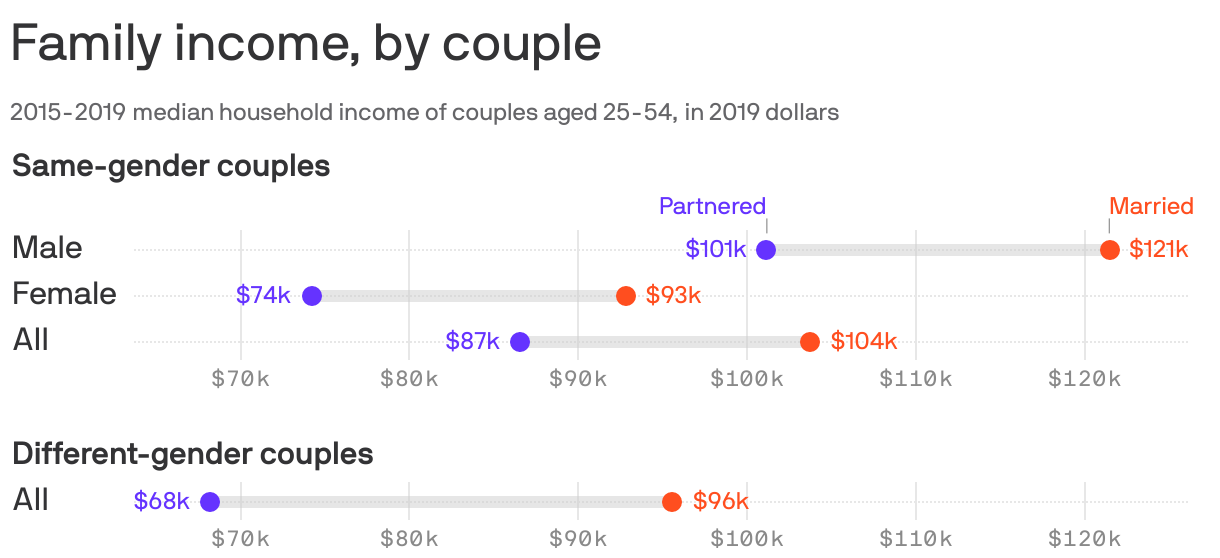
Most people are familiar with the gender wage gap, but less well-understood is the income gap between women in same-gender couples and men in same-gender couples, Emily writes.
Why it matters: Women in same-gender partnerships can experience (at least) two kinds of discrimination, based on their gender and on their sexual orientation.
The latest: A new analysis from The Hamilton Project, a policy think tank at the Brookings Institution, offers new info, delving into five years of Census Bureau data on same-gender household income. Findings:
- Male same-gender married couples earned $121,000 in income, on average.
- Meanwhile, female same-gender married households made $93,000, or slightly less than the average household income for different-gender couples.
Of note: The small difference between female same-gender married couples and different-gender couples was surprising because female partnerships are more likely dual-income (both women working), said Lauren Bauer, a fellow at Brookings, who co-authored the paper.
Sign up for Axios Markets

Stay on top of the latest market trends and economic insights