
Axios Markets

February 09, 2024
🍕Friends. Today is National Pizza Day. We'll observe later — pepperoni may be involved. But first, we newsletter! Today's is 1,043 words, 4 minutes.
1 big thing: Funding Ukraine
Illustration: Sarah Grillo/Axios
Belgium's government is shopping around an avant-garde solution to Ukraine's money problems, now that further direct aid to the country seems all but dead in the U.S. Congress, Axios' Kate Marino writes.
Why it matters: The war has dragged on — this month marks two years. Ideas that once seemed far-fetched or too difficult are now being given serious consideration.
State of play: In broad strokes, the plan would entail Ukraine raising new debt from private-sector lenders, using Russian central bank assets (frozen by Western sanctions) as collateral, as the FT first reported.
- Having collateral is crucial because Ukraine is broke — it can't assure its prospective lenders that it'll be able to pay the money back.
- Think of this in the same way that a house is collateral for a mortgage. It can be taken over by lenders in the future if the borrower can't repay.
The intrigue: In any normal debt placement, the borrower (Ukraine in this case) has to have possession of the collateral for it to actually be collateral.
- The big question is how the West can financially engineer this assurance for would-be lenders.
What we're hearing: Any such plan would probably involve putting the Russian assets into an escrow-type account with a neutral third party until the invasion ends.
- The terms of the escrow would allow Ukraine to use the assets to raise money — likely by placing zero-coupon bonds that mature in 30 or 40 years.
- The escrow account's very existence would give cover to Western governments to insist they haven't seized anything, since Russia's ownership wouldn't technically change.
The upshot: The plan acts as a bridge to a time in the future when Russia has exited Ukraine and is willing to negotiate over compensation. Or, failing that, a legal entity like the International Court for Justice rules that Russia owes reparations, which would mean the assets could finally be seized.
- Reparations rulings can take years — decades, even. The debt plan would allow Ukraine to capitalize on expected reparations now.
- This flavor of lending could appeal to investors who are willing to bet that Russia will be held liable for reparations.
Worth noting: The reason Belgium's circulating the plan to the G7 is because the biggest chunk of Russia's frozen assets are held there.
Between the lines: In some ways, the plan has a model — it's a modern twist on the Brady bonds of the 1980s.
- But, but, but: It's hard to understate how unprecedented it would be to utilize another country's sovereign assets — even with an elegant, arm's length arrangement. Under international law, those assets are sacrosanct.
2. Untested
Illustration: Aïda Amer/Axios
The debt plan may be the leading option for using Russia's assets at scale to help rebuild Ukraine, but the barriers are still high.
- In order to move the assets into escrow, the individual countries where the assets are held may need to pass legislation to allow it. And many countries in Europe still need to be convinced.
- (The U.S. for its part, has expressed openness to using the assets.)
What they're saying: "This is untested. But I think it's something we should take seriously because there's been tremendous pressure on the Europeans to just seize it and give it to Ukraine — which they aren't willing to do," says Charles Lichfield, deputy director at the Atlantic Council GeoEconomics Center.
- "There's now a renewed focus on using Russian assets because everyone is running out of money — it's as simple as that," says Thomas Kleine-Brockhoff, of the German Marshall Fund.
What to watch: The G7 nations will likely want to make progress on some details of a framework at their next meeting, a source familiar with the matter tells Axios.
4. Deflation sensation


China seems to be getting sucked into a deflationary vortex, Matt writes.
Why it matters: A broad-based decline in prices is one of the toughest issues for an economy to shake off.
The latest: Consumer prices fell 0.8% in January, compared with the prior year. It's the fastest decline in the price level since September 2009, amid the deep global recession that followed the 2008 financial crisis on Wall Street.
- Context: China's economy is suffering from a massive bust in its housing sector. That's weakened a key driver of domestic GDP growth while simultaneously unnerving consumers — for whom housing is an important store of wealth — and global investors, who have been voting with their feet and rapidly withdrawing capital from the country.
Be smart: The deepening deflation is reminiscent of the economic woes Japan faced in the aftermath of its own real estate bust and financial crisis in the early 1990s, which led to more than a decade-long struggle to boost growth once again.
The bottom line: This is a bad sign for China, the world's second-largest economy — and for countries that have long hitched their economic wagons to the People's Republic.
5. 🏈 What we're watching: Commercials, tbh
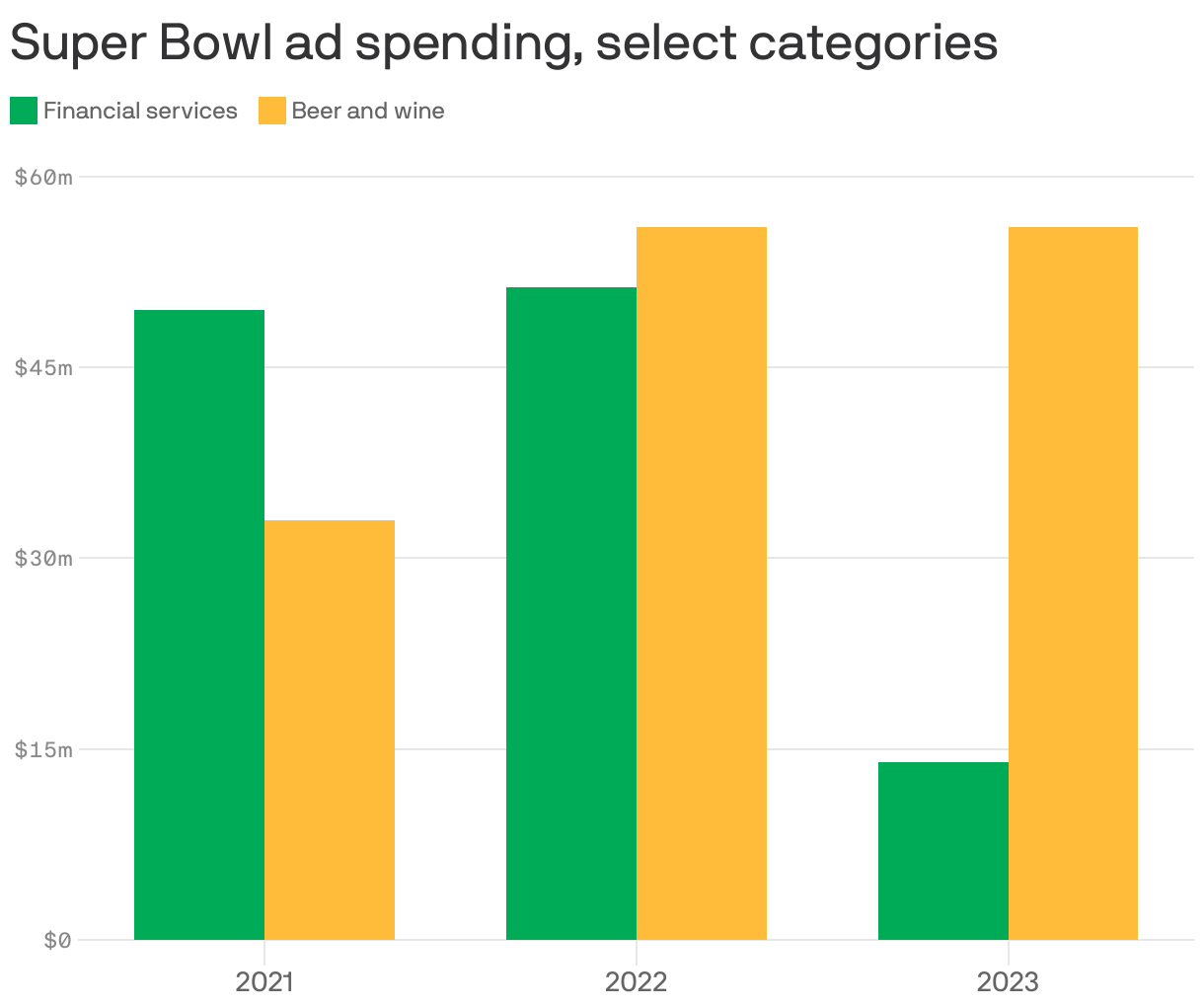
The Super Bowl is the biggest marketing event of the year — one of the few remaining events that most Americans watch in real time, Emily writes.
Here are the big trends to look for on Sunday ...
Taylor Swift effect: Every game she attended this season got a viewership bump, and the assumption is the Super Bowl gets one, too.
- Beauty brands like NYX and e.l.f. bought ad spots hoping to capitalize on those younger and typically female Swifties, reports Axios' Sara Fischer and Kelly Tyko.
Celebrity overload: What's better than one famous person pitching your product? A lot of them, apparently. Piling on celebs is big this year, WSJ reports.
- Fewer than a third of Super Bowl ads are celeb-free, per the paper.
- If you have a minute, watch this absolutely unhinged commercial for Paramount+ ... it features at least seven celebrities (if you count animated characters).
Beer > Finance: Remember the year crypto took over the Super Bowl? Those days are gone. (Look at that chart up top.)
- This year, spending on ads for food and beer and wine is up. Spending for ads on financial services? Positively anemic.
Was this email forwarded to you? Subscribe here.
Axios Markets is edited by Kate Marino and copy edited by Mickey Meece.
Sign up for Axios Markets

Stay on top of the latest market trends and economic insights