Axios Markets

October 15, 2026


1 big thing: AI tremors
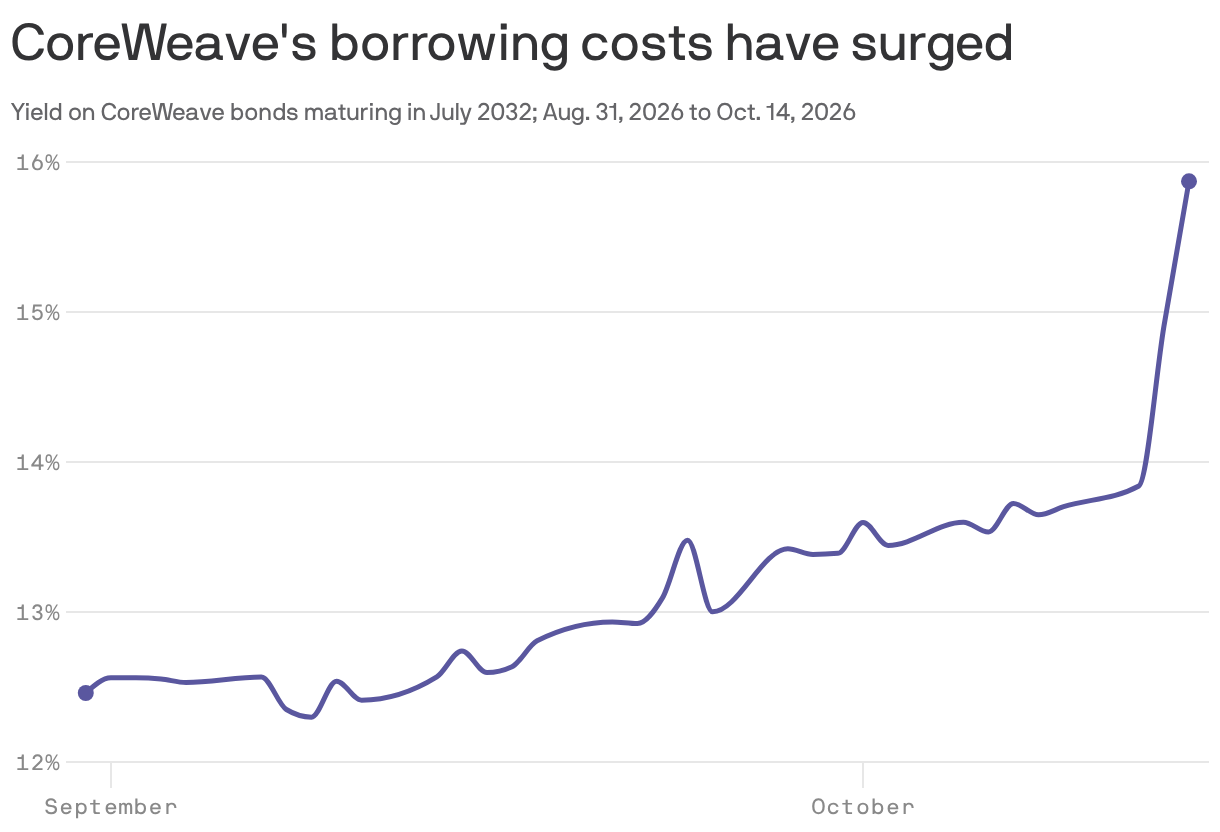
CoreWeave was at the heart of the market's volatility yesterday.
Why it matters: The heavily indebted, cash-burning neocloud — a data center operator that effectively rents out its AI computing capacity — is seen as something of a canary in the coal mine for the broader AI trade.
- The sharp sell-offs in its bonds and stock underscored how jittery investors are getting about the AI investment binge.
The latest: CoreWeave's bonds had their second consecutive day of selling, pushing their yields above 15%. (Prices and yields move in opposite directions.)
- Its stock tumbled roughly 15.5%, its worst drop since February.
The big picture: The slump arrived amid weakness for AI-related stocks in recent days.
- The SOX semiconductor index, for example, fell for the sixth straight session yesterday and is down 7.5% this month.
What they're saying: "CoreWeave is a bellwether for the riskier cusp of hyperscaler sentiment," John Atkins, who covers corporate bonds at PitchBook, tells Axios.
- With the recent surge in borrowing costs, he says, "people are taking a dim view of speculative borrowing that will need to be refinanced at punishingly high rates."
Zoom in: The proximate cause of yesterday's selling was tough to pinpoint, though the pressure of rising interest rates may have had something to do with it.
- Early in the day, a hotter-than-expected Consumer Price Index for September sent Treasury yields sharply higher, with the yield on the U.S. 10-year briefly jumping above 5.30%.
- Corporate bonds can do well when government bond yields rise — especially if those government yields reflect strong, healthy economic growth.
- But sharp moves in government bond yields have a tendency to trigger sympathy sell-offs in corporate debt, analysts say.
The other side: "When you are building a new type of technology company, there will be periods of time when the market misunderstands and acts irrationally," CoreWeave CEO Michael Intrator wrote in an internal memo to staff, adding that he was confident in the company's business model.
The bottom line: Markets overshoot all the time, but the episode does seem to have rattled investors about the AI boom.
- Indeed, yesterday morning's sharp rise in long-end Treasury yields reversed by the end of the day, in what seemed to be a flight-to-safety trade brought on by the AI jitters.
2. Big banks' bad week



America's biggest banks are having a rough week in President Trump's Washington.
Why it matters: The industry has had policy victories under Trump. But this week's historic fine against Bank of America and a regulatory report that raises new concerns about politically motivated "debanking" show the limits of Wall Street's influence with the administration.
Driving the news: Three actions in less than 24 hours have put some of the nation's largest banks on the defensive.
Tuesday: Treasury imposed more than $1.2 billion in penalties against Bank of America for anti-money laundering and sanctions violations, a historic fine that weighed on the bank's third-quarter results.
Yesterday: A federal banking regulator put nine major banks in an uncomfortable spotlight over instances of debanking.
- The report could not establish how widespread the practice is, but it handed the banks an embarrassing public rebuke over an issue that Trump has made a personal crusade.
Also yesterday: The Consumer Financial Protection Bureau said it would investigate whether banks identified in the report violated federal consumer protection laws.
The backdrop: The pressure in Washington comes smack in the middle of Wall Street earnings season. Big bank shares have taken a hit as rising interest rates threaten to chill borrowing and dealmaking.
Between the lines: Big banks have faced competing forces since the start of Trump's second term — on the one hand, an administration eager to loosen financial regulations. On the other, a president willing to publicly attack the industry.
- Regulators are moving ahead with plans to ease capital requirements and streamline bank mergers. The Fed late last month finalized changes to make its annual stress tests more predictable.
- But Trump has repeatedly targeted banks over alleged political debanking and credit card fees, a fight that began just days into his second term when he publicly confronted Bank of America and JPMorgan Chase.
What they're saying: The banking industry's response shows the delicate balancing act. Banks are emphasizing areas of agreement rather than pushing back against the administration's criticism.
- In response to the OCC report, the Bank Policy Institute said it supports efforts to prevent political discrimination while maintaining "sound risk management," and pledged to work with the administration and Congress on further changes.
The bottom line: This week shows the awkward position big banks occupy in Trump's Washington — benefiting from his deregulatory agenda while remaining targets of his administration's scrutiny.
3. CEO confidence drops into negative territory
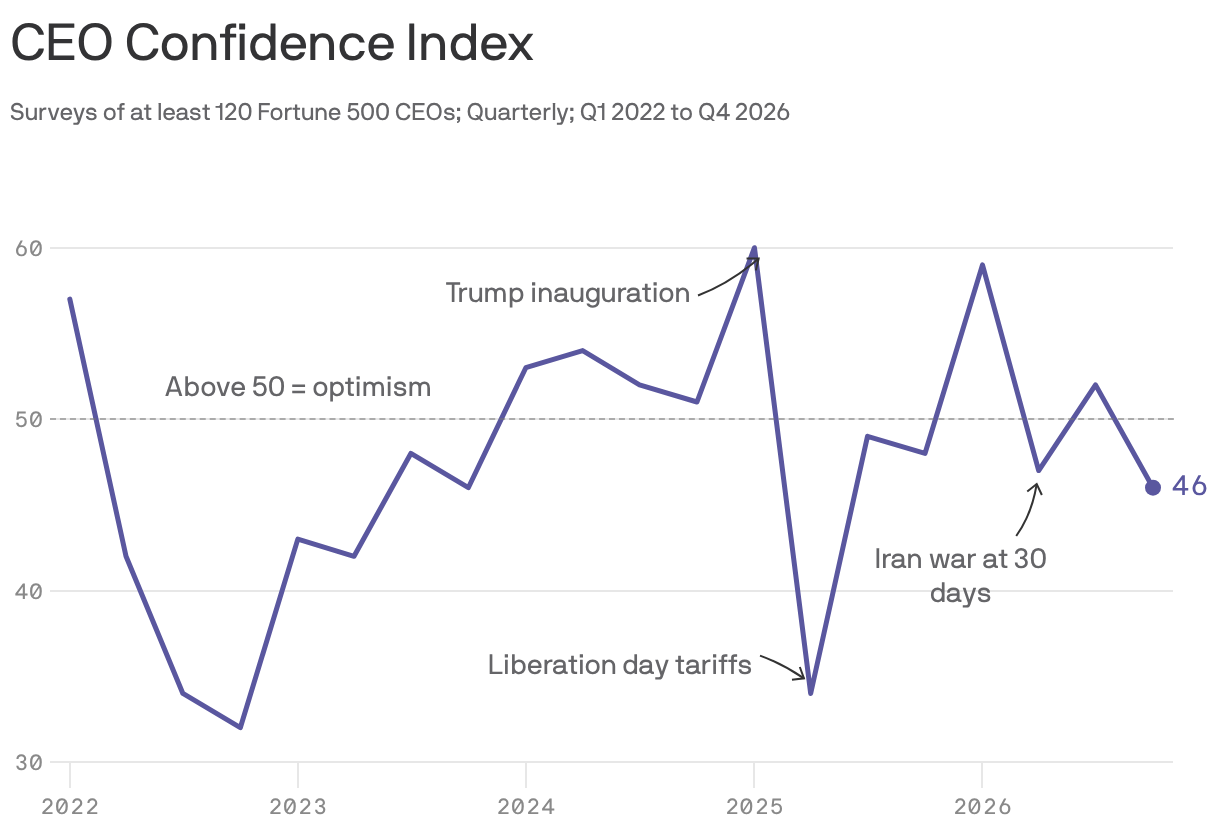
CEO confidence in the U.S. economy sank into negative territory earlier this month, finds a survey from the Conference Board.
Why it matters: Business leaders are mind-melding with most consumers, whose opinions on the economy are now lower than during the pandemic.
- Sour sentiment is shaping up as a key issue in the midterms just weeks away.
Where it stands: The CEO Confidence Index fell to 46 in the most recent period, down from 52 just three months ago — any number below 50 connotes negative sentiment.
- The nonprofit Conference Board and the Business Council surveyed 131 Fortune 500 CEOs from Sept. 21-Oct. 5.
- The survey measures how chief executives at major public companies feel about current economic conditions and their expectations for the economy and their own industries over the next six months.
By the numbers: 41% of CEOs expected economic conditions to worsen — up from 19% in the previous quarter.
The surge in energy prices also contributed to the fall in sentiment, Dana Peterson, chief economist at the Conference Board, tells Axios.
- "All these inflationary shocks, one after the other, is weighing down on the confidence of both CEOs and consumers," she says.
Between the lines: The key worry when CEO moods darken is the spillover into the economy, as they pull back on spending and hiring.
Reality check: Despite their dimming views, CEOs have for the most part maintained their spending plans, per the survey.
Case in point: A separate survey found that 89% of U.S. CEOs said they expected to increase headcount over the next three years as AI creates more business opportunities.
- "As we put more AI into our processes and platforms, the capacity opens up," Tim Walsh, the CEO of KPMG, which conducted the survey, told Axios' Nathan Bomey.
- "What you're seeing there is CEOs being really optimistic that they can actually expand their business, which is going to result in a bigger workforce for them."
The bottom line: CEOs are gloomy about the economy, but their dark mood hasn't yet translated into a meaningful pullback in investment plans.
Axios Markets