Axios Markets

April 18, 2023
☀️ Good morning. It feels like spring in NYC ... Let's do this.
Today's newsletter is 1,097 words, a 4.5-minute read.
1 big thing: Why some people hate tax refunds

Illustration: Sarah Grillo/Axios
Is getting a tax refund irrational? Some economists would have you think so, Emily writes.
Why it matters: Today is tax day; those who pushed filing to the deadline are just learning if they overpaid their taxes this year and are due a refund — or if they owe more money.
The big picture: Some economists and personal finance types argue that the ideal move is to have just enough money withheld from your paycheck to cover the taxes you owe — and that getting a refund is a sign you've failed, essentially giving the government an interest-free loan.
- Almost a third of personal income tax collected by the U.S. government is later returned via a refund, notes a paper published last year by the American Economic Review that seeks to explain this "irrational" behavior.
- Technically, that's a painful hit at a time when you can earn a relatively high interest rate on your savings.
Reality check: An awful lot of people ignore that advice, and pay in excess of what's owed, so they can get a "windfall" come filing season. And that's the way they like it.
- The average refund in 2023 was $2,878 as of April 7, across about 69 million refunds.
Between the lines: "[P]eople really, really hate having to pay money. They feel the pain of having to pay $100 greater than the pleasure of getting an extra $100," Bill Congdon, an economist, explained on Marketplace more than a decade ago.
- If you factor in the psychological costs — particularly, the uncertainty over what you'll owe — overpaying taxes "may be perfectly rational," writes Kathleen DeLaney Thomas, professor at the University of North Carolina School of Law in a more recent paper.
Of note: Even in studies where they tell people exactly what they're going to owe, so there's no uncertainty, about half would still prefer to get a refund, she told Axios by phone recently.
- "There's a disconnect between the way economists, and tax lawyers to a certain degree, think about the tax system and the way people actually think about the tax system," she said.
- To be sure: There are definitely some folks out there who get annoyed by a big refund, and Axios has heard from them.
The intrigue: There is a compromise possible here — though there's no push for it in reality — the U.S. could pay interest on withholdings that are refunded.
The bottom line: "People find value in using their tax refunds as a forced saving device," economist Justin Wolfers wrote Axios in an email. "If the money were readily available, they might spend it. This way they can get a big check from the government and put it toward making a big purchase."
3. Budget politics heat up
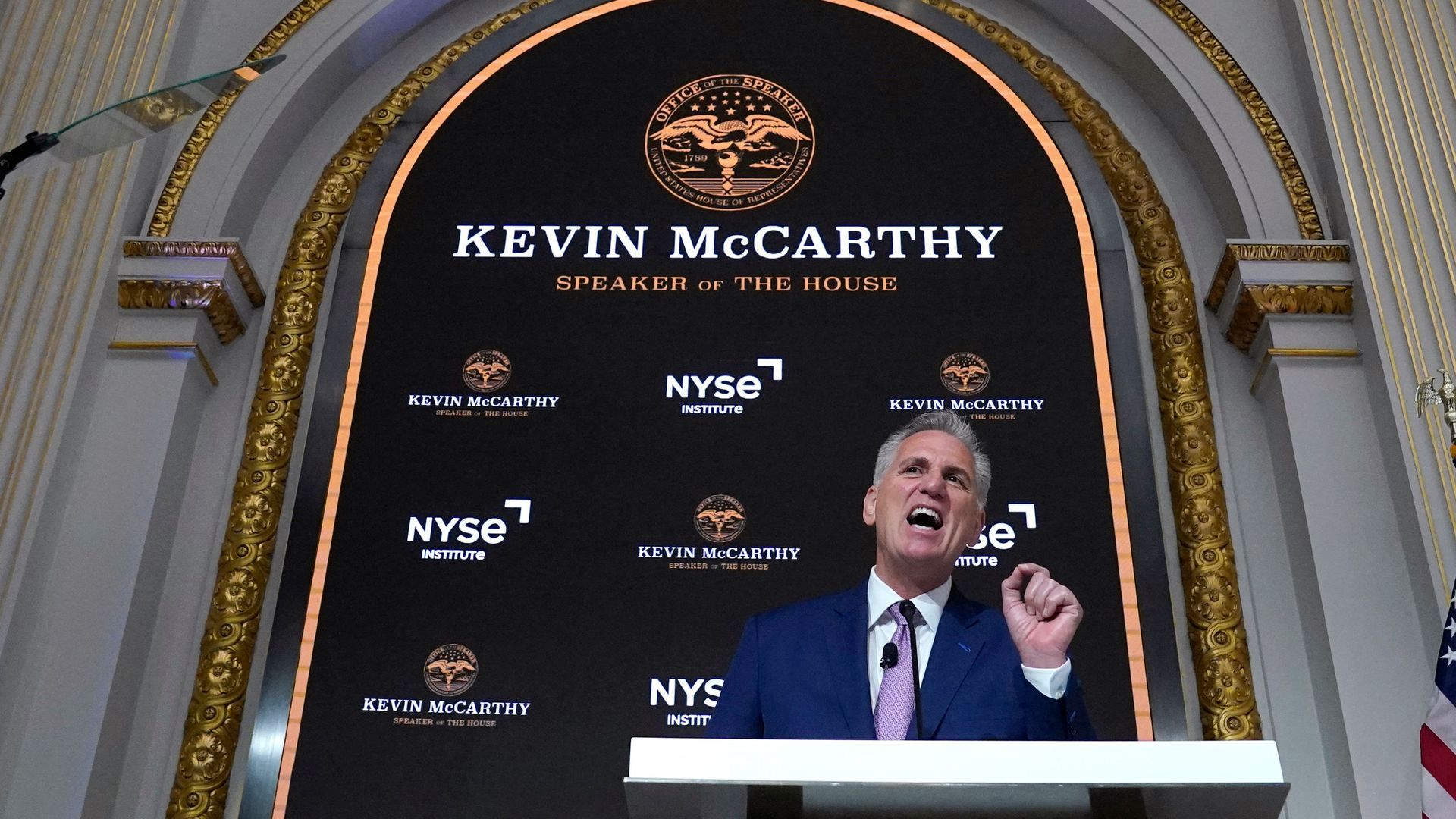
Speaker of the House Kevin McCarthy delivers a speech at the New York Stock Exchange Monday. Photo: Timothy A. Clary/Getty Images
Republicans and Democrats are staking out their positions, ahead of what's expected to be a big fight over raising the debt ceiling, Matt writes.
Why it matters: Congress must raise the debt ceiling in the coming months or risk pushing the Federal government into default, a gamble that could have serious and tough-to-predict economic consequences.
Driving the news: Speaker of the House Kevin McCarthy made the rounds on Wall Street yesterday, starting with a speech at the New York Stock Exchange that established the GOP's opening position.
- McCarthy pledged to pass legislation to raise the debt ceiling — and listed his demands: cut spending back to last year's levels, and cap future spending growth at 1% a year over the next decade.
- "It’s time that government got off its present spending spree before it squanders our future prosperity," McCarthy said in his speech.
The other side: Democrats stressed that despite the speech, House Republicans still haven't proposed an actual budget plan — but that they're open to negotiations once McCarthy does present one.
- In a news conference yesterday, Senate Majority Leader Chuck Schumer said Democrats "first need to see his plan so we can start there and work to avoid catastrophic default."
The bottom line: As we approach the "X-date" — the date of a possible default, which private economists estimate will happen in August — the politics surrounding the debt fight are going to get much louder.
4. Charted: The deficit


The finances of the U.S. government remain under pressure after the pandemic, Matt writes.
The big picture: The Federal deficit hit the largest level since World War II during the COVID crisis. It's recovered a lot but is still pretty big by recent standards.
- The Congressional Budget Office recently projected that the Federal deficit — that is, the difference between what the government collects in revenues and what it spends — will hit $1.4 trillion, or 6% of GDP, in 2023.
- That would be flat year over year, as the deficit was $1.4 trillion in 2022.
Yes, but: Keeping deficits in check is expected to get harder.
- That's because rising interest rates will add to the government's borrowing costs substantially in the coming years.
What they're saying: "Beyond interest, the other contributors to the widening in the deficit we expect are Medicare and Social Security, largely due to increased enrollment and increased health consumption, and other miscellaneous mandatory spending programs (i.e., automatic spending not appropriated by Congress)," wrote Goldman Sachs analysts in a note yesterday.
What we're watching: Goldman also noted that the fiscal picture could be worse, if a recession materializes any time soon.
5. For an EV tax break, buy American

Illustration: Aïda Amer/Axios
Shoppers looking for a tax break on a new electric vehicle have fewer options starting today, Axios’ Joann Muller reports.
Driving the news: The Treasury Department just narrowed the list of EVs eligible for a $7,500 consumer tax credit to U.S.-built cars made with battery components from the U.S. or its trading partners.
Why it matters: The Biden administration is trying to steer Americans toward electric cars with a broad array of new policies.
Details: Under the new rules, just 10 electric and plug-in hybrid vehicles qualify for the full $7,500 tax credit — about half as many as were eligible before the new rules took effect.
- Among those that still qualify are Tesla's Model Y and Model 3 and the Chevrolet Bolt.
- Others, like Ford's Mustang Mach-E, only qualify for half the credit — $3,750 — because their batteries come from abroad.
- Nine EVs are no longer eligible, including models from Nissan, Volkswagen, and Genesis (Hyundai's luxury division).
See the full list on the Department of Energy's fueleconomy.gov website.
Was this email forwarded to you? Subscribe here.
Axios Markets is edited by Kate Marino and copy edited by Mickey Meece.
Sign up for Axios Markets

Stay on top of the latest market trends and economic insights