Axios Macro

May 19, 2026


Courtenay is coming to you from Amelia Island, Florida, at the Atlanta Federal Reserve Bank's annual financial markets conference. This year, attendees are considering one huge question: How will this era of financial imbalances end — with a bust or a more gentle realignment?
- We dig into that below. Plus, the view of debt issues from the G7 finance minister summit concluding today in Paris. 🇫🇷
Today's newsletter, edited by Jeffrey Cane and copy edited by Katie Lewis, is 968 words, a 3.5-minute read.
1 big thing: How global imbalances resemble an ancient parable

The global economy faces the types of massive imbalances that preceded previous crises — despite important differences — and it's not yet clear how this debt cycle will end.
Why it matters: The last four decades of economic turbulence trace back to a similar underlying issue, that the world's biggest economies are chronically out of sync, former top International Monetary Fund official Gita Gopinath argued in a buzzy speech last evening.
- Gopinath pointed to three major eras of global imbalances: the U.S.-Japan tensions of the 1980s, which culminated in the Plaza Accord; the buildup to the 2008 financial crisis; and today's standoff between the U.S. and surplus economies like China.
- "How will this one end compared to the previous two?" Gopinath asked.
Zoom out: Policymakers are acting like the "blind men and the elephant" parable, she said.
- Just as each man in that story feels a part of the animal and has only a partial understanding of the whole, global economic leaders emphasize different symptoms of distortion while missing the larger system.
- Some point to unfair trade practices, industrial policy, fiscal deficits or the dollar's global dominance.
What they're saying: "Everybody has their favorite view on what is responsible for the imbalance," Gopinath said.
- "Part of the challenge, frankly ... is trying to get everybody to say, 'Maybe can we all agree on what we're actually trying to fix over here — what is the problem that's generating global imbalances?'"
The intrigue: The latest legal scrutiny over President Trump's batch of tariffs — implemented under Section 122 of the Trade Act of 1974, meant to be tapped when the nation is experiencing a "balance-of-payments deficit" — hints at Gopinath's analogy.
- Much of the legal fight centered on what exactly constitutes such an imbalance in the modern economy — with lawyers representing the government and others representing businesses describing different aspects of the same system.
Zoom in: A global imbalance is what happens when some countries consistently save and export more than they consume, while others — especially the U.S. — spend and import more than they produce.
- But that gap doesn't just show up in trade deficits. The excess savings from surplus countries often gets recycled back into U.S. financial markets, helping fuel asset booms, strengthening the dollar and keeping borrowing costs low.
The big picture: Gopinath warned that large global imbalances have returned after narrowing in the years following the 2008 financial crisis, with the world's financial fragilities having "rotated" compared with then.
- Before the financial crisis, leverage piled up in households and banks while the bubble centered on housing and subprime mortgages.
- Today, she said, the risks are concentrated more in high government debt and soaring tech and AI equities.
What to watch: Whether the fragilities that Gopinath identifies — overheated AI and tech valuations, and ballooning government debt — trigger the kind of correction that previous imbalance cycles produced.
- She estimated that a stock market shock comparable to the dot-com bust would deliver roughly a 2.5 percentage point hit to U.S. GDP.
- "We're talking about a recession just purely coming from a wealth shock. It's a combination of the fact that there's a lot more exposure, a lot more households who own this," Gopinath said.
Yes, but: After the financial crisis, investors rushed into American assets as a safe haven, with Treasurys rallying and the dollar strengthening.
- "The question is what will happen this time around," Gopinath said during a Q&A session after her speech.
- "I think it's a good idea to stress test your models to allow for the opposite to happen," she added, referring to a world in which U.S. safe-asset status doesn't hold and the traditional crisis playbook breaks down.
2. The view from Paris
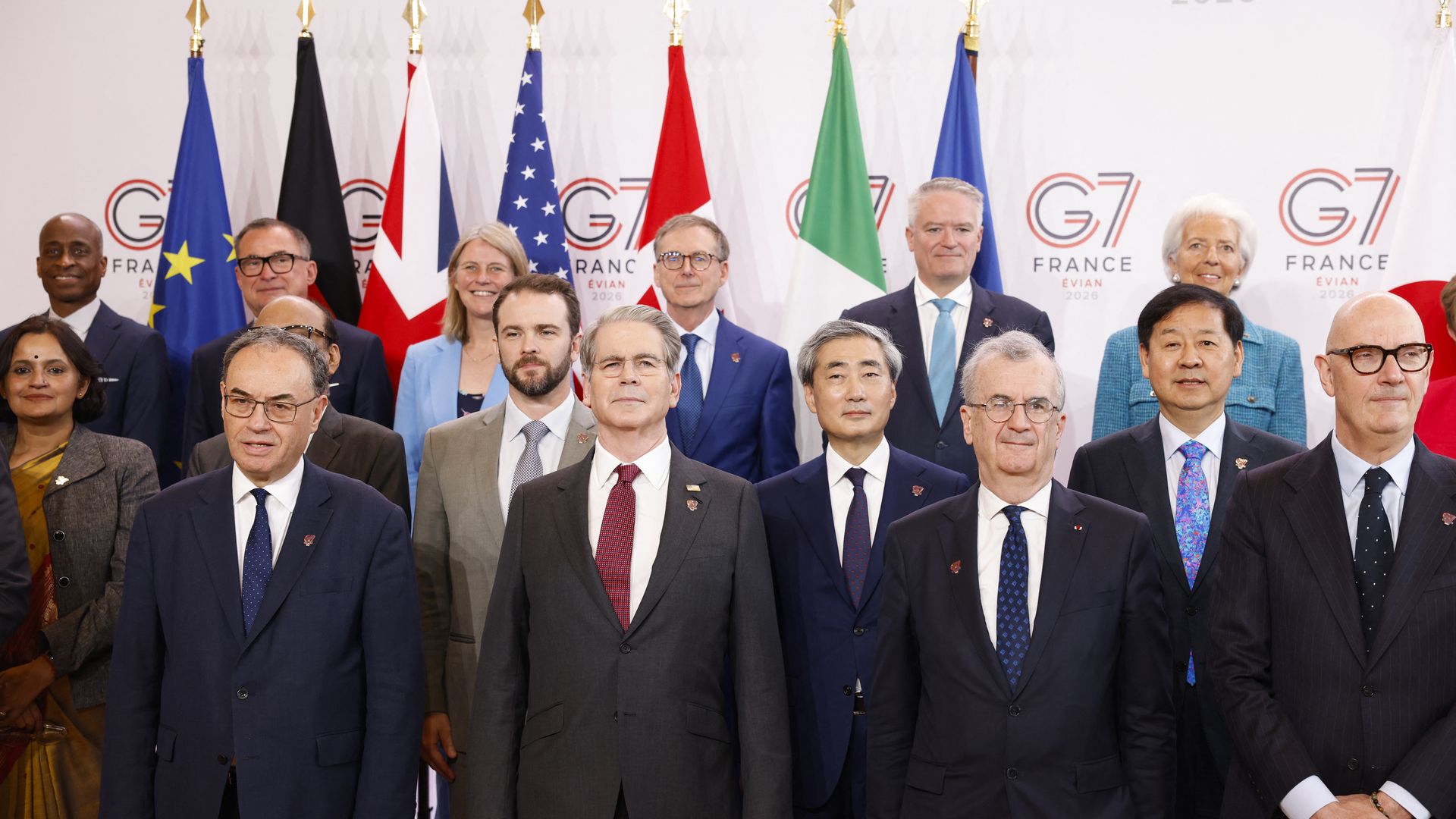
Leading finance ministers and central bankers concluded a two-day summit in Paris today, and the kinds of strains that Gopinath described were top of mind.
Driving the news: In a communiqué, G7 finance leaders jointly said they would aim for policies "promoting balanced growth and macroeconomic stability" in their respective nations.
- "Countries with large and persistent external deficits should undertake policies that include supporting domestic savings and fiscal consolidation."
State of play: That language is pretty much boilerplate. But it takes on additional meaning at a moment when the bond market is growing skittish amid surging inflation and massive public borrowing.
- The Japanese 30-year yield, for example, has risen to a multidecade high of 4.17% today, from 3.72% as recently as May 7. One factor: The Japanese prime minister announced fiscal measures to try to bolster the country's economy amid the energy shock caused by the Iran war.
- Similarly, yields on longer-term U.K. gilts have surged amid uncertainty about the future of Prime Minister Keir Starmer's government and what fiscal direction may follow if it falls.
Between the lines: Throughout the 2010s, finance ministers in rich countries enjoyed a free lunch, with inflation persistently low and demand for safe assets seemingly insatiable.
- Now, they are facing a world where one supply disruption after another is keeping inflation elevated, and bond investors are wary of political risk in a time of already massive public debts.
What they're saying: "The way the global economy has been developing for the past 10 years or so is clearly unsustainable," French finance minister Roland Lescure told reporters, per Reuters.
- "We are no longer in a period where public debt is not a subject," he said.
Sign up for Axios Macro