Trump's latest tariffs face legal test over an undefined phrase

Add Axios as your preferred source to
see more of our stories on Google.
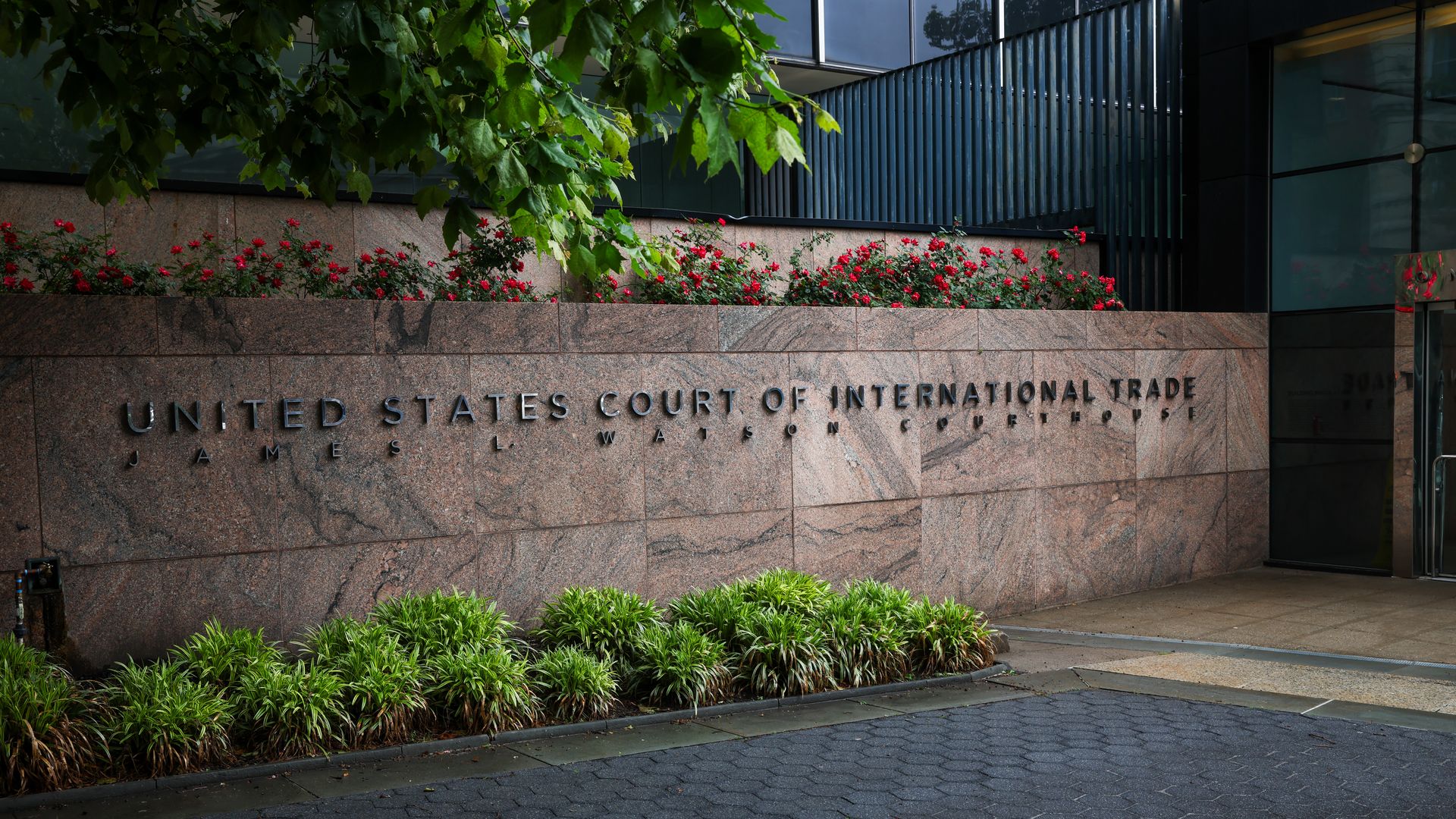
The U.S. Court of International Trade in New York. Photo: Spencer Platt/Getty Images
The nation's top trade court said on Friday that the legality of President Trump's latest tariffs comes down to one question — what counts as a "balance-of-payments deficit" — but no one had a satisfactory answer.
Why it matters: The case will determine the staying power of tariffs underpinned by an obscure, never-before-used trade law — the authority that Trump fell back on after the Supreme Court struck down his sweeping global tariffs.
Zoom in: The case hinges on a "fundamental international payments problem," a 50-year-old phrase that was never precisely defined by Congress.
- Much of the hearing dealt with how to define it — and whether a trillion-dollar trade deficit qualifies.
- The plaintiffs argued that the statute is meant to address something narrower, like a currency crisis that was the backdrop for the creation of the law in the early 1970s.
- In a proclamation earlier this year, the Trump administration justified the action, noting serious effects from the trade deficit that "contributes to the fundamental international payments problems facing the United States."
Catch up quick: Trump imposed 10% global levies under Section 122 of the Trade Act of 1974 immediately after the Supreme Court struck down tariffs under a separate legal authority, the International Emergency Economic Powers Act (IEEPA), in February.
- Section 122 allows the president to impose tariffs of up to 15% for 150 days to address a balance-of-payments crisis. But two lawsuits, brought by some two dozen states and a small business, argue that no such crisis exists.
Driving the news: Plaintiffs argued that the statute's central trigger — a "balance-of-payments deficit" — describes a monetary crisis that is no longer possible, adding that today's trade imbalances don't qualify.
- The government countered that the president has discretion to use modern measures, like the current account deficit, to define it.
What they're saying: The three judges at the Court of International Trade — the court also handling the refund process for the tariffs deemed illegal — pushed back notably on each side's argument.
- The judges said that the government's reading would mean the president could invoke the authority at virtually any time.
- They pressed plaintiffs on whether their reading of the law was too narrow — questioning whether Congress in 1974 was more worried about trade deficits than what plaintiffs acknowledged.
"For many years, the country relied on a trade surplus to offset foreign aid, military expenditures and overseas private investment. That surplus has now disappeared," Timothy Stanceu, a senior judge at the U.S. Court of International Trade, said in an exchange with the plaintiffs.
- "Can we really conclude that the Senate was not worried about trade deficits in enacting section 122?" the judge asked.
The intrigue: The small business is represented by the Liberty Justice Center, the same group that brought the successful IEEPA challenge before the Supreme Court.
What to watch: If the trade court rules against the Trump administration, it may not matter much in practice, as appeals can be expected.
- The Section 122 tariffs expire July 24, and the administration is already constructing a replacement regime.
- Jamieson Greer, Trump's top trade official, told reporters last month that Section 301 trade investigations would conclude before the 122 tariffs expire, paving the way for a new legal basis for the same duties.
