The U.S.-China decoupling arrives

Add Axios as your preferred source to
see more of our stories on Google.
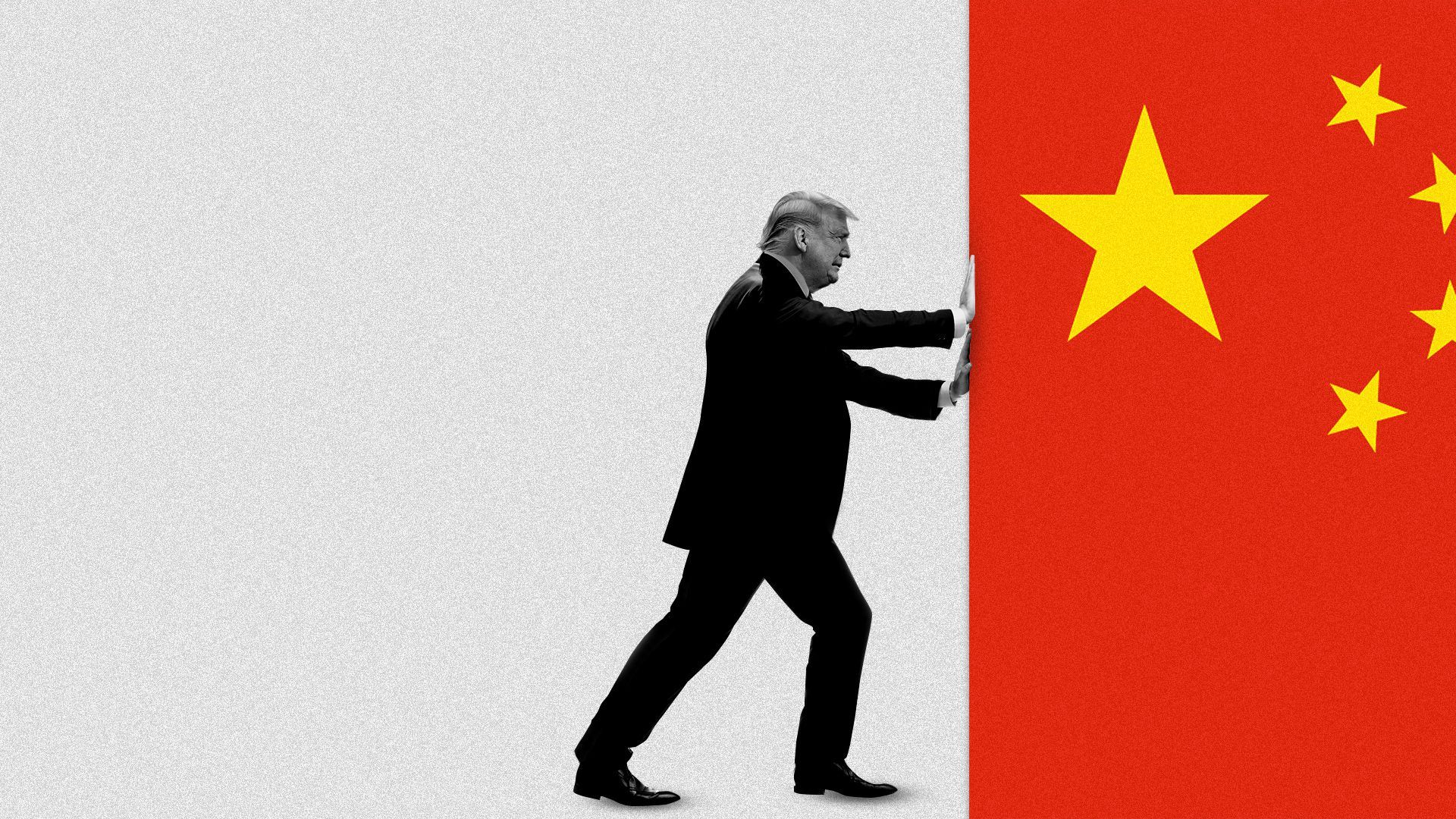
Illustration: Aïda Amer/Axios
What has been a yearslong economic risk is now reality: The tit-for-tat tariffs effectively end U.S.-China bilateral trade, the final step in the economic decoupling of the world's juggernauts.
- That is the new warning from the World Trade Organization on Wednesday in the release of its latest global outlook.
Why it matters: The sudden divorce of the two economies might mean profound pain for American workers and the nation's wealth built on the back of a strong trading relationship.
- A prolonged trade fight risks splitting the global trading system into two distinct blocs — countries that trade with the U.S. and those that trade with China.
Stunning stat: The WTO anticipates trade between the U.S. and China will screech to a halt this year.
- Trade of merchandise between the two countries will drop by 80%, a drop that would have topped 90% without the White House's recent exemption for smartphones and other tech goods, according to WTO director general Ngozi Okonjo-Iweala.
What they're saying: "The drop in U.S.-China trade of the magnitudes we are talking about is virtually tantamount to a decoupling of the two economies," Okonjo-Iweala told reporters Wednesday morning.
- "This is a phenomenon we've talked about before ... and now we're seeing it emerging," Okonjo-Iweala added. " I think this is one of the most worrying factors for us."
The big picture: The total volume of goods traded around the world is expected to contract by 0.2% this year — an abrupt turnaround from the near 3% increase last year.
- The decline in world trade would be as large as 1.5% in 2025 if President Trump reinstates the reciprocal tariffs that are now on pause.
- Consider the counterfactual: If both trade and trade-policy uncertainty were low, the WTO says, world trade would grow by 2.7% in 2025.
Threat level: The group anticipates the trade slowdown — topped with uncertainty about the tariff endgame — will spill over into weaker global growth.
- The WTO expects GDP growth will reach 2.2% in 2025, 0.6 percentage point below its initial forecast that did not account for the global trade war.
- That will nudge up slightly to 2.4% next year, "substandard compared to recent history," it writes in the release.
Between the lines: The Trump administration said it would hold trade negotiations with a slew of nations facing reciprocal tariffs over the next 90 days.
- But China is the exception. The high, country-specific rates have been paused for all countries, though tariffs on China have only increased.
What's new: Trump ordered the Commerce Department to investigate America's reliance on critical minerals from other countries.
- The investigation could further crack down on trade with China, which produces the majority of all critical minerals, many of which are used in defense, energy and electronics sectors.
- Any tariffs that stem from the investigation would "take the place" of current reciprocal tariff rates, according to the executive order Trump signed Tuesday.
What to watch: The WTO says countries should cut back excessive reliance on other trading partners, an admission that Trump-like protectionism is the new threat.
- "The U.S. has a point when it says too many countries are dependent on its market, or the production of some critical inputs are too concentrated in certain sectors and geographies," Okonjo-Iweala says.
- "Building global resilience requires interdependence, not over dependence."
The bottom line: The fear of economic devastation from U.S.-China decoupling helped blunt Biden-era trade policy.
- Trump is taking an unprecedented gamble — one that WTO economists admit means its forecast might not be gloomy enough.
