Axios Login

March 10, 2022
Join Axios virtually at our inaugural What's Next Summit on April 5. Register here to attend livestream sessions with discussions on trends that will revolutionize our future.
Today's newsletter is 1,190 words, a 4-minute read.
1 big thing: For tech deals, it's damn the lawsuits, full speed ahead


Google is plowing ahead with a $5.4 billion acquisition as it fends off a Justice Department lawsuit charging monopolistic practices and inquiries by lawmakers who argue the search giant is already too big, Axios' Margaret Harding McGill and Ashley Gold report.
Why it matters: An increasingly hostile regulatory climate over the past five years hasn't stopped Big Tech giants from making billion-dollar deals.
State of play: Google's bid to buy cybersecurity firm Mandiant is the latest in a string of high-dollar acquisitions by Big Tech.
- Microsoft announced a $68 billion deal for video game company Activision Blizzard in January.
- Amazon is still under regulatory review of its $8.45 billion purchase of Hollywood studio MGM announced last year.
- Meta (then Facebook) bought Kustomer for $1 billion and Giphy for $400 million in 2020, just a few months before the Federal Trade Commission sued the social media company over past acquisitions.
Between the lines: Google is already facing a lawsuit from the Justice Department accusing it of illegally monopolizing the online search and search advertising markets.
- The Justice Department is expected to review the Mandiant deal.
What they're saying: Google argues that the cybersecurity industry has plenty of competition.
- "The voices that want acquisitions blocked simply because the acquirer is a Big Tech company are probably going to be disappointed," Adam Kovacevich founder and CEO of Chamber of Progress, told Axios. "That's just not how mergers of this type are evaluated."
The other side: Big Tech's firms "were built on illegal mergers and the complicity of enforcers who cheered them on," said Sarah Miller, executive director of the American Economic Liberties Project. "But make no mistake, the new generation of antitrust enforcers will not be bullied out of upholding the law."
Biden's antitrust enforcers are flexing their muscles around mergers, too.
- Chip supplier Nvidia abandoned its $40 billion acquisition of U.K. chip designer Arm after the FTC sued to block the deal.
- DOJ antitrust chief Jonathan Kanter warned in a January speech that he is skeptical of conditions imposed by regulators that are meant to "fix" mergers, and will instead seek to block deals likely to reduce competition.
The big picture: Kanter and FTC chair Lina Khan are widely expected to step up antitrust enforcement, bringing more cases against companies and acquisitions.
- But that means companies go into mergers expecting to fight regulators and take their chances in court, Kovacevich said.
What to watch: The FTC is reportedly closing in on a mid-March deadline on whether to challenge Amazon's acquisition of MGM, according to a Wall Street Journal report.
2. Magic Leap headset offers wider view

Image: Magic Leap
Magic Leap has a new version of its augmented reality headset, this time specifically targeted toward enterprise use, particularly in medical, manufacturing and public sector settings.
Between the lines: The company was initially hoping to sell a consumer product but, like others in the VR and AR space, it realized that its product was still too expensive and bulky for mainstream consumers.
As part of its business pivot, Magic Leap significantly cut its staff and brought in Peggy Johnson, a veteran Microsoft and Qualcomm executive, to help lead the transformation. Last year, it also raised $500 million from existing investors.
- "We feel very strongly we have the right focus and the right product," Johnson said in an interview with Axios this week.
- Johnson compared the AR market today to the early days of the mobile phone market, when bulky devices used by professionals paved the way for sleeker, less expensive devices for the masses.
Details: The Magic Leap 2, like its predecessor, pairs a steampunk-inspired headset with a computer pack. This time around, though, Magic Leap is using open-source Android rather than a custom OS, and has switched from an Nvidia processor to a semi-custom AMD chip.
- The biggest changes are a significantly wider field of view and sharper display resolution.
What's next: Julie Larson-Green, a Microsoft veteran who Johnson recruited to be Magic Leap's CTO, told me the company is already exploring what it can do with future devices. "We can double the field of view again," she said.
3. First Look: Magic Leap's ML-2 headset
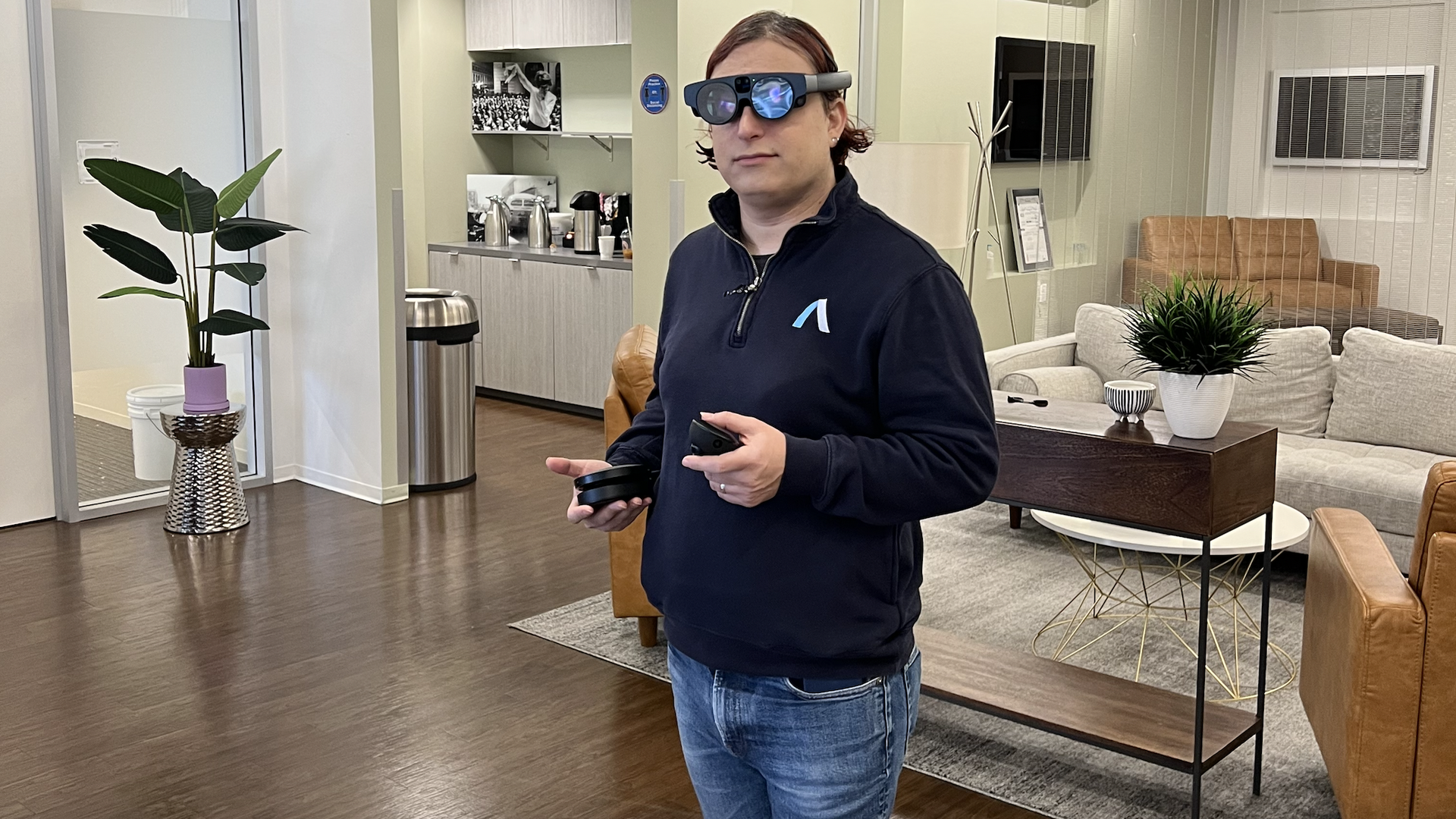
Image: Ina Fried/Axios
The new Magic Leap 2 headset's most notable feature, when you first try it on, is its wide field of vision. It's still not as wide as what the human eye offers, but it's significantly larger than both its predecessor and Microsoft's rival Hololens 2.
The big picture: All the current augmented reality headsets have limitations when it comes to field of view, bulkiness and battery life.
In a briefing this week, I had a chance to spend a little time with the new headset and experience several demos, including one focused on spatial audio and another, prepared with the World Economic Forum, showing the impact of wildfires.
- One noteworthy new feature is "selective dimming," which allows the headset to adjust how translucent its digital images appear. This can be changed for the whole image or just in parts.
- Text appears to be more readable, too. I say appears, because while Magic Leap 2 supports prescription lens inserts, the company didn't have any sample lenses strong enough for my profound nearsightedness.
4. Groups warn against cutting Russian internet

Illustration: Aïda Amer/Axios
A broad coalition of civil society groups is making the case that, as odious as Russia's invasion of Ukraine is, its citizens should not be deprived of basic internet access.
Why it matters: The U.S. has imposed strict sanctions on Russia and at least two internet providers have already cut off service to the country.
Driving the news:
- In a letter to the White House, the groups argue that the U.S. and other actors should "carefully consider the full impact of such measures and their possible unintended consequences."
- There are dozens of signatories to the letter, including Access Now, Center for Democracy & Technology, Committee to Protect Journalists, Electronic Frontier Foundation, Human Rights Watch and the Wikimedia Foundation.
The big picture: Independent information is already becoming harder to get in Russia, with the country having cut off or reduced access to Facebook, Twitter and other major sources of information.
What they're saying: In the letter, the groups say they "deplore Russia's invasion of Ukraine,' but are concerned cutting off Russian people's internet access "will hurt individuals attempting to organize in opposition to the war, report openly and honestly on events in Russia, and access information about what is happening in Ukraine and abroad."
5. Take note
On Tap
- Oracle reports earnings after the markets close.
Trading Places
- Google-owned Waze named Yannis Simaiakis as its new chief strategy and insights officer.
- Wesley Chan, founder of Google Analytics and Google Voice, has quietly teamed with former Morgan Stanley tech banker Pegah Ebrahimi to launch a new venture capital firm, Axios' Dan Primack reports.
ICYMI
- Media companies launch tech workarounds to bypass Russia's restrictions. (Axios)
- Eight more women allege sexism at PlayStation, intensifying lawsuit. (Axios)
- Scoop: RNC to sue Jan. 6 committee over Salesforce subpoena. (Axios)
6. After you Login
So I was torn. I had a few possibilities saved up but wasn't sure which to choose. Should I have gone with:
- Suni Lee's first collegiate perfect 10 in gymnastics.
- A newfound example of the Fibonacci sequence in nature.
- This compilation of fun state maps.
Let me know which was your favorite.
Sign up for Axios Login

Taking you inside the AI revolution, and delivering scoops and insights on the technologies reshaping our lives.


