Axios Login

March 16, 2021

Ina would like you to know that once again Login is hosting a bracket challenge for the NCAA women's basketball tournament. If you want to take part, click here.
Today's newsletter is 1,230 words, a 5-minute read.
1 big thing: China's quest to rule internet-from-space service

Illustration: Aïda Amer/Axios
China is ramping up plans for government-sponsored satellites to beam internet from space, taking on U.S. rivals like SpaceX and Amazon in the race to own the next frontier of connectivity, Axios' Margaret Harding McGill reports.
Why it matters: There's growing concern that China is trying to enter the space internet market with the same strategy it used on earth with Huawei and 5G — use a state-backed company to undercut competitors and spread global influence.
What's happening: China's "StarNet" would launch 10,000 satellites in the next five to 10 years, according to an Asia Times report that cites a publication run by the official China News Service.
- China intends to build a space infrastructure system for communications, navigation and remote sensing with global coverage as part of its latest five-year plan.
The big picture: Faster and cheaper technology has made satellite networks a more viable option for transmitting broadband.
- There's a huge demand for the service, with 4 billion people worldwide lacking broadband access, many of them in hard-to-serve areas, spurring global interest in beaming internet from space.
- SpaceX is leading the way with its Starlink service, while Amazon's Project Kuiper also is working on a constellation of broadband satellites.
- The U.K. government is backing satellite broadband provider OneWeb and the EU has announced plans for its own constellation.
What they're saying: "All these countries are doing this because it's like the wide open frontiers of the 1800s, and the ideas of how best to exploit it are virtually unlimited at this point," said former FCC commissioner Rob McDowell, who now represents clients in the industry.
- China's satellite network will be an extension of its telecommunications infrastructure, said Blaine Curcio, founder of Orbital Gateway Consulting who tracks China's space industry. "It's another tool in the toolbox of China building out its version of the splinter-net."
Flashback: Chinese telecommunications company Huawei became a global power player by providing low-cost equipment in other countries, prompting national security concerns in the U.S. over the Chinese government's potential access to communications data.
- "The United States companies have a lead in terms of deploying systems, but there's an expectation that the Chinese will deploy systems not seeking to provide service in China, but they're seeking to expand their sphere of influence," Satellite Industry Association president Tom Stroup told Axios. "And just as they did with Huawei equipment, there's the potential to do the same thing with satellite."
Our thought bubble, via Axios China expert Bethany Allen-Ebrahimian: China could potentially use such a satellite network for mass data collection and surveillance of internet traffic.
What to watch: China is behind on satellite broadband, but if the Chinese deploy the Huawei playbook of offering cheaper and reliable equipment abroad, "it would have huge geopolitical benefits for China," notes Ainikki Riikonen, a research assistant for the Technology and National Security Program at the Center for New American Security.
2. Pandemic's screen-time warp

Illustration: Annelise Capossela/Axios
Media and tech giants are swarming the kids' entertainment space, hoping to capitalize on the dramatic increase in screen time during the pandemic year, Axios' Kim Hart and Sara Fischer report.
Why it matters: As streaming and digital gaming become more popular, new concerns are rising about kids' privacy and susceptibility to tactics designed to keep them hooked on screens.
Driving the news: Last week's blockbuster IPO of Roblox, a game that's popular among older kids and teens, revived growing concerns about ways in which the kid-friendly game platform can inadvertently lead to addiction, cyberbullying and abuse.
- The New York Times summed it up nicely last year in a piece titled "My kid sold her soul to Roblox."
How it works: Roblox's platform is an extremely social environment, and the ability to build new games and features also means it's hard to put down.
- The company's CEO said last year that roughly three-quarters of American children age 9–12 use Roblox monthly, per NPR.
- Nightmare stories have emerged of parents waking up to giant credit card bills from kids making dozens of in-app purchases — buying things like digital avatar skins or virtual "gifts."
Be smart: School-aged children and teens do not fully understand how their digital data is collected and used for ad-targeting purposes, and laws protecting children's privacy are outdated and weakly enforced, said Nusheen Ameenuddin, chair of the American Academy of Pediatrics Council on Communications and Media, at a congressional hearing last week.
Where it stands: Some watchdogs are calling on federal enforcers to rein in manipulative and privacy-infringing tactics.
- Last month, the Campaign for a Commercial-Free Childhood filed a complaint with the Federal Trade Commission against the math game company Prodigy Education, accusing the company of deceiving teachers and parents by suggesting the program is free while aggressively marketing a $59 premium membership to children.
Be smart: Screen limits for children have been hard to implement throughout the pandemic, and parents are going to struggle to reimpose them once it's over.
3. Facebook to test paying writers on new platform
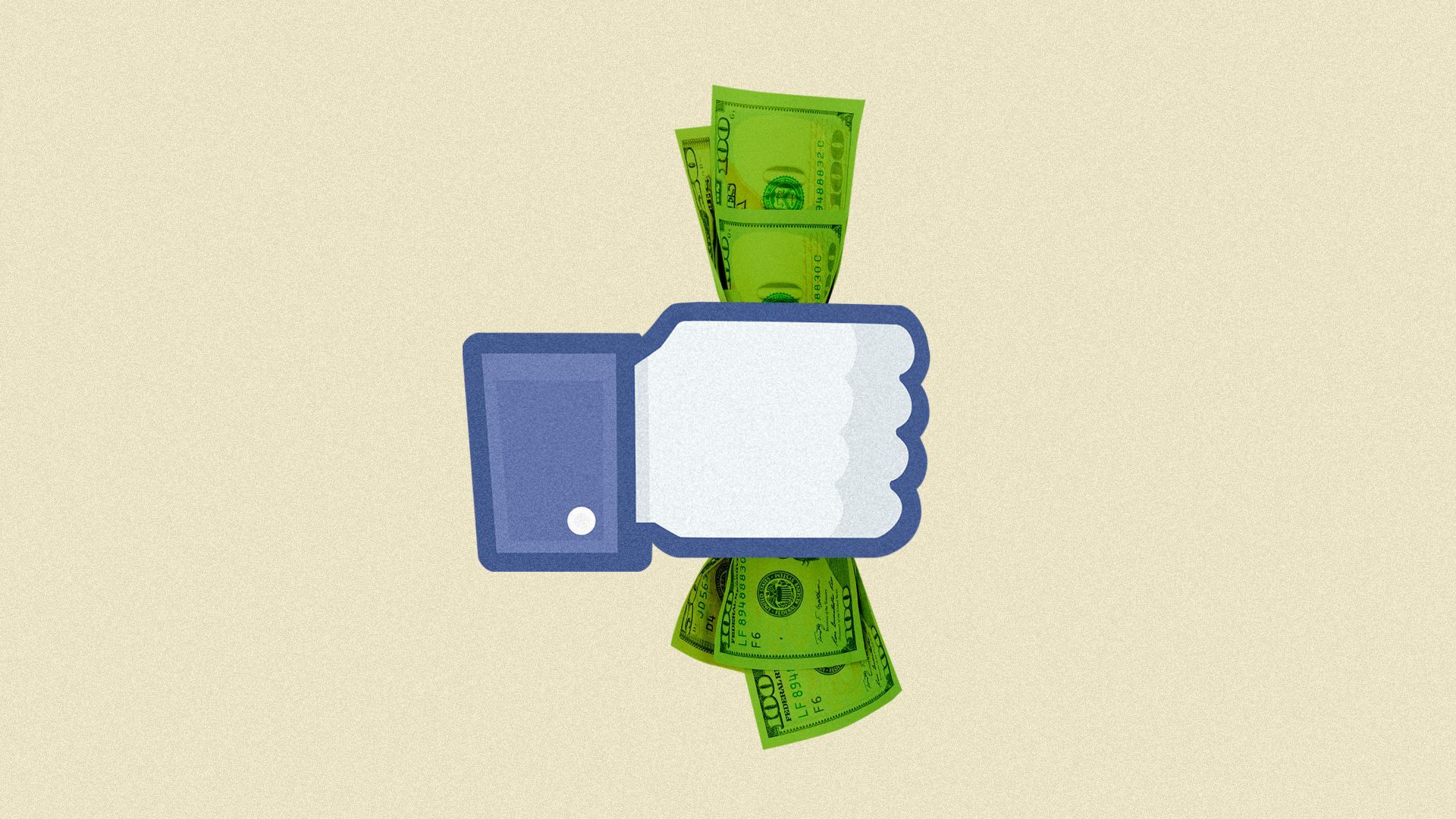
Illustration: Aïda Amer/Axios
Facebook will soon begin testing partnerships with a small group of independent writers for its new publishing platform, sources tell Axios' Sara Fischer.
Driving the news: The platform, which includes tools for journalists to build their own websites, in addition to newsletters, will be tested with a small group of writers, some of whom Facebook plans to pay to help get the service off the ground.
Details: The publishing platform, which has yet to be officially named, is free to use, and will be integrated with Facebook Pages, sources say.
- Facebook plans to build tools within the platform that allow writers to monetize their work and create an audience community.
Be smart: Beginning around four years ago, Facebook began investing in incubator programs, products and events that are geared towards helping news companies, especially at the local level, build sustainable revenue streams.
- It also created a separate feature called the News Tab as a dedicated space for news on Facebook, and it pays established news companies for content featured there.
- Now, it's trying to help find ways individual journalists can thrive as creators.
The big picture: The pandemic has prompted many high-profile journalists to leave newsrooms and launch independent newsletters. Now, tech companies are getting in on the trend.
- Twitter acquired Revue, a newsletter platform for writers and publishers, in January.
- LinkedIn also plans to launch a creator program that would work closely with the company's editorial arm, made up of many former journalists.
4. All your texts belong to us
A $16 service allowed a hacker to hijack every text message sent to Motherboard reporter Joseph Cox, in a demonstration of a chilling new kind of identity theft.
How it works: The attacker filled out a form claiming to be Cox and sent it to a service that's used by businesses that have legitimate needs to redirect streams of SMS (text) messages. A little while later, all the texts people sent to Cox got routed to the attacker instead.
Why it matters: Because so many online platforms and services allow text-message-based password resets, such an attack could quickly lead to compromised accounts — and the victim would never know.
- The companies involved all said they've tightened security since the story posted.
Our thought bubble: This is a classic kind of vulnerability opened up largely by failures in human processes and gaps between companies' responsibility. However thoroughly this one is closed, there will always be more.
5. Take note
On Tap
- Fortnite's 16th "season" kicks off today, this time with a solo experience for players rather than a collective spectacle, Axios gaming expert Stephen Totilo reports (sign up for his new Axios Gaming newsletter).
Trading Places
- Leigh Zarelli joins Amazon-owned audiobook giant Audible as chief product officer.
- Oded Shein is the new CFO for auto e-commerce platform Shift.
ICYMI
- Encrypted messaging app Signal appears to be blocked in China as of Tuesday. (AP)
- Spam calls are everywhere — even in Apple's tightly controlled FaceTime. (Ars Technica)
- Amazon's book recommendations can point customers down a COVID-19 conspiracy theory rabbit hole. (BuzzFeed News)
- Under its privacy law, California is banning "dark patterns" in product design that subtly "confuse or mislead" users. (Gizmodo)
6. After you Login
Line Rider meets Beethoven's Fifth. (At least the first movement.) I watched the whole thing.
Sign up for Axios Login

Taking you inside the AI revolution, and delivering scoops and insights on the technologies reshaping our lives.