Axios Login

March 09, 2022
You know that feeling when you can't wait to put the kid to bed so you can go to sleep, too? That was me last night.
💰 Situational awareness: President Biden will issue an executive order today for multiple government agencies to develop policy recommendations on digital assets and cryptocurrencies.
Today's newsletter is 1,166 words, a 4-minute read.
1 big thing: China's Facebook ads push Russian line

Photo illustration: Aïda Amer/Axios; Photo: Sergei Guneyev/Sputnik/AFP via Getty Images
Ads from Chinese state broadcaster CGTN are running on Meta-owned Facebook, targeting global users with pro-Russian talking points about Russia's invasion of Ukraine, Axios' Ashley Gold reports.
Driving the news: Meta said last week it would ban ads from Russian state media and stop recommending content from such outlets. But that hasn't stopped countries close to Moscow, like China, from using their state channels to buy ads pushing a pro-Russian line.
- In 2020, Meta said it would begin blocking state-controlled media outlets from buying advertising in the U.S. But those outlets can still buy ads targeting users abroad.
The big picture: Beijing views Russia as a close partner, and has stayed by Russian President Vladimir Putin's side as he invaded Ukraine, even going so far as to blame the invasion on the U.S. and NATO.
Details: China Global TV Network, a China state-controlled outlet with nearly 118 million followers on Facebook and 2.4 million on Instagram, placed at least 21 advertisements on Facebook this month, most featuring newscasts about the war or media briefings from Chinese officials.
Meta's advertising library, which is intended to provide a transparent record of all ads running on Meta's services, does not specify how much CGTN spent on the ads or which countries it targeted, and the company declined to provide that information.
- Per a search, some of the ads are targeted at users in Hong Kong, Azerbaijan, Kazakhstan, Uzbekistan, Turkmenistan and Tajikistan.
- Many of the ads, which are mostly clips of CGTN newscasts, sprinkle in pro-Russia, anti-NATO talking points and downplay Russia's actions in launching an unprovoked invasion of its neighbor.
State of play: China's domestic media have supported Russia's propaganda about the war and systematically amplified pro-Putin talking points, Axios' Bethany Allen-Ebrahimian previously reported.
What they're saying: While Meta is protecting U.S. users from state-sponsored media disinformation, the rest of the world deserves similar protections from known bad actors like China's state media, Laura Edelson, an online disinformation expert who is a Ph.D candidate in computer science at New York University, told Axios.
The other side: Asked about the CGTN ads, a Meta spokesperson said the company had no specific comment but pointed to statements by Nick Clegg, Meta's president of global affairs, last week.
- Clegg acknowledged to reporters that the company faces a tricky balancing act between promoting the free flow of information and stemming disinformation.
2. Evading Russia's internet blockade

Tools to sidestep internet restrictions have surged in Russia following the invasion of Ukraine and the government's decision to block some social media services, including Facebook, Axios' Margaret Harding McGill reports.
Why it matters: Finding ways around Russia's internet blockade could enable its citizens to stay connected to the rest of the world and gather information from sources beyond state-owned outlets.
Catch up quick: Virtual private networks, or VPNs, enable users to hide their locations to evade location-based restrictions and make browsing more private by encrypting internet traffic.
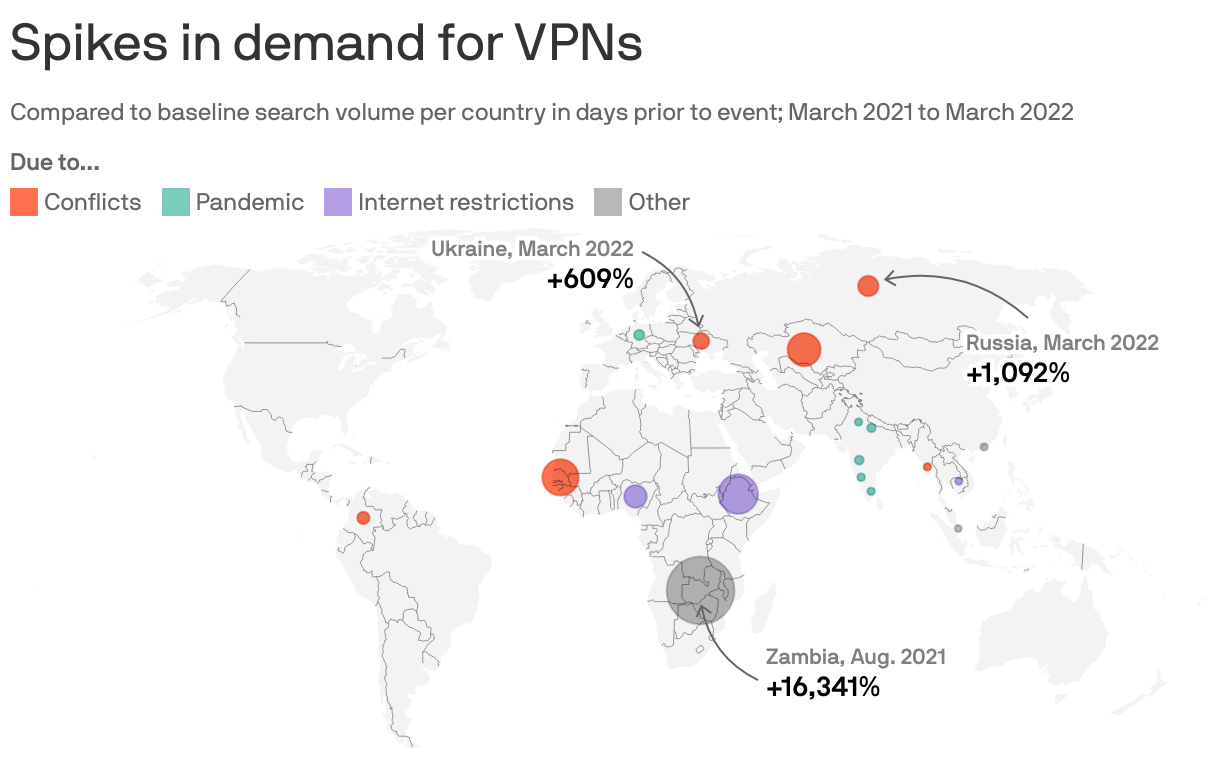
By the numbers: Demand for VPNs surged by 1,092% in Russia on March 5, the day after Russia blocked access to Facebook, according to Top10VPN.com.
- Demand in Ukraine climbed 609% higher than before the invasion began, according to the site, which tracks search volume data.
- Eight popular VPN apps in Russia received 12,848 downloads on Feb. 15, that number grew to 415,547 downloads on March 7, according to data from Apptopia.
Meanwhile, VPN providers are reporting spikes as well.
- Surfshark said average weekly sales in Russia have increased by 3,500% since Feb. 24, when Russia invaded Ukraine, and spiked after the country blocked Facebook and other Western media.
- Proton said it has seen a 1,000% increase in sign ups for its VPN service in Russia this month.
Between the lines: VPN use in Russia is legal, but accessing officially blocked content is not, said Simon Migliano, head of research at Top10VPN.com, who also noted there are about 15 VPN services that have been banned by Russian authorities.
Yes, but: Russia is already trying to block VPN traffic at the network level, Migliano said, and he expects that to intensify.
- "This is a game of cat-and-mouse, and the best VPN services have years of hard-won experience gained in China in obfuscating their traffic," Migliano said.
The big picture: Conflicts and internet crackdowns in recent years have sparked similar VPN surges in other countries, including Myanmar, Nigeria and Kazakhstan.
3. Making sense of what Apple announced

Screenshot: Axios
Apple's biggest move Tuesday was the introduction of the Mac Studio, its first new desktop computer category in years. The company also debuted new iPhone SE and iPad Air models with faster chips and 5G support.
Why it matters: While Apple didn't preview any other new products, some features within the new hardware highlight key directions for the company.
The big picture: Apple's Mac Studio and its accompanying monitor represent a bet not just on separating the computer and monitor, but also a new approach toward increasing performance.
- To create the new M1 Ultra processor, Apple fused together two M1 Max processors using a homegrown, ultrafast method for exchanging data between them.
Apple's new Studio Display has its own Apple processor to handle video and audio tasks.
- The new monitor also supports spatial audio, which can make sound appear to be coming from a specific place — a feature that has uses for both video conferencing and virtual reality. Apple has already added spatial audio to some of its latest AirPods headphone models.
Between the lines: As is often the case, Apple's performance and customization comes with a high price. The entry-level Mac Studio, with an M1 Max processor, starts at $1,999, while the M1 Ultra-powered version starts at twice that price. The Studio Display sells for $1,499.
Meanwhile, Apple also announced its entry into live sports with a deal to broadcast two Major League Baseball games per week on Apple TV+ and added a green color option for both the iPhone 13 and iPhone 13 pro.
Go deeper: Read about all of Apple's announcements here.
4. Take note
On Tap
- Today's earnings reports include Asana and CrowdStrike.
Trading Places
- ChowNow is announcing today it has hired Karene Tropen as chief marketing officer. Tropen previously held senior marketing roles at Disney+, Netflix, HBO and NBCUniversal.
- Employee services firm Rippling has hired Slack and Salesforce veteran Brad Armstrong as senior vice president of business and corporate development.
ICYMI
- The Ukraine crisis is driving a renewed focus in Congress on funding for domestic semiconductor manufacturing. (Axios)
- Lumen, a leading internet provider in Russia, is disconnecting service in the country. Meanwhile, Amazon said it has stopped accepting new Web Services customers in Russia and Belarus. (Axios)
- A Ukrainian mom killed along with her two children has been identified as the chief accountant for a Silicon Valley-based online marketing firm. (Marketwatch)
- Twitter has reportedly launched a Tor onion service version in Russia, so users can reach the platform amid internet restrictions through the Tor anonymity network. (Vice)
5. After you Login
Photo: Alex Wong/Getty Images
The Smithsonian has opened "#IfThenSheCan - The Exhibit," a new exhibit featuring 120 3D-printed statues of modern women innovators and role models in science and technology careers.
Sign up for Axios Login

Taking you inside the AI revolution, and delivering scoops and insights on the technologies reshaping our lives.