Axios Login

October 04, 2022

No bots were used to create today's Login. (That I know of.)
💰 Situational awareness: Micron plans to spend up to $100 billion over the next 20 years on building a semiconductor factory in upstate New York following the passage of the CHIPS act, the New York Times reports.
Today's newsletter is 1,270 words, a 5-minute read.
1 big thing: White House's AI "Bill of Rights" enters crowded field

Illustration: Sarah Grillo/Axios
The White House issued a call for artificial intelligence systems to be developed with built-in protections Tuesday, even as the tech industry barrels forward in an AI free-for-all, Axios' Margaret Harding McGill and I report.
Why it matters: Automated systems can influence or even determine important aspects of Americans' lives, including healthcare, employment, housing and education. In the U.S., government regulations covering the new technology remain minimal or nonexistent.
Driving the news: The Blueprint for an AI Bill of Rights, released Tuesday by the Office of Science & Technology Policy, describes five principles that should be incorporated into AI systems to insure their safety and transparency, limit the impact of algorithmic discrimination, and give users control over data.
The report details real-world consequences of failures to put such principles into practice.
- A model meant to predict the likelihood of sepsis in hospitalized patients underperformed and caused "alert fatigue" with false warnings.
- A hiring tool that "learned" employees were predominantly men rejected women applicants, with resumes that had language like "women's chess club captain" penalized in ranking candidates.
Our thought bubble: The White House is late to this party. Many others have already weighed in with recommendations on AI best practices, including other governments, human rights groups and tech companies.
- IBM produced a set of principles in 2017, calling for, among other things, AI that can explain itself. "Companies must be able to explain what went into their algorithm's recommendations. If they can't, then their systems shouldn't be on the market," IBM said at the time.
- The EU released its list of guidelines back in 2019.
- Even the Vatican published on the topic, issuing in 2020 what it dubbed a "algor-ethical" framework saying that AI systems need to be designed to protect "the rights and the freedom of individuals so they are not discriminated against by algorithms."
Flashback: In 2020, the Trump administration outlined 10 regulatory principles for agencies writing rules for the technology, warning against over-regulating the systems.
What they're saying: In a call with reporters, senior administration officials described the principles as part of President Biden's commitment to tech accountability.
- "These technologies are causing real harms in the lives of Americans," a senior administration official said. "Harms that run counter to our core democratic values, including the fundamental right to privacy, freedom from discrimination and our basic dignity."
Yes, but: The principles don't carry the force of law.
- The White House wants technologists to integrate the safeguards into their products and incorporate them into new designs.
- Senior administration officials expect enforcement to happen sector by sector, with, for example, Health & Human Services focusing on AI in healthcare or the Department of Housing and Urban Development investigating algorithmic discrimination in housing prices.
The big picture: The tech industry is divided between some companies that say they are seeking to develop AI responsibly and others that believe in advancing the technology as quickly as possible regardless of potential problems.
- In this game, the fast deployers effectively rule out the possibility that voluntary guard rails might work.
What's next: The White House says it will lead by example — with a dozen federal agencies announcing actions related to automated systems, including the development of a new federal policy for the procurement and use of AI systems.
2. Hackers leak stolen data from LA schools
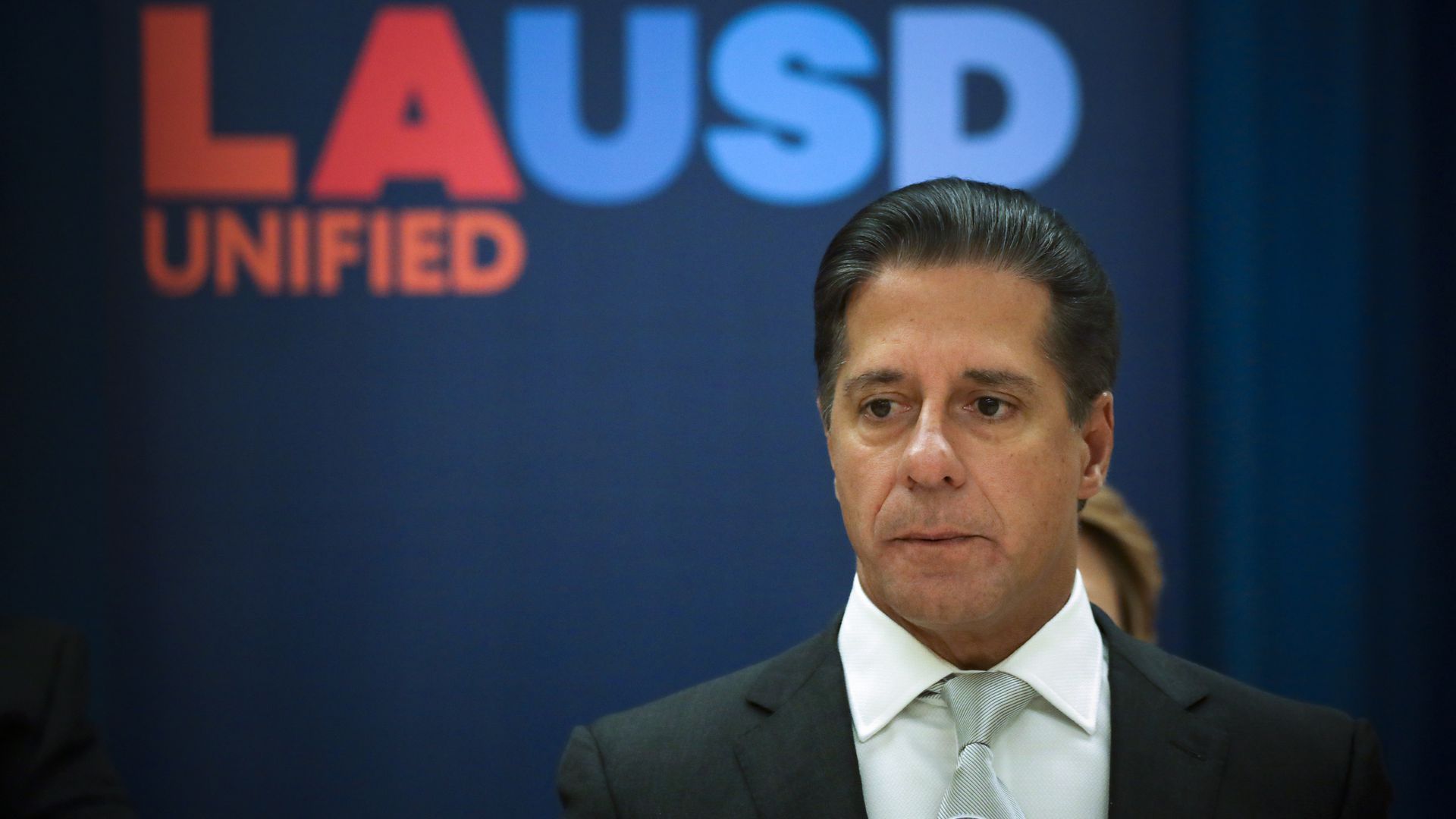
L.A. Unified superintendent Alberto Carvalho at a press conference in Sept. Photo: Irfan Khan/Los Angeles Times via Getty Images
A ransomware gang published roughly 500 gigabytes of data about students and employees of the Los Angeles Unified School District over the weekend, Axios' Sam Sabin reports. The move comes after the district refused to pay a ransom following last month's attack.
Driving the news: LA Unified School District superintendent Alberto Carvalho confirmed in a tweet Sunday that "a criminal organization" released the data set.
- Ransomware gang Vice Society, which has claimed responsibility for the ransomware attack, published the apparent leak on its dark web site.
- The district and law enforcement are still analyzing the "full extent of this data release," and set up an incident response hotline to help anyone affected by the data leak.
- LA Unified is the country's second largest school district, with more than 1,000 schools and 600,000 students.
Threat level: Researchers at Check Point Software Technologies tell Axios that the data leak "appears to be massive," including more than 248,000 files containing Social Security numbers, contracts, employment tax forms, invoices, passports and more.
- The data trove also appears to include health information, including COVID-19 test data, previous conviction reports and psychological assessments of students, according to TechCrunch.
The big picture: LA Unified joins a growing list of schools that have faced a ransomware attack this year, according to publicly available data.
- Allan Liska, a ransomware analyst at cybersecurity firm Recorded Future, estimates there have been 115 ransomware attacks against schools through September, tracking closely with the number of attacks against schools during the same period last year.
3. Groups sound alarm on anti-trans campaigns

Boston Children's Hospital. Photo: Lane Turner/The Boston Globe via Getty Images
Three major medical groups are calling on Twitter, TikTok and Meta to do more to "prevent coordinated campaigns of disinformation" about transgender youth, Axios' Sri Ravipati reports.
Why it matters: Several hospitals have scaled back services and ramped up security in recent months due to threats and harassment, as several Republican-governed states have proposed bills or passed laws targeting transgender youth.
Details: A letter, sent Monday by the American Academy of Pediatrics, the American Medical Association and the Children's Hospital Association to Attorney General Merrick Garland also calls on the Justice Department to investigate increasing threats of violence against children's hospitals and physicians that provide gender-affirming care to trans youth.
Driving the news: The threats have caused real-world health care disruptions, including a bomb threat at Boston Children's Hospital after Libs of TikTok, a popular far-right social media account, posted a video to its 1.3 million followers that made false claims about the hospital's gender-affirming care.
- Lurie Children's Hospital in Chicago recently notified families of a support group for trans youth that it was canceled due to threats.
- Vanderbilt Medical Center's Clinic for Transgender Health shifted its medical appointments to virtual telehealth appointments due to threats.
Meanwhile, children's hospitals and their medical staffs continue to face increased threats via social media, emails, phone calls and protesters at health care sites, according to the letter.
What they're saying: "As physicians, we condemn groups that promote hate-motivated intolerance and toxic misinformation that can lead to grave real-world violence and extremism and jeopardize patients' health outcomes," said AMA President Jack Resneck Jr. in a statement, adding that the group will continue to work with federal, state and local law enforcement officials.
- Representatives for the Justice Department, Twitter, TikTok and Meta did not immediately respond to Axios' request for comment.
By the numbers: The groups represent over 270,000 physicians and more than 200 children's hospitals nationwide.
4. Take note
On Tap
- It's not just Taco Tuesday, it's National Taco Day. (It's also apparently National "Eat Fruit at Work" Day, but one can only celebrate so much and I will be too busy with tacos.)
Trading Places
- Samsara named former Salesforce HR executive Steve Pickle as its first chief people officer.
- Analytics company Amplitude is announcing the hiring of former Dropbox marketing chief Tifenn Dano Kwan as its new chief marketing officer.
ICYMI
- Naver, a Korean internet company, is buying Poshmark for $1.6 billion in cash. (Axios)
- Meta launched a set of software tools for AI applications Monday aiming to speed up processing and provide greater flexibility between underlying chips. (Reuters)
- The European Parliament voted overwhelmingly to force companies to use USB-C chargers, with phones and tablets expected to comply by the end of 2024. (Bloomberg)
5. After you Login
The publisher of The Onion filed an amicus brief with the Supreme Court defending the First Amendment. And yes, it's as good as you'd hope.
Thanks to Scott Rosenberg and Peter Allen Clark for editing and Bryan McBournie for copy editing this newsletter.
🎧 Check out How it Happened: Elon Musk vs. Twitter Part II: Empire of Risk — the second installment in Axios’ new podcast docu-series about how Musk built his cross-industry empire, the rise of Twitter, and what the collision between the two could mean for us all. Listen here.