Axios Login

June 21, 2023

Ina here, though it's nice to have Ryan also here in San Francisco some this week. Today's Login is 1,250 words, a 5-minute read.
1 big thing: Tech's stake in the U.S.-India relationship
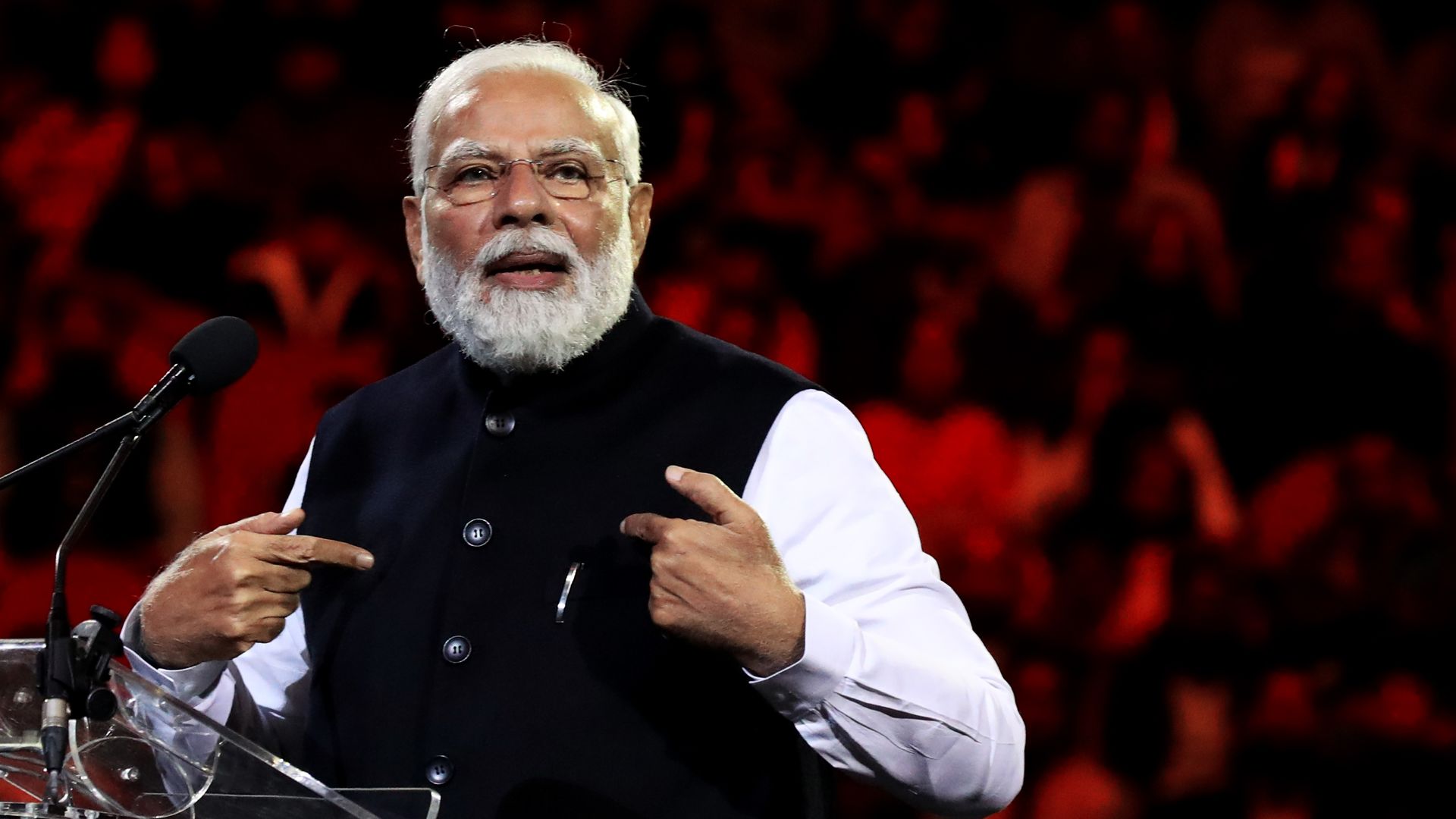
India's Prime Minister Narendra Modi speaks during an Indian cultural event. Photo: Lisa Maree Williams/Getty Images
China's shadow hangs over the first state visit of Indian Prime Minister Narendra Modi to the U.S., which begins today, Axios' Ryan Heath reports.
Why it matters: Modi's India is a global leader in both tech innovation and democratic backsliding, and American tensions with China have placed urgent new demands on the U.S.-India relationship.
- India is a huge supplier of tech talent, both to American companies operating in India and directly to the U.S. itself — a role that's grown as friction with China has made it harder for the U.S. to tap Chinese tech talent and industrial capacity.
Yes, but: Modi uses India's democratic status and America's need for Asian partners to contain China as a cover for what the State Department labels "significant" human rights abuses.
The big picture: Key elements of American AI are often made in India — usually at much lower wages that prevailing U.S. rates, as workers manually label data to improve AI foundation models.
- Established names such as IBM have in recent years employed around half their global workforce in India.
- Lesser-known companies such as Sama contract for clients ranging from Walmart to Microsoft to Google.
By the numbers: India is a hub for more than 1,500 multinational companies and around 60 CEOs at Fortune 500 companies have an Indian background, including the CEOs of Microsoft, Google, IBM and Adobe.
- The Indian public's trust in AI is the highest in the world, with 75% expressing strong trust. That support comes with experience of the world's largest biometric ID system and the government's mobile-based instant payment system, which processes 6 billion transactions a month.
Driving the news: Ahead of Modi's visit, Secretary of State Antony Blinken told Indian media, "We're elevating and expanding the strategic technology partnership."
- The U.S. may sign off on joint production of GE military jets.
- Twitter co-founder Jack Dorsey said last week Modi's government ordered him to restrict accounts critical of the government, or face shutdown. Modi's government labeled that a "lie."
What they're saying: Modi is keen for any collaboration that creates significant high-tech manufacturing jobs in India, Anja Manuel, executive director of the Aspen Security Forum, told Axios — and Biden wants to see Modi say something supportive of Ukraine.
Between the lines: President Biden needs Modi as a hedge against China.
- Both the American and Indian governments would like deeper military tech ties. India wants technology transfers and joint production, while the U.S. doesn't fully trust India — which has refused to condemn Russia's Ukraine invasion.
- But Freedom House rates India as only "partially free," and Human Rights Watch says the government engages in arbitrary internet shutdowns, which deprive Indians of work and basic services.
- The Modi government has increasingly targeted members of minority Muslim communities, activists, and journalists with violence and legal action.
The intrigue: Modi all but endorsed then-President Trump in the 2020 election — even with Vice President Kamala Harris, the first Indian-American elected to serve in the White House, on the Democratic ticket.
What's next? India is looking to carve out its own path on AI under the banner of AI for All.
- India is a leading supplier of tech talent and solutions but punches below its weight in regulatory discussions, which pivot around competing U.S., European and Chinese approaches.
- India is using its G-20 presidency to push for broader access to AI tools, especially for small businesses in the global South.
2. For AI-generated political ads, a Wild West

Illustration: Shoshana Gordon/Axios
AI-generated political ads could explode in upcoming elections as generative AI becomes more popular, adding a serious complication to online advertising that already struggles with misinformation, Axios Pro's Ashley Gold reports.
Why it matters: No federal rules are on the books about the use of AI in political advertising — though that may be about to change.
Driving the news: The Federal Election Commission announced Tuesday it will hold a meeting Thursday to consider whether to initiate a full rulemaking on political deepfakes.
- In May, Public Citizen petitioned the FEC to clarify that its existing law against "fraudulent misrepresentation" applies to deceptive campaign ads using AI.
The big picture: Right now, tech platforms that sell and host political ads have yet to develop definitive new policies around it.
- Katie Sanders, managing editor of PolitiFact, told Axios that it's "alarming to see more candidates embracing this technology" — especially video and audio manipulation, since it's "just kind of created out of whole cloth, where you don't have something original to reference."
- Emma Steiner, disinformation analyst at Common Cause, told Axios that the group's biggest concern about generative AI is that platforms "are not willing to act on evolving disinformation narratives."
Driving the news: A new ad from Republican presidential candidate Ron DeSantis, governor of Florida, features AI-generated, fake images of former President Trump kissing and hugging Anthony Fauci.
- A disclaimer on the video, written by users and shared on Twitter, says the video contains AI-generated elements. But critics say such disclaimers are insufficient.
- An AI-generated Republican National Committee ad from April portrays a dystopian future if President Biden is re-elected, Axios previously reported.
What they're saying: "Since 2018, we have provided industry-leading transparency for ads about social issues, elections or politics," Kevin McAlister, a Meta spokesperson, told Axios.
- "We remain committed to that goal, and we are working with experts to determine what, if any, changes are needed to address the use of generative AI."
State of play: Sens. Amy Klobuchar (D-Minn.), Cory Booker (D-N.J.) and Michael Bennet (D-Colo.) raised the alarm in May, introducing a Senate bill that would require a disclaimer on political ads that use images or video generated by AI.
Flashback: In 2019, then-candidate Joe Biden pledged to not use deepfakes, synthetic social media accounts or bot networks in his campaign.
3. AI makes mark on Time's list of top companies
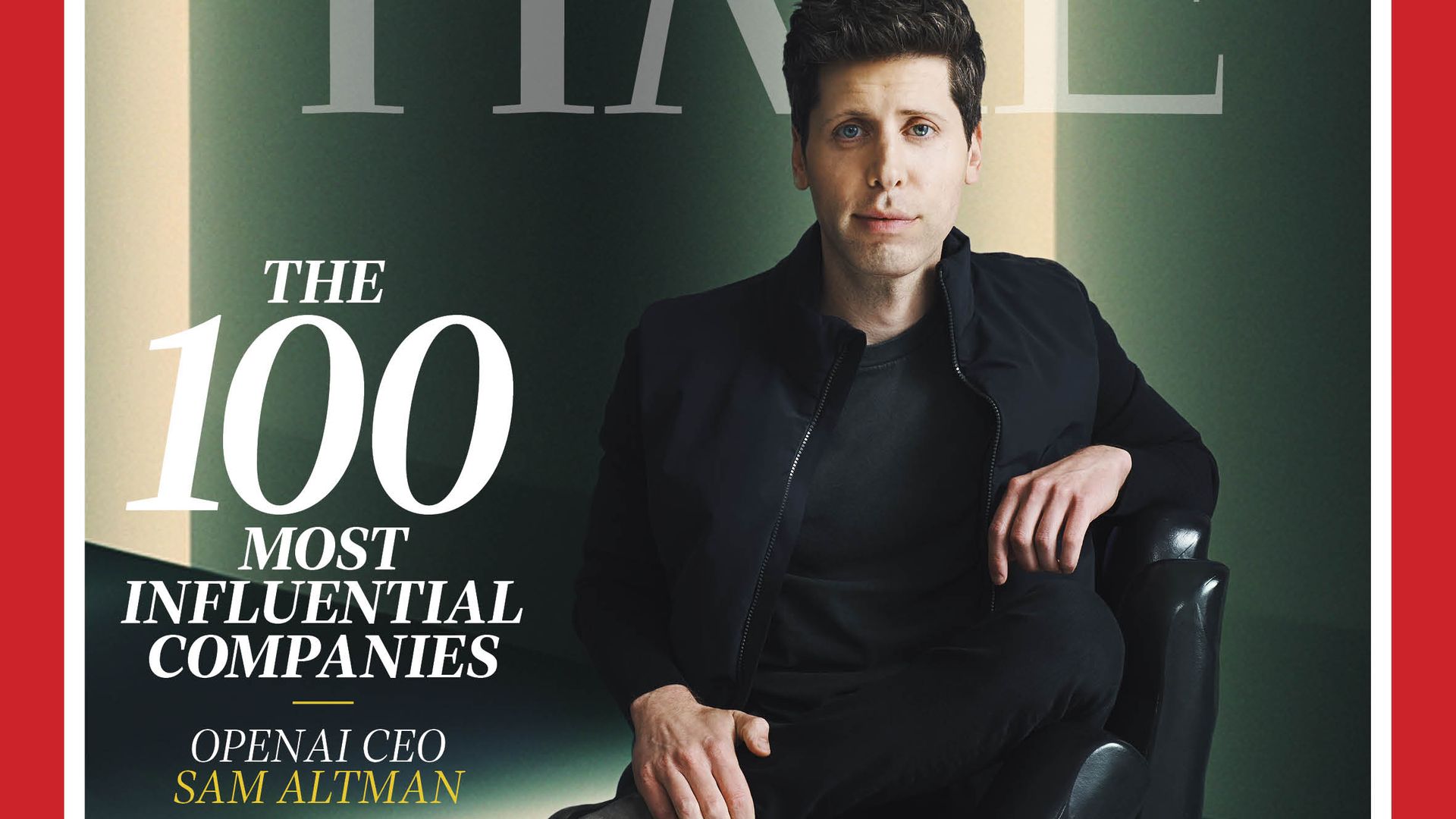
Image: Time
In a sign of just how quickly the AI boom is moving, this year's Time 100 list of most influential companies includes a dozen firms either focused on the technology or are reshaping their businesses around the technology.
Between the lines: Only four of the companies were on last year's list and two of those — Google and Microsoft — weren't really on there for their AI prowess.
Details: Joining last year's honorees OpenAI and Nvidia were: Google DeepMind, Hugging Face, Metaphysic, Runway, Microsoft, Oddity, Stability AI, Canva, Graphika and Duolingo.
- Other tech companies made the list for non-AI reasons, including Apple and IBM, Canva and drone delivery startup Zipline.
What they're saying: OpenAI CEO Sam Altman explained to the magazine how he simultaneously holds AI's promise and potential pitfalls: "I'm a Midwestern Jew ... I think that fully explains my exact mental model — very optimistic, and prepared for things to go super wrong at any point."
4. Take note
On Tap
- Figma is hosting its Config conference today and tomorrow in San Francisco, while HPE's Discover 2023 conference runs through Thursday in Las Vegas.
- Carnegie Mellon is hosting the K&L Gates conference in Ethics and AI today and tomorrow.
Trading Places
- Electronic Arts announced that longtime finance executive Stuart Canfield is taking over for Chris Suh as chief financial officer.
- The Allen Institute for AI has hired Ali Farhadi, who most recently led an AI and ML division at Apple, as its new chief executive.
ICYMI
- Recent major investments in chip manufacturing and electric and autonomous vehicles have made Phoenix a new darling of the innovation elite. (Axios)
- The Justice Department announced a new cybersecurity crimes unit within its National Security division. (Recorded Future)
5. After you Login
This seal was caught on video hopping from surfboard to surfboard near San Diego.
Thanks to Scott Rosenberg for editing and Bryan McBournie for copy editing this newsletter.