Axios Login

October 05, 2022

For those who were intrigued by The Onion's legal brief in After you Login yesterday, NPR has a bit more of the backstory.
Today's Login is 1,262 words, a 5-minute read.
1 big thing: Musk's Twitter to-do list

Illustration: Aïda Amer/Axios
Elon Musk looks like he is once more poised to purchase Twitter, but the company hasn't changed much since he decided to walk away from acquiring it in July: It's financially hurting, beset by free-speech disputes and shaken by months of relentless criticism, much of it from its likely new owner, Axios' Scott Rosenberg reports.
The big picture: Musk and his supporters believe he is just the person to solve these problems. His critics point out that building electric vehicles and reusable rockets is a very different skill from managing a community of hundreds of millions of people.
Here are the immediate tasks Musk would face as Twitter's new proprietor.
Free speech
- Musk has said Twitter should enforce fewer rules about speech and let users say anything that is not explicitly outlawed by their governments.
- 15 years of experience with mass social networks online tells us that such an approach is wildly impractical and likely to unleash floods of spam, bullying, fraud and disinformation.
- That will either drive swathes of Twitter users away from the platform in disgust or push Musk to rebuild the content-moderation systems he now wishes to dismantle.
Donald Trump
- The biggest free-speech choice of all Musk will immediately confront is what to do about former President Trump's account.
- Trump was permanently banned from Twitter after the Jan. 6 attack on the U.S. Capitol, and Musk doesn't have to do anything.
- But he has said that he is against permanent bans, and many of his fans believe he will invite Trump back to the service.
Business
- Big social platforms typically start with meteoric user growth and then build massive revenue streams with fat profit margins, but Twitter has never figured out how to fulfill that pattern.
- Musk has promised to turn the business around, and given the debt the company will take on in order to go private, he will have to push hard to do so.
- But the outlook for Twitter, as for every ad-supported business, looks dim in the current market downturn, and it isn't at all clear that subscriptions will turn the tide for the company.
Technical work
- During Musk's months-long effort to wriggle out of his deal to buy Twitter, he made much of a complaint that the service is overrun by fake accounts and bots. Whether it's as big a problem as he says or not, it will be his problem once he owns the company.
- Last month, Twitter's former security head filed a whistleblower complaint charging the company with a slew of operational lapses. As a new owner, Musk will own that problem, too.
Staffing
- A Musk-owned Twitter will face the challenge of trying to retain and inspire teams at Twitter whose work Musk has repeatedly disparaged — or, more likely, he will have to hire a ton of new talent to replace the departing droves.
- Text messages that surfaced during the court proceedings indicated Musk thinks poorly of Twitter's current CEO, Parag Agrawal, so expect the new owner to hire new leadership, too.
- In another of those leaked texts, venture capitalist Steve Jurvetson suggested Musk hire Emil Michael, a former Uber exec with a business background. Musk answered, "Please send me anyone who actually writes good software" — as if the company's chief problem is bad code.
The bottom line: A Musk-owned Twitter will aim to unleash free speech, make money and "write good software." If Musk ever closes the deal, we'll see whether he can achieve those goals — and whether people will want to use Twitter once he's done.
2. Micron CEO: N.Y. plant will revive U.S. leadership
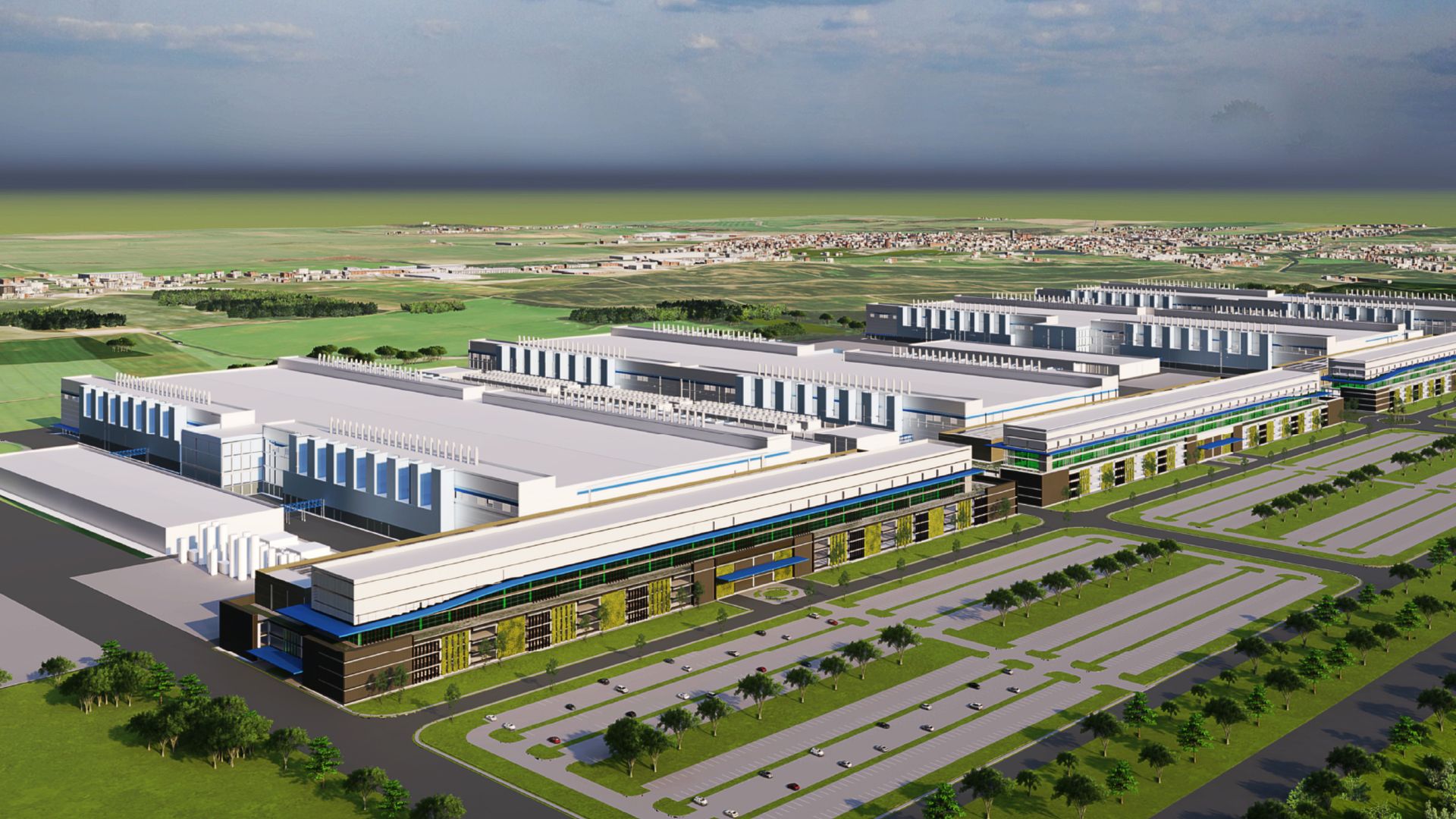
A rendering of the future Micron plant in New York state. Image: Micron
Micron CEO Sanjay Mehrotra tells Axios that its massive investment in a New York state chip facility will create as many as 50,000 jobs and allow 10% of the total global memory chip market to be U.S.-made by the end of the decade, up from 2% today.
Why it matters: The U.S. has committed $52 billion to reboot the domestic semiconductor industry amid growing concern that the concentration of leading-edge chip production overseas threatens U.S. security.
- "Our customers want to see a diversified supply chain as well," Mehrotra said in a telephone interview.
Driving the news: Micron said on Tuesday it will spend as much as $100 billion over the next 20 years to manufacture state-of-the-art memory chips in Clay, New York, outside of Syracuse.
- The company hopes to begin on-the-ground preparations for the New York facility next year, start construction in 2024 and start producing chips by the latter part of the decade, Mehrotra said.
- Micron, which is based in Utah, makes some memory chips in the U.S., but all its leading-edge production has been overseas for some time.
The big picture: Micron joins a long list of chipmakers looking to take advantage of $52 billion in federal funding approved by Congress.
- Intel, TSMC, Samsung and others have announced significant U.S. expansion plans in recent months, spurred by the promise of federal dollars.
Yes, but: All this new fab construction comes as the years-long chip shortage appears to be easing, with fears there could be a potential glut in the near term as demand slows and manufacturing capacity increases.
3. Google settles Arizona data suit for $85 million
Google will pay $85 million to settle a lawsuit by the Arizona Attorney General's Office over the way the tech giant has used customers' location data, Axios Phoenix's Jeremy Duda reports.
- The settlement averts a trial that was scheduled to begin on Oct. 24.
Catch up quick: Attorney General Mark Brnovich began investigating Google in 2018 after the Associated Press reported that some of the company's apps continued tracking and storing users' location data even after they turned off the location history feature.
- Brnovich sued Google in state court in 2020 for alleged violations of the Arizona Consumer Fraud Act.
Of note: The settlement does not require Google to admit wrongdoing or violating the law.
The other side: Google spokesperson José Castañeda told Axios that the case was based on outdated policies the company changed years ago.
4. More labor woes for Big Tech
The National Labor Relations Board filed a complaint against Apple on Tuesday, alleging the iPhone maker suppressed protected union organizing efforts, per Bloomberg.
Meanwhile, a group of Amazon drivers are suing Amazon and its delivery partners for failing to provide required rest and meal breaks, Axios Seattle's Melissa Santos reports.
Why it matters: Unionization efforts are gaining some traction in the industry as workers doing some of tech's least glamorous jobs seek better working conditions.
Driving the news:
- The NLRB case against Apple relates to allegations brought by the Communication Workers of America that Apple violated federal labor laws by actions including forcing workers to attend anti-union speeches, Bloomberg reported.
- Amazon has faced multiple complaints over not providing rest breaks, which some drivers have said forces them to urinate in plastic bottles. The new lawsuit focuses on drivers in the Seattle area, but previous disputes have unfolded in California and Pennsylvania.
In other labor news, at least 50 Amazon workers were suspended Tuesday for refusing to return to work after a fire at its unionized Staten Island warehouse, union leaders told the Washington Post.
5. Take note
Trading Places
- Nanotechnology startup Leia has hired former Spotify and Lego Ventures executive Cecilia Qvist to be its CEO.
- GM is adding former Lyft and Tesla executive Jonathan McNeill to its board of directors.
ICYMI
- Amazon has frozen corporate hiring for the retail side of its business, while it will continue to fill jobs in its AWS unit. (CNBC)
- Facebook is pulling the plug on its email newsletter project Bulletin, a would-be competitor to Substack. (Hollywood Reporter)
6. After you Login
Check out this powerful ad for public transit, created by authorities in Denmark.
Thanks to Scott Rosenberg and Peter Allen Clark for editing and Bryan McBournie for copy editing this newsletter.