Axios Login

March 09, 2023

I'm not saying everyone is talking about ChatGPT, but Stan and Clyde were talking about it on "South Park." Today's Login is 1,227 words, a 5-minute read.
🔍 Situational awareness: Microsoft announced that its Bing search engine, recently updated with chatbot capabilities, has hit over 100 million daily active users.
1 big thing: Meta's new yardstick for testing algorithmic bias
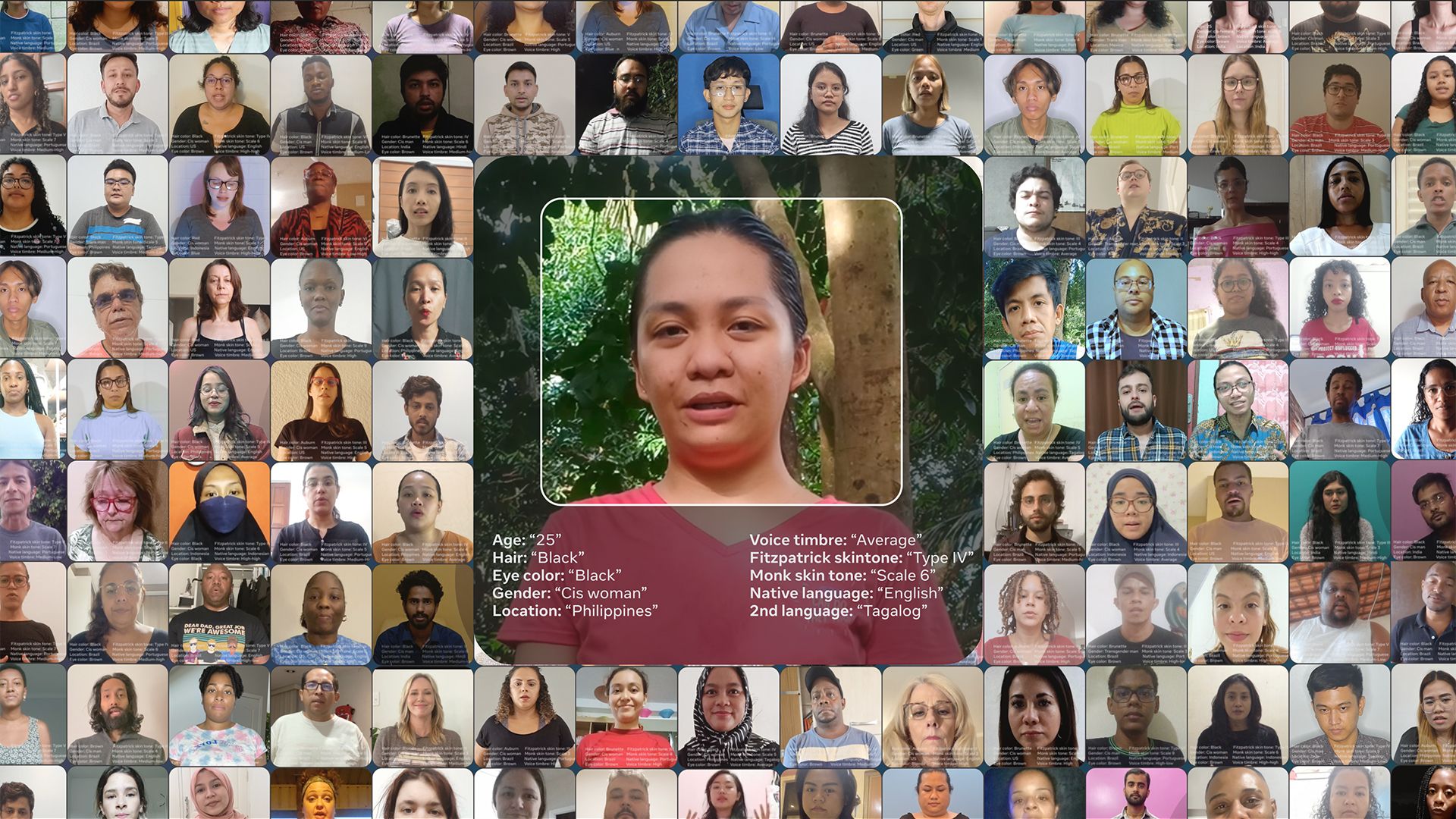
An illustration showing some of the labels Meta's Casual Conversations v2 data set captures. Image: Meta
Facebook parent Meta is sharing an updated data set for voice and face recognition AI that it hopes others in the industry will use to test how accurately their systems work across a diverse set of people.
Why it matters: Machine-learning-driven artificial intelligence — which powers everything from these recognition algorithms to the popular ChatGPT — is only as fair as the data used to train and test it. The more representative the data, the less likely it is that human bias will turn into automated discrimination.
- Early facial recognition systems, for example, were shown to perform less reliably on people with darker skin.
How it works: Meta's new data set, known as Casual Conversations v2, includes more than 25,000 videos from more than 5,000 people across seven countries, with people self identifying their age, gender, race and other characteristics such as disability and physical adornments. Trained vendors added additional metadata, including voice and skin tones.
- The videos, featuring paid participants who gave their consent to be part of the data set, included both scripted and unscripted monologues.
- An earlier data set, released in 2021, had similar goals but involved fewer people, included a narrower set of categories and only had U.S. participants.
- As with the prior data, Meta is making it available both externally and to its own teams.
What they're saying: In an interview, Meta vice president of civil rights Roy Austin told Axios that now is the best time to start ensuring that algorithms are fair and inclusive.
- "It's much easier and much better to get things right at the beginning than it is to fix things late in the process," he said. "We are at the beginning of a technology likely to impact us for decades if not centuries to come."
The big picture: Ethical AI experts say there are a range of actions that need to be taken to minimize algorithmic bias, from improving training data to testing for disparate outcomes.
- Meta's new data release is designed to help with the latter issue, at least with regard to speech and visual recognition algorithms.
- Different approaches are needed for other types of AI. For instance, large language models trained on broad swaths of the internet, such as OpenAI's ChatGPT, can easily spew out hateful information or perpetuate stereotypes.
- "If we look at our large language models, they lack diversity," Austin said. "They are filled with a lot of hateful, bullying, harassing speech. The only way to test is to have a diverse model, is to have those voices that may not be in the larger models and to be intentional about including them."
Of note: Another way to limit bias in AI is to set boundaries for how a particular type of system will be used.
- Salesforce, for example, is limiting its generative AI to answering questions of the sort that a sales or support staffer would need to ask.
2. Interview: Meta civil rights chief sees progress

Photo Illustration: Shoshana Gordon/Axios. Photo: Meta
Two years after joining Meta, Austin tells Axios he believes the company has made strides on everything from how it designs products to checking for unintended discriminatory impacts.
- Austin said the company has now completed or created ongoing projects to address 97 of the 117 to-do items identified as part of a civil rights audit completed in 2020.
Yes, but: Austin, who was hired following the company's civil rights audit, acknowledges that there is plenty still to address. "We still have a huge breadth of work we are involved in," he said. "We have more work than anyone could expect to do."
Between the lines: Austin's team remains small — just 13 people (up from nine a year ago) — but he says awareness of the need to create more inclusive and equitable products is growing, in part due to the fact 50,000 Meta workers have taken a civil rights training program that the company has made mandatory for most employees.
- Importantly, he said his team has made progress in being included in key conversations.
- "More often than not, people invite us to efforts and give us a chance to weigh in," Austin said. "I think the training helped."
The big picture: Some other companies have agreed to undergo a civil rights audit similar to the one Meta undertook, but Austin said that to his knowledge no other company has created a role similar to his.
- "I continue to want to see more companies do it," he said.
3. After Stadia, Google's new gaming roadmap

Illustration: Aïda Amer/Axios
Google is positioning itself as a go-to tech partner for publishers of live-service video games, as it revises its messaging around gaming, Axios' Stephen Totilo reports.
Why it matters: Google is pitching its Cloud program as proof it remains invested in gaming, after it shut down its Stadia platform in January.
What they're saying: "It was at that moment when we basically had to make decisions about Stadia that we realized that, at Google Cloud, we are at our best when we're helping other people build this stuff, not necessarily building it ourselves," Google Cloud’s director of game industry solutions, Jack Buser, told Axios.
- Buser had joined Google in 2016 from PlayStation as the 10th employee at Stadia, which aimed to compete with Sony, Microsoft and Nintendo by offering (and at times developing) games that could be played via streaming connections from remote servers, with no console or PC required in the player's home.
- In late 2021, Buser shifted to Google Cloud’s gaming team, where Google's tech is being harnessed to operate third-party games running on consoles, PC or phones.
Details: Google is selling a bundle of services to game publishers with a strict focus on the operations of live-service games, the kind of games that are meant to be played and updated in perpetuity.
- The three-part Google Cloud bundle, some of which has been offered previously, includes a game-centric server platform, cloud storage data management and a searchable player and game analytics through BigQuery.
- Google's pitch is that its tech can ameliorate risk for live-service games, which are lucrative but prone to numerous technical problems, including being potentially overloaded by surges in popularity.
- Ubisoft, Niantic and Unity are active clients, the company says. Google is courting other big publishers to come on board.
The big picture: As Google pushes its Cloud business as a strong option for game companies, it will compete with Amazon and Microsoft's own cloud and server infrastructure.
- But Buser's team is selling itself as a solution strictly for live-service games.
Sign up for the Axios Gaming newsletter here.
4. Take note
On Tap
- Oracle is slated to report earnings after the markets close.
Trading Places
- The Global Cyber Alliance has hired Komal Bazaz Smith as chief business officer. Bazaz Smith was previously working on digital connectivity and cybersecurity partnerships for USAID.
ICYMI
- Hundreds of members of Congress and their staffs this week were hit by a data breach of their health records in D.C.'s health insurance marketplace. The FBI and Capitol Police are investigating. (Axios)
- FBI director Christopher Wray acknowledged that the agency purchased location data of Americans as part of a now-ended pilot program. (Wired)
- Anthropic, a rival to OpenAI, is raising $300 million in capital at a $4.1 billion valuation. (The Information)
5. After you Login
This one is for you, Dad. Check out a fresh "M*A*S*H" scene written by AI at the behest of Alan Alda (aka Hawkeye). Spoiler alert: Alda told the New York Times that ChatGPT has a terrible sense of humor.
Thanks to Scott Rosenberg and Peter Allen Clark for editing and Bryan McBournie for copy editing this newsletter.