Axios Latino

Welcome to a special edition of Axios Latino!
👋🏽 Astrid here. We don't write much about immigration in this newsletter, but with so much happening — from the recent deadly Ciudad Juárez fire to the upcoming end of Title 42 — we think it's a good time to cover an issue that's affecting so many lives and will likely be a top issue during next year's elections.
- Do you have your own immigration story that you'd like to share with us? Reply to this email.
- Puede leer este boletĂn en español aquĂ.
This newsletter, edited by Astrid Galván and Laurin-Whitney Gottbrath, is 1,696 words, a 6.5-minute read.
1 big thing: Title 42's end will test Biden strategy
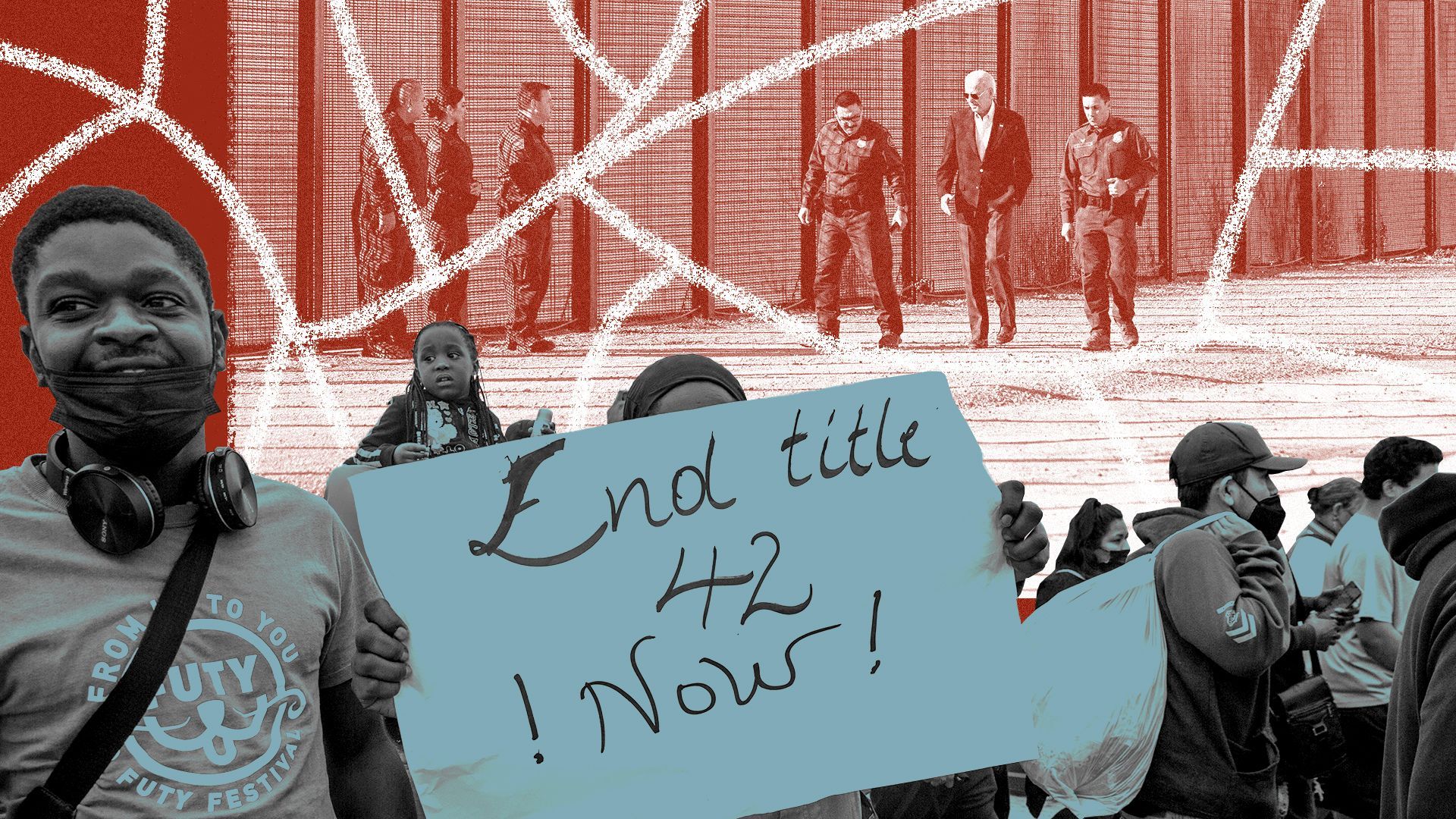
Photo illustration: Annelise Capossela/Axios. Photos: Aimee Melo/picture alliance, Jim Watson/AFP via Getty Images)
Migration through the Americas has radically changed over the past decade, yet U.S. immigration laws remain stuck in the last century, with a patchwork of policies to address a growing humanitarian crisis at the southern border, Axios' Stef W. Kight writes.
Driving the news: On May 11, the Biden administration is expected to end the Title 42 pandemic policy, which has allowed immigration authorities to rapidly turn back hundreds of thousands of people without giving them a chance for asylum.
- A different policy that allowed authorities to more quickly release and track migrants using ankle monitors or a phone app was halted by a Florida court in March.
- Without either option, Border Patrol could again face overcrowded facilities or be forced to quickly release migrants into the United States without a court date.
The big picture: Immigration advocates and some Democrats are eager to see the end of Title 42, which they say infringed on migrants' right to seek asylum.
- They call for comprehensive immigration reform and opening up different legal pathways for migrants.
A scenario in which tens of thousands more people come to the U.S. border in a short time frame — which experts say is likely to happen with the end of Title 42 — poses dangers to immigrants and could overwhelm the resources of border authorities and local communities.
- Dozens of people died in a recent fire at a migrant facility in Ciudad Juárez, Mexico, at a time when the city is struggling with a massive influx of migrants seeking to enter the U.S., and as migrants' desperation grows.
- Last year was the most deadly on record for migrants at the Southwest border, data shows.
Faced with this reality, the Biden administration is considering stringent new immigration proposals.
- One policy would block migrants from asylum if they do not use new parole programs, schedule an appointment at the border through an app or first seek protections in a country they traveled through. Another would resume the detention of migrant families.
- The Department of Homeland Security has also increased resources on the border and cracked down on smuggling networks.
Yes, but: These are short-term fixes; they're politically risky and could have unintended consequences; and they don't address the root causes of migration.
2. Why it's hard to come "the right way"
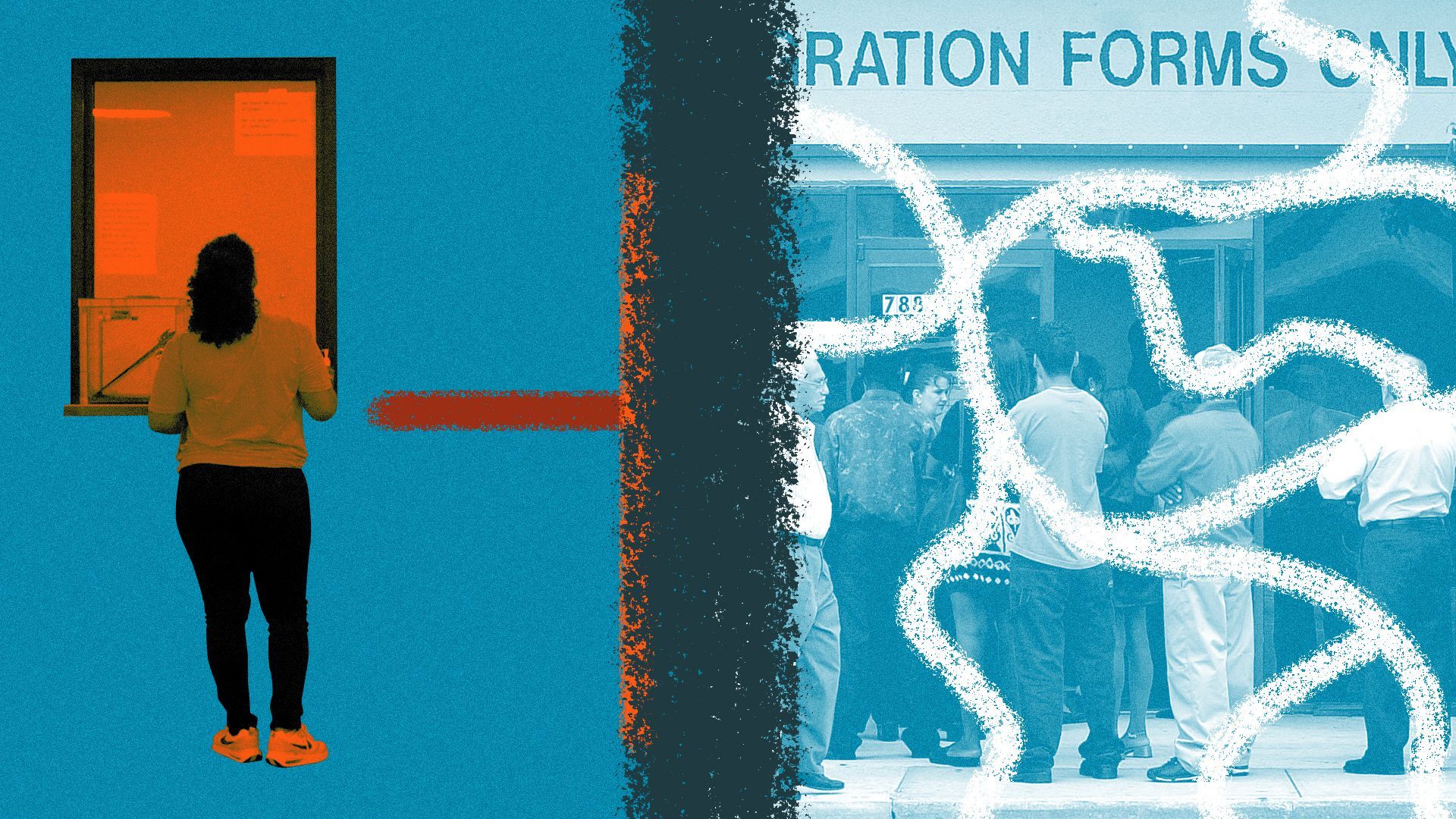
Photo illustration: AĂŻda Amer/Axios. Photo: Irfan Khan/Los Angeles Times and Rhona Wise/AFP via Getty Images
Permanently moving to the U.S. was once as easy as getting on a ship or strolling across a border, Russell writes.
Today, most lawful means of entering the country take years because of overwhelmed immigration agencies, rising levels of global migration and a limit on the number of certain visas, all of which have culminated in a massive backlog of people trying to get to the U.S.
- Around 9 million people are awaiting green cards, and those wait times have skyrocketed from just a few months to years, possibly decades, according to the Cato Institute and other researchers.
- In 1991, only 3% of people seeking visas through family members already in the U.S. had to wait more than 10 years. That spiked to 27% by 2018.
What the legal immigration system looks like now
The U.S. hasn't increased the number of certain visas it grants each year since 1990, when President George H.W. Bush signed an immigration bill that set quotas based on the country's population and labor and economic needs at the time.
- There's a backlog of over one million cases.
What did migrating to the U.S. look like in the past?
Before World War I, the U.S. didn't have its current visa system and effectively had open borders for some people, David J. Bier, associate director of immigration studies at the Cato Institute, tells Axios.
- Europeans only had to board a ship to the U.S., and they would be processed for entry at Ellis Island.
Yes, but: The U.S. still prevented some people from entering the country or discriminated against them during waves of public anti-immigrant sentiment.
- Under the 1882 Chinese Exclusion Act, Chinese workers were banned from coming to the United States for a decade. The act was in place in one form or another until 1943.
- During the Mexican Revolution from 1910-1920, the U.S. forced Mexican migrants to strip and sprayed them with pesticides in response to racist claims that they "carried diseases and lice."
3. The global migration crisis south of the border
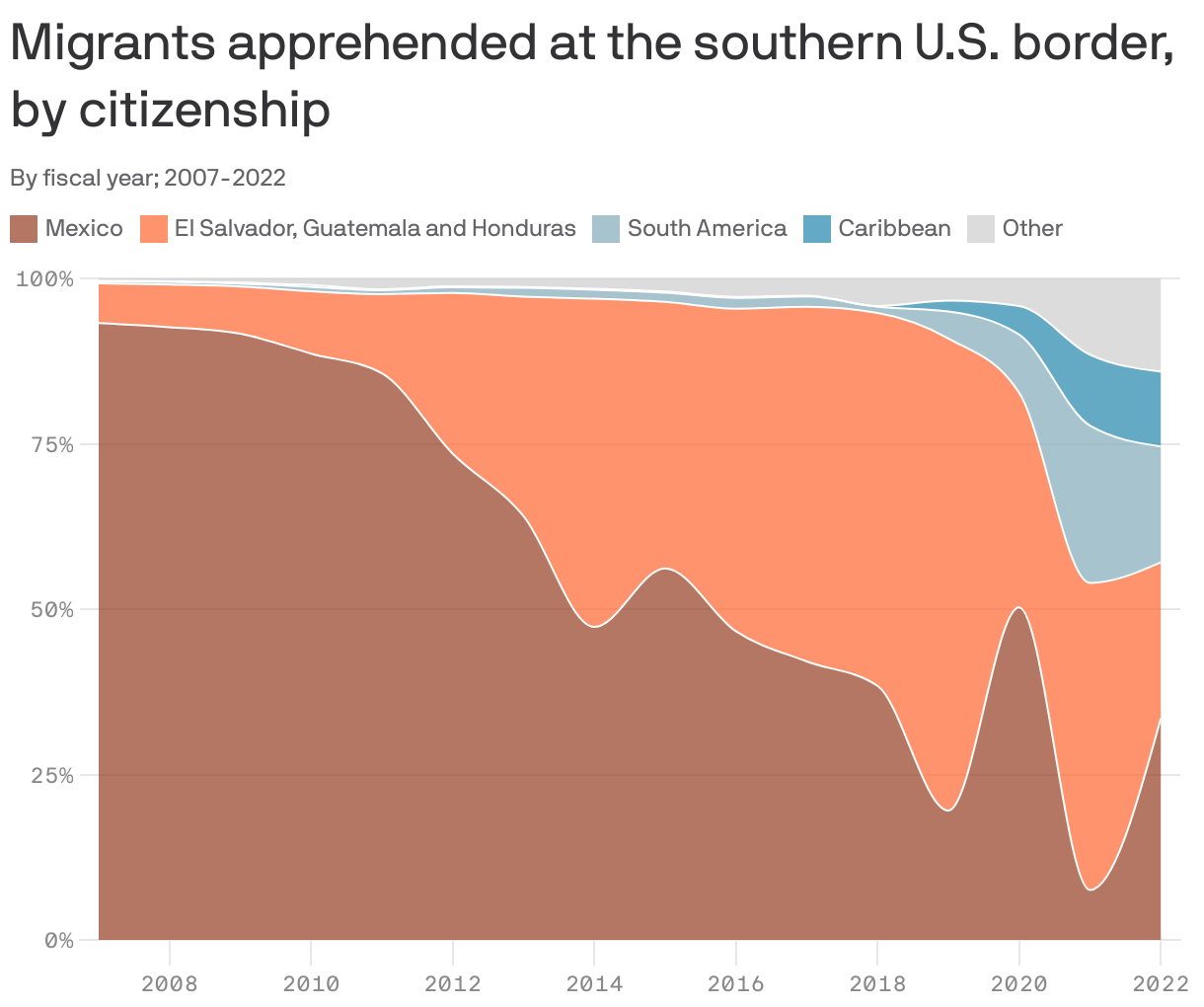
To seek asylum at the U.S.-Mexico border, migrants are increasingly making treacherous journeys from faraway nations, including China, India and Russia, Stef writes.
Why it matters: This has complicated an already chaotic situation at the border, with authorities now contending with new language barriers and countries that do not cooperate with U.S. deportation efforts.
- The shift in demographics at the southern border is a sign of how desperate many people are to reach the United States.
Details: Many people from outside the western hemisphere often fly to South American countries with lax visa requirements, then slowly make their way north, risking kidnappings, extortion, robbery and death.
- For example, thousands of Chinese migrants have recently made the perilous journey through the Darién Gap, a thick jungle infamous for its poisonous snakes, armed guerillas and drug traffickers.
What they're saying: Andrea Rudnik, the volunteer coordinator for Team Brownsville, a group that provides aid to recently arrived migrants in Texas, says her organization has struggled to meet the needs of many Chinese nationals because of the language barrier.
- Often, they just make do with Google Translate, Rudnik adds.
4. A closer look at asylum in the U.S.
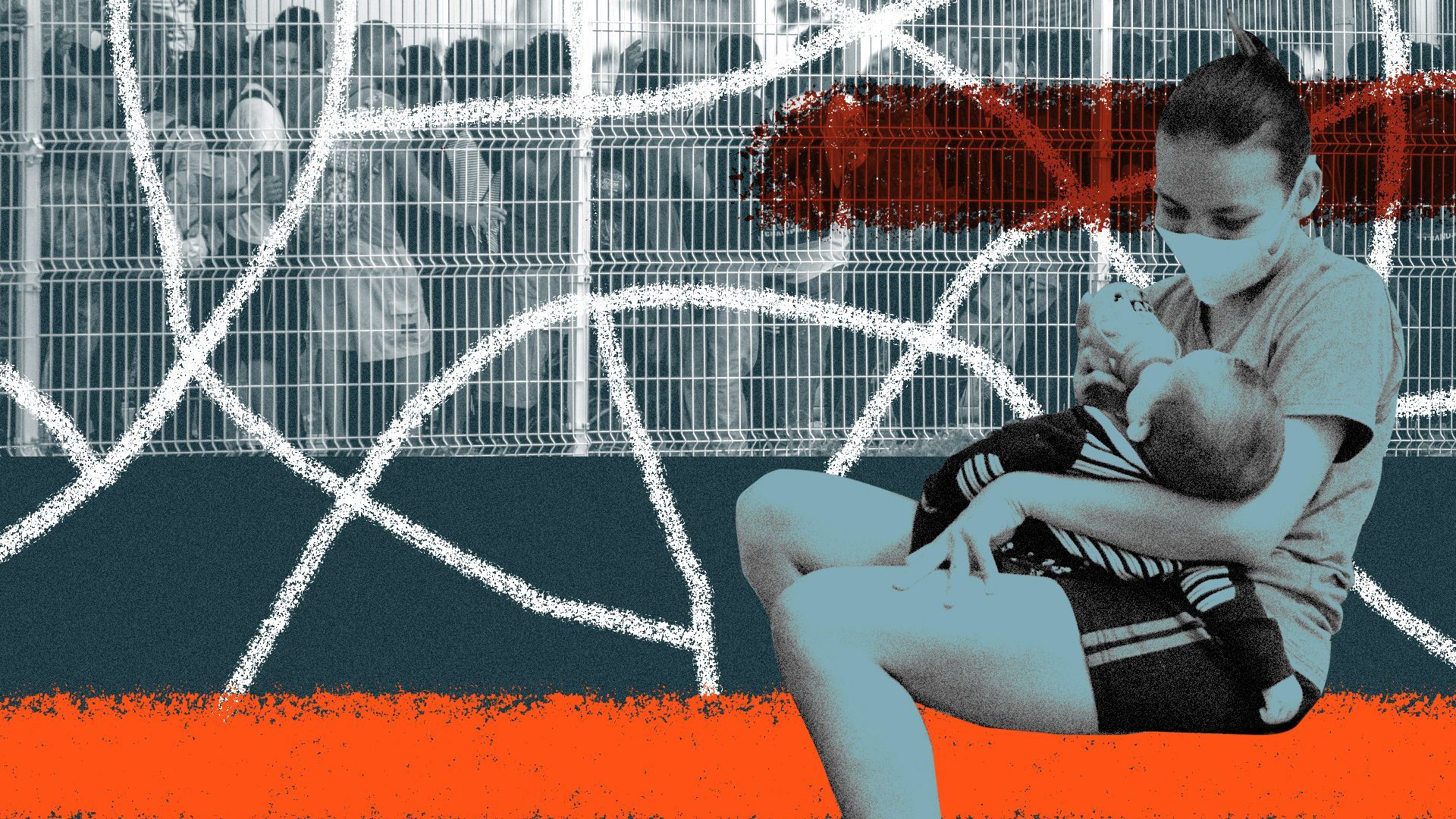
Photo illustration: Shoshana Gordon/Axios. Photos: Gerardo Vieyra/NurPhoto, Jair Cabrera Torres/picture alliance via Getty Images
Seeking asylum in the United States is a codified right — but immigrant advocates say it's been severely restricted, Astrid writes.
The big picture: A string of policies aimed at reducing irregular migration, both by former President Trump and now President Biden, have made it much harder for people fleeing persecution to seek safety in the U.S. if they come through the southern border.
What is asylum?
Asylee and refugee protections were codified in international law in 1951 following World War II, which saw a massive displacement of people.
- The protections and obligations defined by the convention were expanded to apply universally when the UN adopted the 1967 Protocol.
- The U.S. didn't ratify the 1951 Convention but did sign onto the 1967 Protocol, making it legally required to provide protections to people who qualify as refugees.
- Asylum seekers can ask for protection in the U.S. if they have been persecuted or fear persecution due to their race, religion, nationality, membership in a particular social group, or political opinion.
- The United States adopted the UN definition of refugee into its immigration law in the Refugee Act of 1980, although asylum has a "discretionary" status, which means some people who fall under the definition of a refugee can still be turned away.
What is it like to seek asylum?
Ana Rosa, a 31-year-old asylum seeker from Venezuela, traversed the Darién Gap and several Latin American countries with her four children ages 3, 6, 8 and 11, and husband before arriving in Texas last summer.
- All of her children are deaf and two require surgeries that they couldn't get in Venezuela, she tells Axios Latino.
- The family has applied for asylum, but their first hearing isn't until August — more than a year after first arriving in the U.S., says Ana Rosa, who asked to go only by her first name as her claim is still being processed.
- "In reality, we really struggle," says Ana Rosa, who will be able to apply for a work permit in May. "We like to work and here we have to do so without a permit because can you imagine how we'd support four children?"
5. It's not just to the U.S.
Photo illustration: Annelise Capossela/Axios. Photos: Pedro Pardo/AFP, Seth Sidney Berry/SOPA Images/LightRocket via Getty Images
The effects of climate change, violence, political instability and economic strife across Latin America and the Caribbean are displacing millions of people, Marina writes.
The big picture: Not only are more people coming to the U.S., they're also migrating more within Latin America and beyond the cities that have long drawn migrants.
State of play: Ecuador has for at least two decades drawn many migrants from nearby countries. Now people are leaving Ecuador as a rise in gang violence has made living in major cities like Guayaquil untenable for many.
- Natural disasters, which climate change has worsened and made more frequent, have also forced more Guatemalans, Panamanians, Dominicans and Hondurans to leave home.
- Financial pressures aggravated by the pandemic and worsening inflation also contribute to rising migration, such as from Colombia, which had record emigration last year.
Between the lines: Another major issue prompting increased movements across the Americas is a lack of policies to help new immigrants adapt culturally and be allowed to contribute to the country's economy, says Diego Chaves-González, senior manager of the Latin America and Caribbean Initiative at the Migration Policy Institute.
- For example, more Nicaraguans are trying to get to the U.S. as the political crackdown at home has worsened in the past two years. In the past, many had moved to Costa Rica, but getting legal status there has become much harder amid reports of anti-immigrant sentiment.
- Similarly, many Venezuelans who in the past fled political instability and food and medicine shortages to other South American nations have started to trek north since the pandemic.
What to watch: Last June, 21 governments in the Americas, including the United States, signed the Los Angeles Declaration on Migration, promising to develop regional and coordinated solutions to regulate the flow of people.
- Representatives from the signatory nations met again in Washington, D.C., last September to begin forming joint plans of action.
Huge thanks to managing editor for politics David Lindsey, illustrator Annelise Capossela, visual journalist Erin Davis and associate director for audience Lydia Massey for their help with this. And big thanks to Carlos Cunha for the copy edits!
Sign up for Axios Latino

Keep tabs on the stories that most affect the U.S. Latino community on both sides of the border, a collaboration with Noticias Telemundo.