Axios Generate

May 06, 2025

✅ Tuesday. We start with a look at AI's mineral needs and then roam around the beat, all in a newsy 1,282 words, 5 minutes.
🚨 Situational awareness: Via Reuters, EU officials will unveil plans today for a "ban on new Russian gas deals by the end of this year, and a ban on imports under existing contracts with Moscow by the end of 2027."
- Watch this space for what the plans mean for U.S. LNG and Europe's energy transition efforts.
🎶 Diana Ross' sparkling album "Diana" turns 45 this month (h/t Albumism) and provides today's intro tune...
1 big thing: Minerals, the other data center vulnerability
Everyone knows getting power for data centers is a challenge for U.S. AI development — but don't sleep on minerals, new and recent analyses warn.
Why it matters: A new Barclays report finds that obtaining critical minerals and attracting elite talent are the "new battlegrounds in the fight for AI supremacy."
State of play: On the materials front, over 60% of the most critical raw minerals for AI hardware come from a few developing and emerging countries, it finds.
- Materials like copper, cobalt, aluminum, lithium and nickel are needed for wiring and other components, battery materials, and storage infrastructure.
- Rare earths (not that rare, I know) are essential for semiconductors, Barclays notes. China recently imposed new export controls.
Threat level: In a vulnerability akin to risks for clean energy supply chains, China dominates the processing of many minerals produced elsewhere.
- For instance, it provides nearly 80% of processed cobalt and over 90% of refined rare earths needed for magnets.
What we're watching: The report provides various recommendations.
- It notes that mineral-rich nations like Chile and Congo have opportunities to expand their processing and boost geopolitical leverage.
- "They could secure strategic advantages by forming trade relationships and alliances with tech-heavy economies such as the US, the EU, and Japan," it states.
- Barclays also sees opportunities to boost e-waste recycling.
Catch up quick: "There is a significant overlap between the minerals needed for building new data centres and those that are critical to energy technologies," the International Energy Agency said in a report last month on the energy-AI nexus.
- IEA name-checks material needs, like silicon for processors and memory components, aluminum for server racks, and gallium for power converters, to name just a few.
The bottom line: "Geopolitical conflicts, trade wars and natural disasters can turn dependencies into vulnerabilities," Barclays analysts write.
- "While high-tech chips and components often steal the spotlight, it is the critical mineral dependencies in the AI supply chain that are the true linchpin."
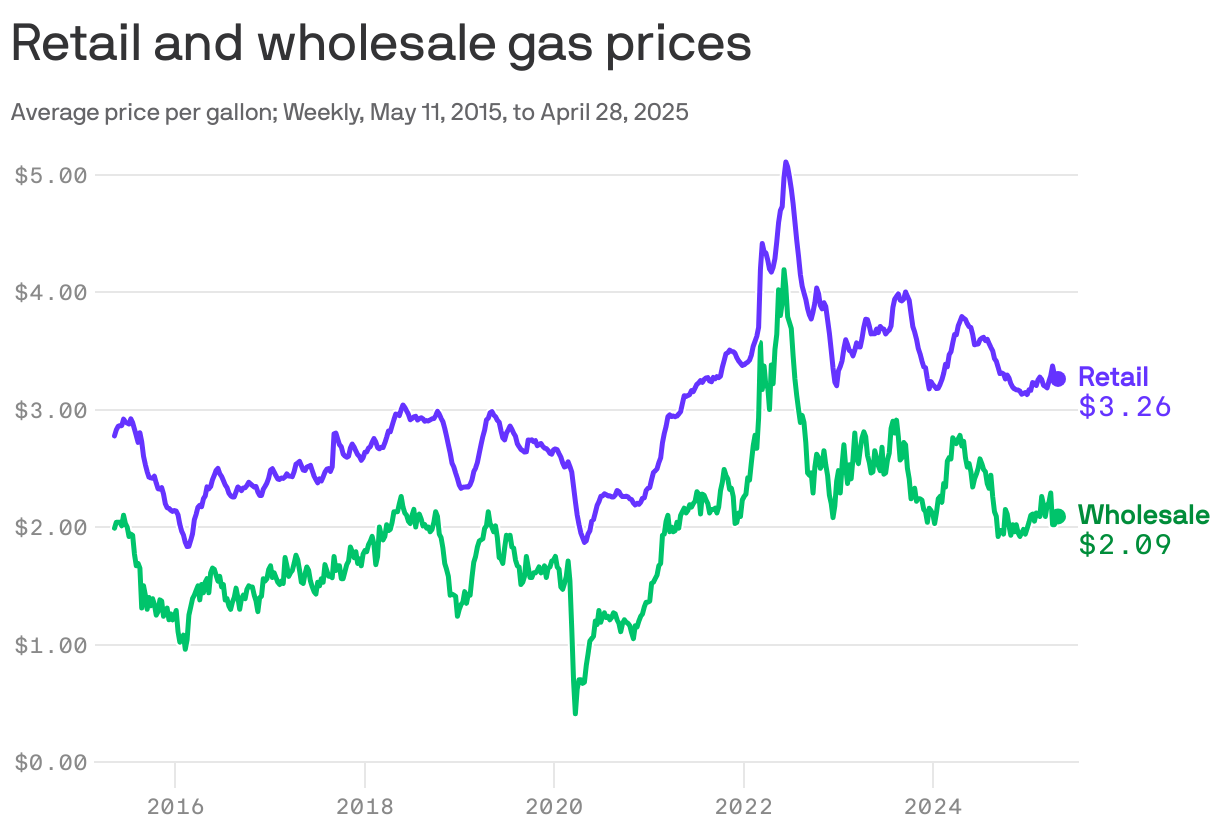
2. ⛽ Where gas can cost $1.98

Last week, President Trump triumphantly announced that "Gasoline just broke $1.98 a Gallon, lowest in years," even as the price at the pump was about $3.18.
Why it matters: Gasoline did touch $1.98 briefly in April — but not at any pump in the country.
- The wholesale price of gasoline, something known as Reformulated Gasoline Blendstock for Oxygenate Blending, or RBOB, is traded on the Nymex and has occasionally touched that level.
How it works: Once the RBOB lands at New York Harbor, it then has to be blended with ethanol and transported to gas stations.
- As a result, the price at the pump is normally more than a dollar more than the RBOB price.
The bottom line: Gas is the most salient price in the economy; it's almost impossible to take a car journey in America without seeing it multiple times.
- Americans are fully aware that $1.98 gas is not a thing that exists — at least outside wholesale markets.
3. 👟 Catch up quick on litigation: wind, climate, congestion pricing
⚖️ Democratic AGs from 17 states and DC sued Trump officials over their policies that halt new federal approvals of wind projects offshore and on land.
- What we're watching: Whether and how the case could affect Equinor's Empire Wind project off New York's coast, which is discussed at length in the complaint.
- Catch up quick: A January executive order slammed the brakes on new federal leases and approvals. The Interior Department last month upped the ante by halting construction of the in-progress Empire Wind, alleging deficiencies in the Biden-era approval.
🛑 Puerto Rico dropped its climate case against oil companies. It did not cite a reason, but the move comes days after Trump officials ramped up legal efforts against state climate litigation.
- The big picture: It's the latest move in a large matrix of state and local government cases aiming to hold fossil fuel producers financially accountable for climate harms under state laws.
- State of play: Some have been dismissed in federal or local courts, while many are still active. Theodore J. Boutrous, Jr. of Gibson, Dunn and Crutcher LLP, which represents Chevron, said Puerto Rico's move adds to "growing momentum" among federal and state courts holding that such cases are "precluded and preempted by federal law."
🚦Via Bloomberg, "New York asked a judge to stop the Trump administration from withholding federal approvals or funds in the president's push to end Manhattan's congestion pricing program."
4. ⚔️ A wonky but important Capitol Hill battle just escalated

Senate Minority Leader Chuck Schumer and other top Democrats are warning that sidestepping the parliamentarian on California's Clean Air Act waivers would be a precedent-busting "nuclear option."
Why it matters: The wonky debate over auto emissions rules is becoming a major dustup about Senate rules and the future of the Congressional Review Act.
Driving the news: The Democrats, in a letter sent late last week and first obtained by Axios, said the GOP is considering "a dramatic break from Senate precedent with profound institutional consequences."
- The letter to Majority Leader John Thune and Majority Whip John Barrasso doesn't specify what steps Democrats might take if Republicans proceed.
Zoom in: It centers on waivers granted to California under federal law allowing the state to set its own regulations on cars and truck emissions.
- Trump officials and Hill Republicans say the waivers are federal rules subject to congressional repeal via a simple majority vote under the CRA.
- The Government Accountability Office has said they are not. Parliamentarian Elizabeth MacDonough has agreed.
What's next: Republicans are pushing to proceed with a vote, which could entail overruling her.
- Republicans call it a minor procedural issue. Several told Axios they don't consider it a move to override the parliamentarian, but rather the GAO.
Unlock the whole story, and if you need smart, quick intel on energy and climate policy for your job, get Axios Pro Policy.
5. ⚛️ Commercializing nuclear fusion is not easy
General Fusion, a Canadian fusion energy developer backed by billionaire Jeff Bezos, published an open letter yesterday calling for investors.
Why it matters: The unusual public plea signals that one of the most well-funded fusion energy developers is struggling to use private capital to commercialize its tech.
Driving the news: General Fusion CEO Greg Twinney said his company is acting in light of "unexpected and urgent financing constraints."
- "Everything is in place," he wrote. "All we need now is the capital to finish the job. We are opening our doors and actively seeking strategic options with investors, buyers, governments, and others who share our vision."
Follow the money: General Fusion, based outside Vancouver, is one of the most well-funded fusion developers. It has raised more than $440 million, per PitchBook.
- Investors include Braemar Energy Ventures, SET Ventures, and Chrysalix Venture Capital.
The big picture: Over a dozen companies and governments spent decades and billions of dollars to develop a fusion reactor.
- The richest startups — Commonwealth Fusion, TAE, and Helion — are among the biggest fundraisers in climate-tech, yet remain largely pre-revenue.
Catch up quick: General Fusion is pursuing a design using pistons to compress a fuel pellet instead of lasers, an approach that's been likened to a "steampunk" version of fusion energy.
What we're watching: The effort is straining the limits of investor capital — and perhaps patience.
Talk to our sales team about Axios Pro Deals, where the full story first appeared, for a steady diet of scoops and smart analysis.
6. 🛢️ Quote of the day: peak oil edition
"As a result of these activity cuts, it is likely that U.S. onshore oil production has peaked and will begin to decline this quarter."— Travis Stice, CEO of Permian oil giant Diamondback Energy, in a new letter to shareholders
Why it matters: The letter is a candid take on overlapping hurdles facing the U.S. sector — and it's not only prices.
- "Today, geologic headwinds outweigh the tailwinds provided by improvements in technology and operational efficiency," it states.
📧 Did a friend, colleague or an AI chatbot send you this newsletter? Welcome, please sign up.
🙏 Thanks to Chris Speckhard and Chuck McCutcheon for edits to today's edition, along with the brilliant Axios Visuals team.
Sign up for Axios Generate


/2025/05/06/1746528017623.gif?w=3840)