Axios Generate

January 09, 2025

☀️ Good morning, all. Our thoughts are with residents of Southern California who are coping with unimaginable losses from the wind-driven wildfires.
📰 A lot of news today, all in a quick-hitting 1,303 words, 5 minutes.
🚨 Situational awareness: Media reports indicate Constellation Energy is pursuing a $30 billion purchase of Calpine, amid increasing U.S. power demand.
🎧 Today's intro tune comes from our editor Chuck's wife Liisa, who became a fan of Polish rock (yes, it's a thing) when living in Warsaw. Her favorite artist is Kazik Staszewski, whose band Kult does "Gdy nie ma dzieci" ("When the Kids Are Gone").
1 big thing: 🌀 NOAA chief defends agency's weather, climate, other work
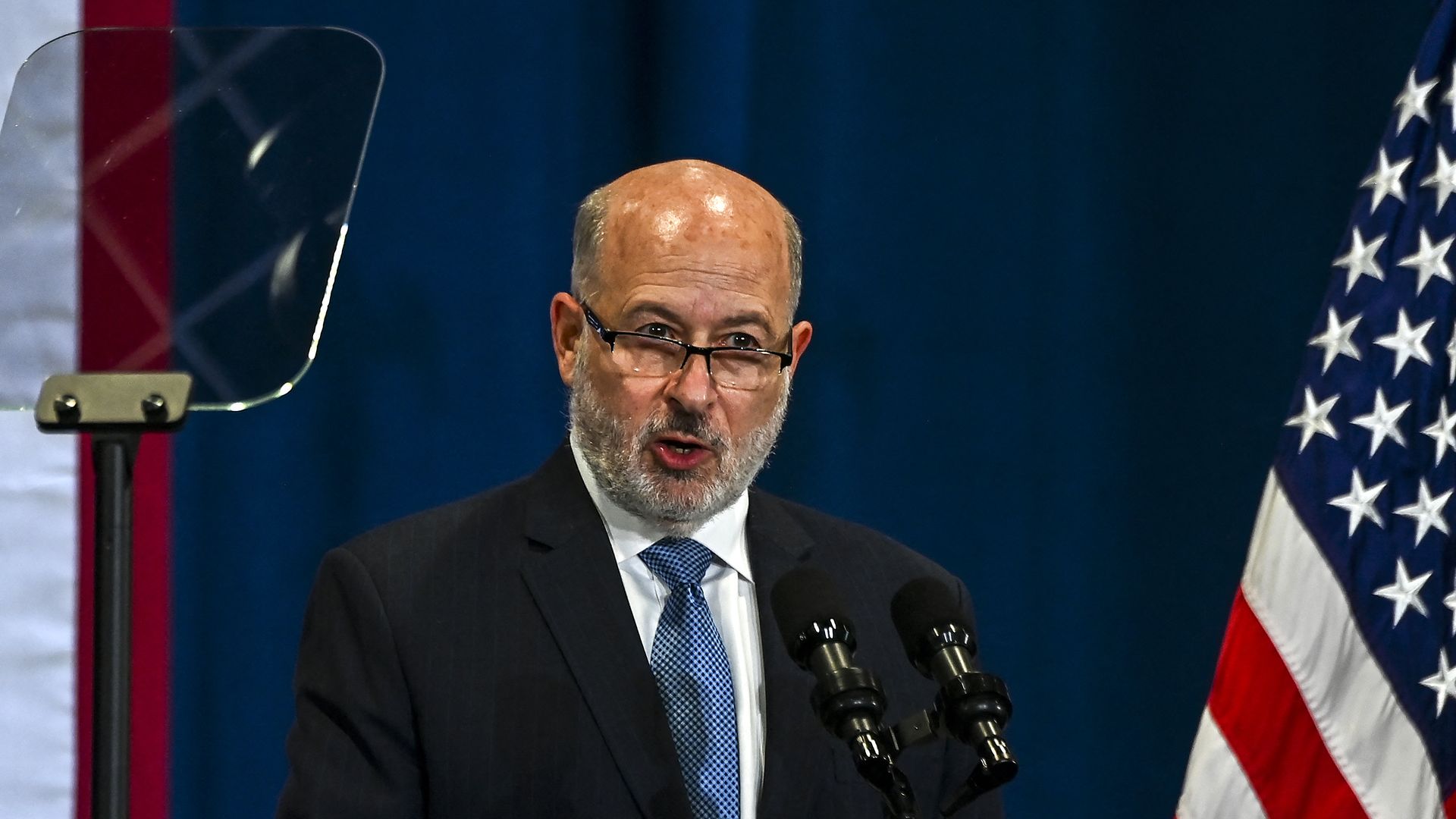
NOAA administrator Rick Spinrad is leaving the federal atmosphere and oceans agency at an uncertain, increasingly stormy time.
Why it matters: In an exit interview with Axios, Spinrad said NOAA's services — from weather forecasting to climate research and space weather warnings — have never been more important and economically valuable.
Yes, but: Project 2025, a blueprint for President-elect Trump's second term, calls for radical measures, including breaking up the 12,000-federal employee agency up and all but eliminating its climate research.
- It also calls for privatizing the National Weather Service.
- Trump hasn't endorsed those particular steps, though he has nominated numerous report contributors to his new administration.
Zoom in: Spinrad, an oceanographer by training, frames NOAA as a "national environmental intelligence agency," which provides information and products ranging from fisheries health to climate change.
- Under the Biden administration, NOAA has benefited from investments in its cloud and supercomputing facilities, boosts to coastal resilience spending and other extreme weather and climate adaptation and forecasting work.
- This positions it to provide even more accurate forecasts in the future, Spinrad said.
The intrigue: He cites the "Climate Ready Nation" initiative as one of his tenure's biggest achievements. It seeks to establish NOAA as "the primary federal authoritative provider of climate information and services" across the government.
- This program, he told Axios, demonstrates "how you can take some of the most fundamental science and translate it into getting ahead of the challenges of climate change and making lives more productive, safer, and building whole new industries."
- He said much more work is needed, however: "In some cases, we're seeing 30 times as much demand for what we can do as we have resources for."
- That demand is coming from the public, state and local agencies, and other parts of the federal government.
Zoom out: NOAA has struggled to point to its economic impacts. But Spinrad said that for a small agency, it has a big taxpayer payoff.
- "If you look at NOAA's budget, it costs every American six cents per day to get the products and services we get," he said.
- He cited hurricane intensity and tornado warnings as one such life-saving feature: "To individuals, it affects their decisions they make about what they're going to do every day, but more importantly perhaps, it's the impact that it has on everything from agriculture to energy to commerce to transportation to health."
- He also described some of NOAA's value as coming in the form of "cost avoidance," such as averting power outages and flight delays from a solar storm.
- "By any measure, the return on investment is orders of magnitude, at least 10-to-1 on all of these kinds of activities."
Asked about NOAA's uncertain future, Spinrad noted that even if it were to change or fold, the federal government would still need to carry out its functions.
2. SoCal's wildfire catastrophe: No end in sight
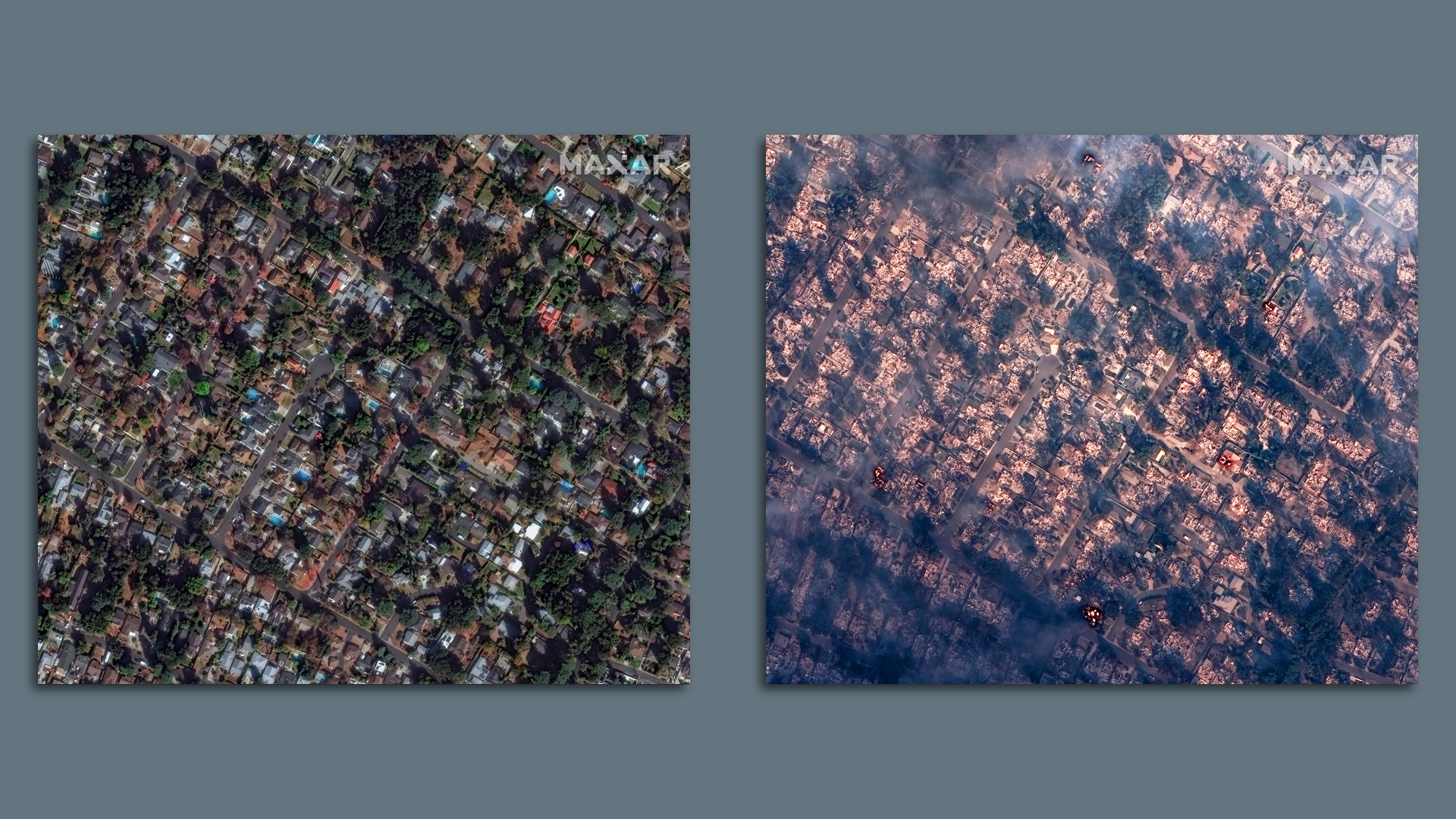
Tens of thousands of residents in Los Angeles County remain under evacuation orders as wind-whipped wildfires tear across the urban landscape.
Threat level: Winds relaxed last night but are forecast to strengthen again today, complicating firefighting efforts and raising the risks of new fire starts.
- "Critical fire weather" is forecast to continue through 6pm PT tomorrow, with winds gusting to 55 mph, per the National Weather Service.
Context: "Hydroclimate whiplash" — with wet periods immediately followed by drawn out, parched months to a year, isn't just worsening in Southern California, but globally.
- A new study published today shows it is becoming more of a trigger for wildfires, floods and drought.
- Climate scientists cite this phenomenon as a major factor in triggering this firestorm, after a wet winter last year was followed by an unusually hot summer and the second-driest period on record for downtown LA between May 6 to Dec. 31.
Go deeper: In photos: LA County Fires; LA infernos pose added health dangers
3. 🚘 Tesla's easy money from clean car credits at risk under Trump

Tesla has pocketed $11 billion from the sale of regulatory credits to rival automakers needing help to hit tough emissions targets — easy money that could dry up if President-elect Trump rolls back Biden-era regulations.
Why it matters: Tesla's billionaire CEO, Elon Musk, is spearheading Trump's effort to cut government red tape, but this is one instance in which reversing Biden's environmental policy would significantly hurt his own company's bottom line.
- 43% of Tesla's net profit through September 2024 came from selling regulatory credits to other carmakers.
Absent a change in policy, that revenue stream is likely to soar in coming years as legacy carmakers scramble to buy emissions credits from Tesla (whose electric lineup is fully compliant) as allowed under the government's clean car rules.
- With its car sales declining, however, Tesla's net profit margin would lag that of General Motors without those credit revenues propping up its performance.
The big picture: Transportation is the leading source of climate-changing CO2 emissions. Under Biden, the EPA has enacted ever-stricter limits on tailpipe emissions.
Automakers could comply by selling a mix of more efficient gas, hybrid and electric vehicles, but there's no disputing that lots more EVs are essential to hitting such targets.
- The EPA estimates that compliance would mean 56 percent of new cars sold would be electric by 2032.
The other side: Trump claims President Biden's policies are akin to an "EV mandate," and has said he'd relax EPA standards, which he also did during his first term.
Friction point: In the meantime, EV sales aren't increasing as fast as expected, which means carmakers face substantial penalties for noncompliance.
- One way to avoid such fines is to purchase tradeable "emissions credits" from companies that have exceeded the standards by selling lots of electric cars — primarily Tesla.
- As long as EPA standards keep rising and EV sales lag, demand for credits will increase, driving up the costs of compliance for most automakers — and fattening Tesla's coffers.
The bottom line: Trading emissions credits is big money, and Tesla is the clear winner, as long as Trump doesn't pull the rug out from under his first buddy.
4. La Niña is finally here, later and more muted than expected


A few months later and likely to be weaker than expected, the tropical Pacific Ocean has officially tipped into La Niña conditions, which can influence weather patterns globally, NOAA declared today.
Why it matters: La Niña winters are often drier than average across the southern tier of the U.S., with more rain and snow favored in the Pacific Northwest, among other knock-on effects.
The big picture: La Niña is a periodic ocean and atmosphere cycle in the equatorial tropical Pacific that features cooler-than-average waters along the equator.
- This, in turn, alters weather patterns over that region, with the effects rippling outward for thousands of miles.
- The La Niña this year, which follows a strong El Niño in 2023 into early 2024, is now expected to be brief and relatively weak.
- La Niña, the cooler sibling of El Niño, is forecast to persist through the February to April period and transition back into neither El Niño or La Niña conditions during the March to May timeframe, NOAA stated.
Yes, but: Throughout the spring, summer and into early fall, NOAA forecasts called for a potentially moderate La Niña to develop before the end of the Atlantic hurricane season.
- Instead, the atmosphere over the tropical Pacific resembled a La Niña weather pattern, NOAA meteorologist Michelle L'Heureux told Axios, but the ocean didn't meet the definition.
The intrigue: L'Heureux, who leads the team that forecasts such climate events, said it's possible that widespread warm water anomalies across the tropical oceans hindered La Niña's formation.
- If this is the case, La Niña events may become more muted and harder to predict as the oceans and air temperatures continue to warm.
- "It is not entirely clear why the La Niña was so late to form and I'm sure that will be a subject of future research," L'Heureux told Axios via email.
Did a friend, colleague or a LinkedIn contact you don't actually know send you this newsletter? Welcome, please sign up.
🙏 Thanks to Chris Speckhard and Chuck McCutcheon for edits to today's edition, along with the brilliant Axios Visuals team.
Sign up for Axios Generate