Axios Generate

May 02, 2024

✅ Thursday. We're sprinting toward the weekend with 1,218 words, 4.5 minutes.
🎶 This week marks 40 years since the late, legendary Tina Turner released today's perfect intro tune...
1 big thing: Asia's relentless heat wave is a warning


A punishing heat wave is affecting hundreds of millions of people from India to Japan, with monthly and all-time temperature records falling repeatedly.
Why it matters: The heat, exacerbated by human-caused climate change, is proving relentless and fatal in many areas.
- In multiple countries, extreme heat is disrupting daily life by keeping kids out of school and people out of work due to exposure risks. The impact cuts into economic growth as well.
The big picture: According to climate records tracker Maximiliano Herrera, thousands of records have fallen in recent weeks across at least half a dozen countries in Oceania and Asia. And the heat shows no signs of slowing.
By the numbers: Myanmar's national temperature record was set Monday, with a sweltering 48.2°F (118.8°F), the AP reports.
- Cambodia and Thailand have also been unusually hot, and the extreme heat has extended to India, where numerous locations have exceeded 46°C (114.8°F) for daytime highs.
- The India Meteorological Department issued a code red alert for excessive heat for Kolkata and nearby areas through today, with temperatures climbing to 46°C (114.8°F).
- In Japan, Tokyo had its hottest March day on record, and the country saw its hottest April overall.
- And in China, an observing station in Yunnan Province beat the country's all-time highest temperature record for April, with a temperature of 43.4°C (110.1°F).
What they're saying: "Because heat-related deaths are so poorly counted, especially in the Global South, we will never know how many people are dying (to say nothing of suffering and economic losses) during this extreme heat wave in Southeast Asia," climate journalist Jeff Goodell, author of "The Heat Will Kill You First," wrote on X.
Context: Studies on recent extreme heat events in East Asia have found that human-caused climate change drastically increased their likelihood and severity.
The intrigue: Other factors are also exacerbating the heat. Typically, April and May are the hottest months in Southeast Asia, but unusually warm ocean temperatures associated with El Niño have boosted air temperatures further.
What's next: The ocean warmth in the western Pacific and Indian Ocean has helped to dial up the thermostat in adjacent countries for prolonged periods.
- Barring a dramatic and rapid oceanic cooldown, a long, hot summer can be expected in this region. They may offer a preview of what's in store for other parts of the world where ocean temperatures are also sky-high, including the U.S. and Europe.
2. FTC to allow Exxon megadeal
➡️ The Federal Trade Commission won't seek to block Exxon's $60 billion deal for Pioneer Natural Resources after securing agreement that ex-Pioneer boss Scott Sheffield won't serve on the board.
- Why it matters: The merger is the biggest step in a wave of consolidation sweeping the U.S. oil patch, and Exxon's largest acquisition in 25 years.
- State of play: The FTC this morning said it took action to "resolve antitrust concerns" around the deal, and announced a consent decree with Exxon, which the company confirmed in a separate statement.
- Friction point: The regulators said they're acting to prevent "collusive activity" that could raise oil prices. They allege that in the past, Sheffield had attempted to collude with OPEC+ reps to reduce output.
- What they're saying: Exxon said it learned about the allegations from the FTC and that they're "inconsistent with how we do business," adding the FTC "raised no concerns with our business practices" in its review.
- What's next: "We will close on May 3 and look forward to implementing the integration plans we've jointly developed with Pioneer over the past six months," Exxon said.
📉 Oil prices have slumped to their lowest level since mid-March amid rising U.S. inventories and somewhat lower Middle East tensions.
- State of play: The global benchmark Brent crude regained some ground today after losing several dollars this week, currently trading around $83.
- What we're watching: The OPEC+ posture. ING analysts, in a note, predict that if oil goes below $80 for a "prolonged" stretch, OPEC+ would likely roll over voluntary output cuts into the second half of 2024.
3. The climate threat to mining
Here's a worrying feedback loop: climate change may complicate mining for minerals needed to help fight climate change.
The big picture: New PwC analysis finds 74% of global lithium and cobalt at risk from drought in 2050, with 54% of copper threatened.
- That's under a "low emissions" scenario that sees temperature rise held under 2°C compared with pre-industrial times.
- PwC's report is a wider look at heat and drought risks to food, mineral and metal commodities.
Why it matters: These minerals are heavily used in climate-friendly energy tech like EV batteries and renewable power.
- "[A] lack of water undermines water-intensive operations including ore extraction, mineral processing and dust control," the report states.
What's next: PwC urges companies to expand resilience efforts to ensure supplies of key materials, especially where production is concentrated in just a few areas.
4. Catch up quick on tech finance
🤝 Crux, a startup that helps companies use "transferable" tax credits in the 2022 climate law, has a new partnership with the largest renewables trade group.
- State of play: The agreement with the American Clean Power Association will give ACP member companies transaction fee discounts on Crux's platform.
- Why it matters: The tax credit sales market is becoming a key way for developers to access capital, in part because parties that lack tax liability can monetize the incentives by selling credits to others.
- Our thought bubble: It shows how shifting rules and norms spawn new industries, akin to the rise of carbon accounting startups to serve corporate disclosure and sustainability targets.
And two funding rounds related to extreme weather caught my eye...
💵 Arbol, which provides climate-related insurance and other financial risk management, raised a $60 million Series B round led by Giant Ventures and Opera Tech Ventures.
- Why it matters: Extreme weather worsened by climate change is creating new risks for farmers, energy companies and many more parties.
- How it works: One key Arbol focus is "parametric" insurance, which "uses predefined climate data triggers — such as rainfall amounts or temperature thresholds — to determine payouts rapidly."
🔥 AiDash, a software startup that helps utilities and others monitor assets with satellites and AI, raised a $58.5 million, oversubscribed Series C round.
- Why it matters: Wildfires and other risks require power companies to closely monitor conditions like vegetation encroachment around assets. Go deeper via Axios Pro: Climate Deals.
5. Charted: the long nuclear drought ends — for a moment
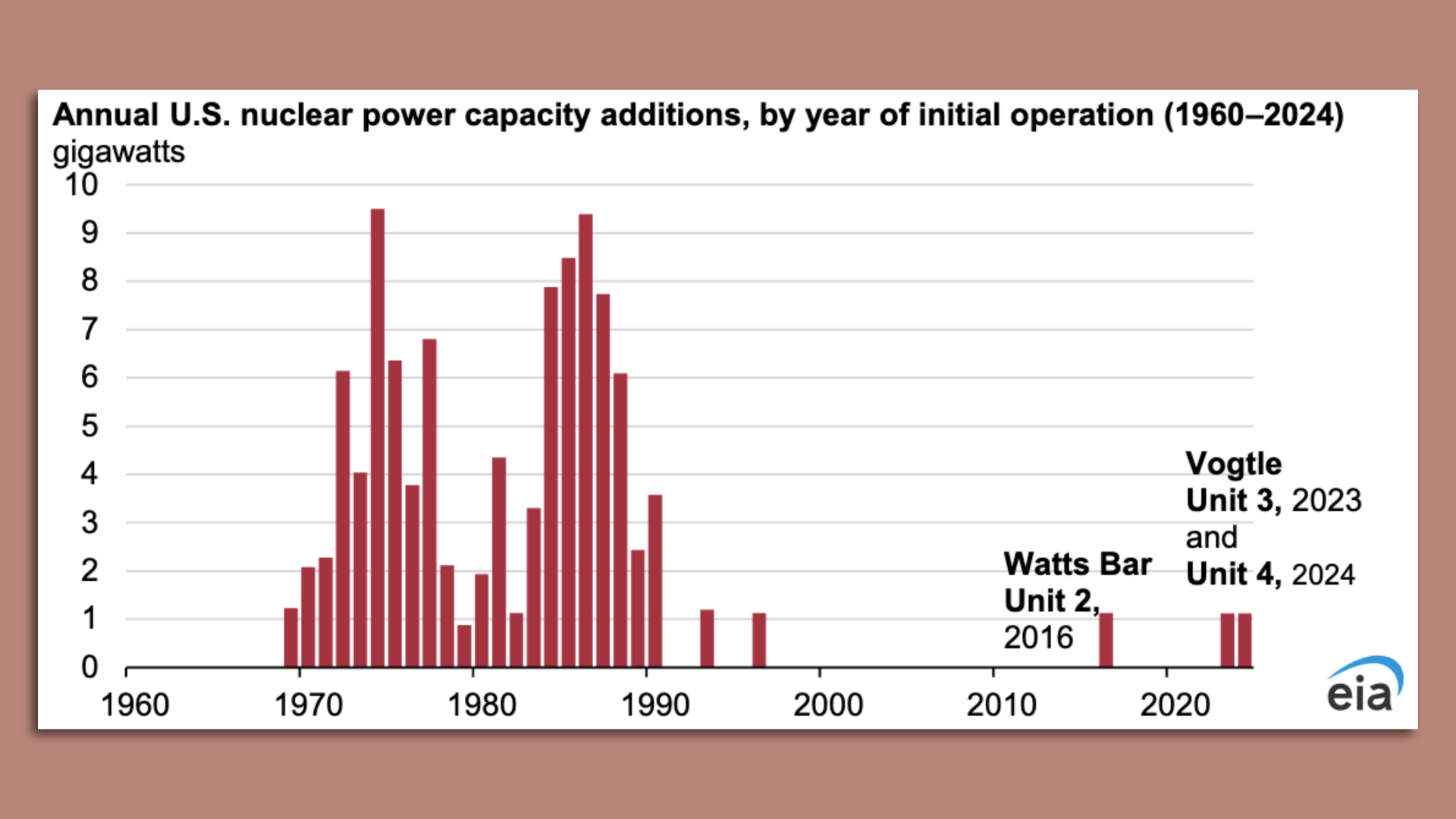
The launch of commercial operations at Georgia Power's Vogtle Unit 4 marks a 21st-century rarity: a big new reactor opening in the U.S.
Why it matters: The two new Vogtle units, well over 2 gigawatts together, are likely the last two large-scale reactors to come online for many years — at least.
- Utilities are no longer planning these kinds of massive projects, which have faced huge delays and cost overruns.
- The Vogtle project ultimately ballooned to over $30 billion, roughly twice the original estimates, the Energy Information Administration notes.
What's next: Today the action in the nuclear sector centers on approval and future deployment of small modular reactors and, longer term, fusion projects.
6. 🚗 Quoted: Tesla charging stunner
"It feels like the rug just got pulled out from under a lot of the industry alignment that has been built in the last 12 months."— Chargeway CEO Matt Teske, via E&E News, explaining how Elon Musk's big charging team layoffs will slow expansion — even as more automakers have aligned with Tesla's tech
📫 Did a friend send you this newsletter? Welcome, please sign up.
🙏 Thanks to Chris Speckhard and Javier E. David for edits to today's edition, along with the brilliant Axios Visuals team.
Sign up for Axios Generate