Axios Generate

August 27, 2024


✅ Tuesday. We've got 1,120 words, 4 minutes.
🎸 Happy birthday to Rush guitarist Alex Lifeson, whose talent animates today's intro tune...
1 big thing: Meta warms to geothermal for data center needs

Facebook parent Meta is making its first foray into geothermal energy via a new partnership with the startup Sage Geosystems.
Why it matters: Big tech is under growing scrutiny over the growth of energy-thirsty data centers.
🗞️ Driving the news: Meta and Sage plan to develop up to 150 megawatts of projects east of the Rocky Mountains, with an initial 8MW arriving in 2027.
- There's a lot TBD, and they didn't share potential costs. But Urvi Parekh, head of Meta's renewables efforts, tells me 150 megawatts is akin to a pretty large data center.
- The projects won't necessarily be co-located with data centers at first, but will nonetheless "support" their growth, the companies said yesterday.
How it works: Sage touts its ability to access geothermal resources in varied geographies.
- Sage drills wells and pumps water underground, withdraws it, and then converts the heat to electricity.
Zoom in: Sage uses tech from the oil industry, with several top executives coming from Shell and other companies.
- The method doesn't require aqueous formations nor demand extraordinary temperatures that some next-wave geothermal startups are experimenting with.
- They're seeking to access subsurface temps in the range of 300°F to 485°F.
Founded in 2020, the company is already working with the Defense Department on potential projects.
- There's also a deal with the San Miguel Electric Cooperative on a planned Texas storage project. Sage sees big potential in other industrial needs too.
- "It is industrial operations that are remote, such as mining and then data centers. So we do think this is one of the cornerstone off takers that we would like to be working with," CEO Cindy Taff tells Axios of the Meta deal
🖼️ The big picture: Data center buildouts, partly for generative AI needs, are one reason U.S. power demand is jumping after 15 or so static years.
- The Electric Power Research Institute sees data centers accounting for 4.6%-9.1% of U.S. electricity demand in 2030.
🏃 Catch up quick: It's not the first pairing of big tech and advanced geothermal. Fervo Energy has a 3MW project running in Nevada with Google.
- The companies, working with NV Energy, hope to tap 115 MW of power for Google.
The bottom line: The Sage project is a very small slice of Meta's renewables portfolio. But Meta sees more ahead.
- "We've been evaluating the technology for a really long time. We think Sage is a perfect partner for us to scale up this technology," Parekh said in an interview.
2. 🛢️ Risk roars back into focus

Oil supply risks have, for the moment, gained the upper hand in trading against weak demand signals from China and the mixed U.S. economic picture.
State of play: Prices jumped early this week as fresh geopolitical tension in Libya added to concerns about escalation between Israel and Hezbollah.
- The global benchmark Brent crude is trading at $81 this morning, up well over 6% since the middle of last week.
Catch up quick: A dispute between rival Libyan governments over the central bank has reportedly begun halting production from the OPEC member.
- The country isn't a huge producer at around 1.2 million barrels per day, but it's enough to sway the market.
- Fed chair Jerome Powell signaling a rate cut is also bullish.
What they're saying: "How significant it is for prices will depend on the duration of the stoppage. A prolonged outage will leave the market in a deeper deficit," ING analysts said in a note.
What we're watching: When and if downward pressures regain control as U.S. production keeps rising and OPEC+ prepares to start unwinding voluntary curbs in the fourth quarter.
- "Wall Street is beginning to sour on the outlook for crude next year," Bloomberg reports, citing revised price outlooks from Goldman Sachs and Morgan Stanley.
3. U.S. heat-related deaths hit a record high last year

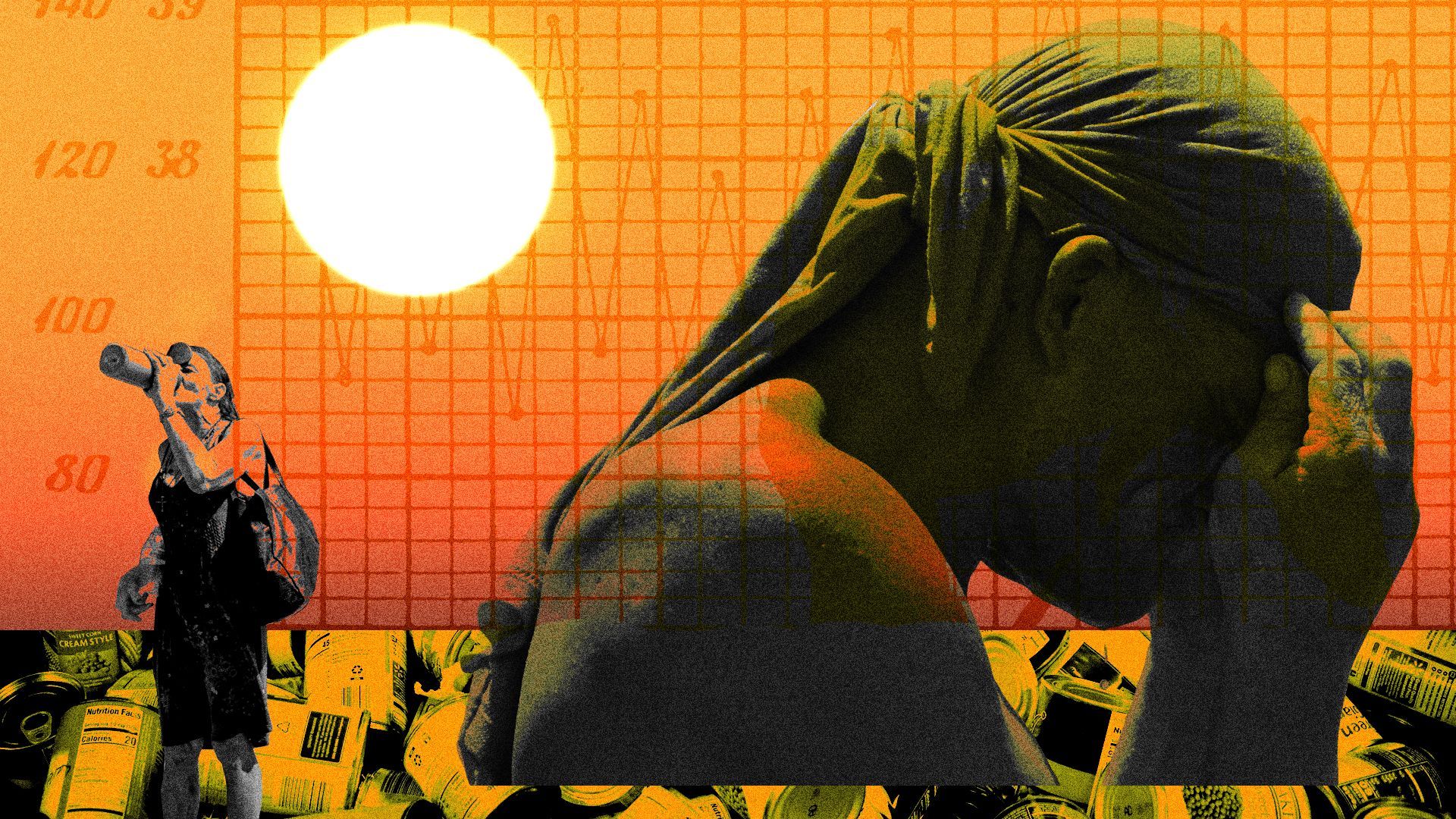
Heat-related deaths in the U.S. rose 117% between 1999 and 2023, with more than 21,500 people succumbing over that time, according to a new analysis of Centers for Disease Control data.
The big picture: There were 2,325 deaths last year, when numerous climate records were shattered and global average temperatures were the hottest seen in at least 125,000 years.
- Human-caused climate change is causing heat waves to get longer, more intense and more likely to occur.
- As global average temperatures continue to climb, planners in at-risk areas should expand access to hydration and public cooling centers and make other accommodations, researchers wrote in JAMA.
What they found: Deaths in which heat was an underlying or contributing cause varied year-to-year from 1999 to 2016 before showing steady increases over the last seven years observed.
- Last year featured record heat in the Southwest, particularly in Phoenix, which had its hottest summer on record with a staggering 54 days that reached or exceeded 110°F.
Zoom out: The study lands as some of the hottest temperatures of the summer grip portions of the Midwest, Ohio Valley and Mid-Atlantic states.
- Temperatures are slated to peak in Chicago today at about 98°F, which is about 20°F above average.
- The heat index, which factors in humidity, is forecast to hit 105°F to 115°F in parts of at least a dozen states.
Between the lines: Mortality rates may have been understated because heat's effects aren't always noted on death certificates.
4. On my screen: "Disinformation" and export risks

ℹ️ A thought-provoking piece in the outlet Jacobin argues a big chunk of the climate movement — including some academics, lawmakers, think tanks, NGOs, and journalists — are counterproductively obsessed with combating "disinformation."
- Why it matters: Social scientist Holly Buck sees several drawbacks in this focus on fossil fuel disinformation. One of them: it's used in lieu of constructively engaging with people's legit concerns with energy transition — and fuels polarization and distrust in the process, she argues.
- Threat level: "Given that funding and public attention is limited, this climate-disinformation obsession is a missed opportunity and a strategic dead-end — part of a larger liberal tendency to make disinformation a bogeyman we can blame for our major political problems," writes Buck.
🌀 The combo of growing Gulf Coast petro-exports and increasingly strong hurricanes means the industry and policymakers need to improve resilience, Atlantic Council analysts argue.
- The intrigue: Their primer covers lots of ground. Here's one part that illustrates the challenges as oil, gas, and petroleum product infrastructure grows: an "uncomfortable tradeoff" between electrifying LNG terminals and making them more resilient to powerful storms.
- Threat level: Going electric cuts CO2 emissions, but "facilities that receive power from underground gas pipelines are less vulnerable to hurricane-related disruptions than terminals that receive electricity from above ground wires."
5. 🇨🇦 Number of the day: 100%
That's the newly announced Canadian tariff on Chinese-made electric vehicles, matching levies President Biden announced months ago.
Why it matters: These penalties, and smaller new EU tariffs, show governments' concerns that low-cost Chinese EVs will undercut domestic sectors.
The NYT has more.
📨 Did a friend, colleague or even a frenemy send you this newsletter? Welcome, please sign up.
🙏 Thanks to Chris Speckhard and George Moriarty for edits to today's edition, along with the brilliant Axios Visuals team.
Sign up for Axios Generate