Axios Generate

January 02, 2024
🥞 Welcome back readers! We're racing into 2024 with a Smart Brevity count of 1,155 words, 4.5 minutes.
🎶 Exactly 10 years ago, Eminem and Rihanna were No. 1 on Billboard's Hot 100 with today's intro tune...
1 big thing: A record hot 2023 could be just the beginning
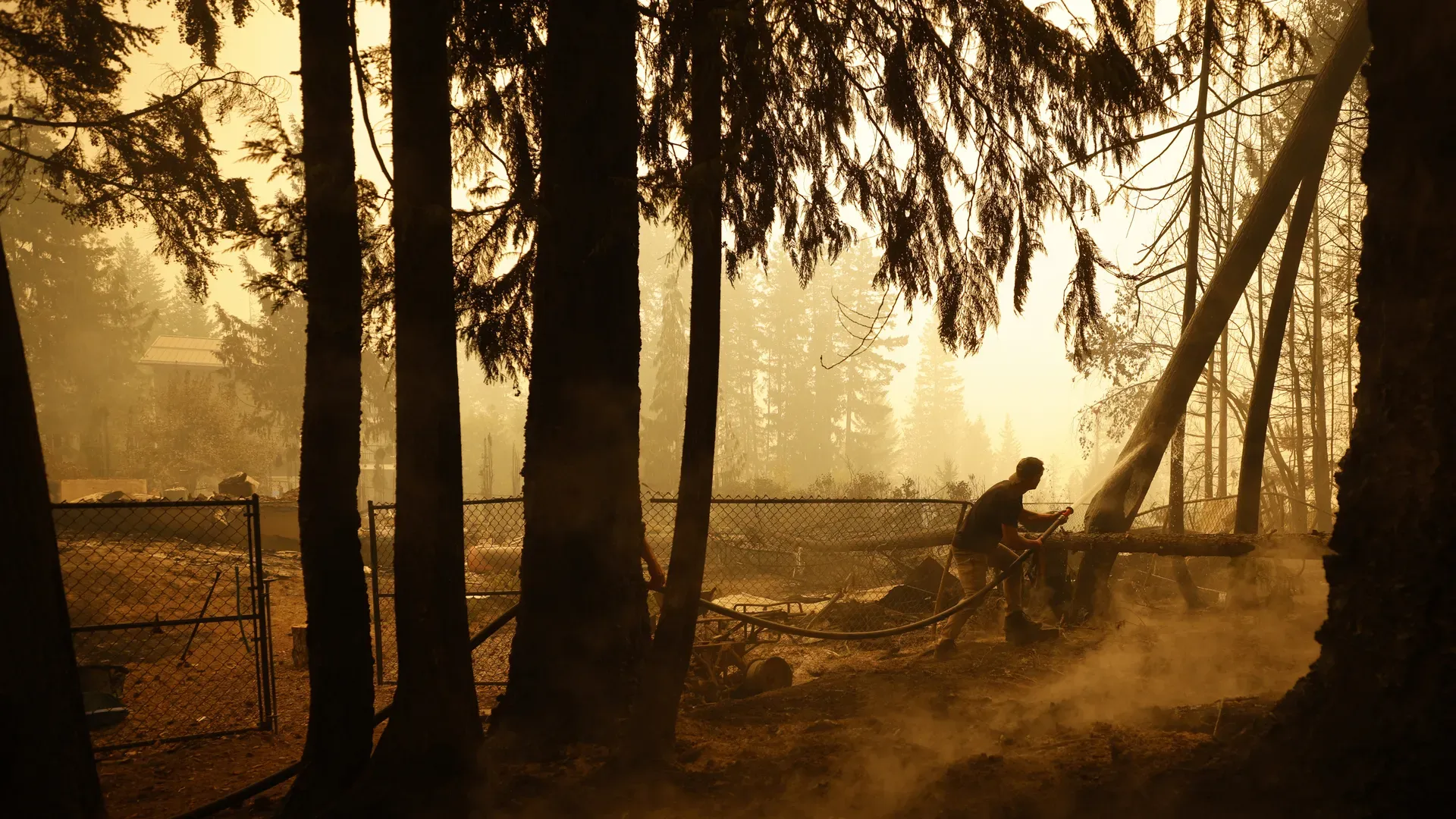
A resident sprays water on hot spots near a house during a wildfire in Celista, British Columbia, on Aug. 19, 2023. Photo: Cole Burston/Bloomberg via Getty Images
Humanity's hottest year in at least 125,000 is now over. But with further warming ahead, we may soon look back on it as an average year, Andrew writes.
The big picture: Last year's record warmth surprised some climate scientists and policymakers alike and contributed to the sense of urgency diplomats addressed during the COP28 climate summit in Dubai. (Whether the agreement they forged fully reflects that urgency is up for debate.)
Zoom in: Starting early last summer, global average surface temperatures reached record high levels. They briefly flirted with the 1.5°C target set in the Paris Agreement.
- Hundreds of millions across the globe felt the growing impact of human-caused warming, including unprecedented early-season conflagrations in British Columbia that forced tens of thousands to flee, to flooding in Kenya that displaced millions.
By the numbers: The Earth's climate entered discomforting territory during 2023, with every month from June through December setting heat records.
- The margin by which the records were set have themselves set milestones, indicating that a sizzling year didn't just eke out its status but blew away the competition.
Between the lines: Scientists may be studying the climate of 2023 for quite some time.
- The record-breaking warmth was in part encouraged by the one-two punch of long-term warming from burning fossil fuels and a historically strong El Niño event, which temporarily boosted global average temperatures even higher than they otherwise would have been.
Yes, but: A vocal minority think 2023's temperature bounce isn't a fluke at all, but rather a quickening of the planet's thermostat that will become increasingly obvious in the next few years.
What's next: International scientific agencies will release more data during the next two weeks, but the end result of where 2023 ranks is already baked in.
2. Tesla likely to lose throne as top EV seller — for now

Illustration: Sarah Grillo/Axios
China's BYD tallied well over 526,000 fully electric vehicle sales last quarter, Ben writes.
Why it matters: Tesla would need to blow way analyst expectations to maintain its spot as the world's top seller, per Bloomberg and the FT.
- The company will report Q4 production and deliveries as soon as today. WedBush Securities estimates a tally over 480,000 deliveries.
Yes, but: It's more a story of BYD's rise than Tesla's struggles, with Elon Musk's company also expected to post record deliveries.
- WedBush analysts say 2024 could bring 25%-30% year-over-year Tesla sales growth.
- And multiple legacy automakers are seeing challenges in their EV businesses.
What they're saying: "We expect to see Tesla competitors significantly pull back on EV investments…ceding higher levels of market share to Tesla, particularly outside of China, in the years ahead," Morgan Stanley's Adam Jonas said in a note last week.
3. 🏃🏽♀️Catch up fast on policy: Hydrogen, EVs, carbon sequestration

Here's a quick rundown of big stuff since our last edition — and a look at what's next, Ben writes.
🧭 Biden officials unveiled long-awaited, heavily lobbied draft rules spelling out what's needed for hydrogen producers to tap lucrative climate law tax credits.
- Why it matters: Hydrogen is climate-friendly but requires lots of power to make.
- Driving the news: Companies must rely on (relatively) newly developed "clean" energy sources that are also in the same region. Starting in 2028, production must be matched with clean energy on an hourly basis.
- What they're saying: "The agencies appear to have prioritized emissions reduction virtue over production volume," ClearView Energy Partners said in a note.
- What we're watching: Whether the draft rules — which drew pushback from parts of the hydrogen sector — loosen once finalized. Axios' Jael Holzman has more.
📉 Via Reuters, "Many electric vehicles lost eligibility for tax credits of up to $7,500 after new battery sourcing rules took effect on Monday, including the Nissan Leaf, Tesla Cybertruck All-Wheel Drive, some Tesla Model 3s and Chevrolet Blazer EV, the U.S. Treasury said."
➡️ EPA gave Louisiana regulators the green light to permit underground wells for storing carbon dioxide.
- Why it matters: It could speed up pending and future projects in a state that oil companies and others see as a key region for CO2 storage.
- What they're saying: Permitting is currently a "major bottleneck to the fast and cost-effective development of projects," the Bipartisan Policy Center's Sasha Mackler said in a statement applauding the move.
🧊 The Energy Department issued final efficiency regulations for new residential refrigerators and freezers that officials said would save consumers $36.4 billion over 30 years. They start taking effect in five years.
4. Charted: Drillers open wallets for Gulf tracts


Another noteworthy development over the holiday break: The Interior Department's Dec. 20 auction of Gulf of Mexico drilling leases drew $382 million in high bids — the largest total in eight years, Ben writes.
Why it matters: Analysts said producers were eager to snap up acreage because it's the last sale until at least 2025.
- Biden officials, over industry objections, are greatly scaling back offshore offerings.
State of play: Hess Corp. (which Chevron is acquiring), Occidental-owned Anadarko, Shell, Chevron and Woodside Energy were the top five bidders.
- It outpaced sales in recent years. But it's nowhere near the multibillion dollar auctions before shale took flight.
The bottom line: The Gulf is still a prime region.
- But "higher costs and a tough regulatory environment will create barriers to entry in addition to the long time between bids and first oil production," Capital Alpha Partners said in a note.
5. Three energy finance things: scrapped merger, transmission, solar

Illustration: Aïda Amer/Axios
🛑 Breaking Tuesday: Avangrid, a unit of Spain-based renewables giant Iberdrola, is abandoning its multibillion dollar plan to buy the big New Mexico-based power company PNM Resources, Ben writes.
- Driving the news: Avangrid, in a statement, said there's no clear timeline for court review of New Mexico regulators' rejection of the deal or "any subsequent regulatory actions."
- Why it matters: The FT reports the deal's demise will "force a rethink of Iberdrola's plans in the US, where the transaction would have made Avangrid the third-biggest renewable energy company in the country."
⚡ Pattern Energy Group, developer of the major SunZia transmission and wind projects, said last week it closed $11 billion in financing and has begun construction.
- Why it matters: The long-planned developments are together "the largest clean energy infrastructure project in U.S. history," the company states.
- Catch up fast: The SunZia line is a 550-mile project that will run from central New Mexico and south-central Arizona.
☀️ U.S.-based First Solar has deals to sell up to $700 million of clean energy manufacturing tax credits under the 2022 climate law.
- Why it matters: It shows how companies are using flexibilities built into the "advanced manufacturing" subsidies in the Inflation Reduction Act.
- State of play: First Solar said the deal to quickly monetize the incentives is "believed to be the first significant credit transfer of its kind in the solar manufacturing industry."
- Catch up fast: The Dec. 27 announcement came shortly after Treasury issued guidelines for implementing the so-called 45x provisions.
6. 🛢️Quote of the day
"A select few companies will determine whether (production) growth will be strong, more stable or somewhere in between."— Wood Mackenzie analyst Ryan Duman, via Reuters, on the big wave of U.S. oil patch mergers.
📬 Did a friend send you this newsletter? Welcome, please sign up.
🙏 Thanks to Chris Speckhard and Javier E. David for edits to today's edition, along with the talented Axios Visuals team.
Sign up for Axios Generate

Untangle the energy industry’s biggest news stories


