Axios Generate

March 14, 2025

๐ธ Friday. We're still taking the pulse at CERAWeek by S&P Global. Today's readout from the conference and beyond is 1,311 words, 5 minutes.
๐ This will be awesome: Axios' auto reporting wizard Joann Muller launches her Future of Mobility newsletter on March 19. Sign up.
๐ท Today we salute the late, legendary Texas sax player Bobby Keys, whose indelible notes propel Rolling Stones classics including today's intro tuneโฆ
1 big thing: Reporter's notebook from the big energy event
HOUSTON โ I'll be heading home from CERAWeek by S&P Global when this newsletter arrives, so behold some final reporting nuggets from the huge gathering.
๐ There's renewed interest in Alaskan gas. White House support for a pipeline and LNG project to supply Asian markets juiced behind-the-scenes activity here. And don't forget that President Trump pairs encouragement to buy U.S. energy with threats of tariffs.
- State of play: Alaska Gov. Mike Dunleavy (R) told me he's had "many, many" meetings with gas buyers and investors. "Hopefully we've got some agreements that hopefully will be announced in the ... near future," he said yesterday. Dunleavy cited Trump 2.0 support, Asian energy needs, and more as reasons for optimism.
- Reality check: It's still a very heavy lift. Alaska gas line plans have rattled around since the 1970s. The current, $44 billion pipeline-to-LNG proposal is over a decade old, and Gulf Coast exporters already have supply access and infrastructure.
๐ข๏ธTrump can't trump the fundamentals. Yes, the oil industry warmly welcomed Trump's energy team. But "drill, baby, drill" is another story.
- Friction point: While execs support most of his agenda, it's not bringing new pledges to greatly expand U.S. oil output, which is already at record levels. Instead, modest oil demand growth, ample supply, and angst about tariffs' economic drag and supply chain cost effects all spell continued restraint.
- Catch up quick: That was punctuated yesterday when IEA further trimmed its global oil demand estimates. Macroeconomic conditions underpinning their projections "deteriorated over the past month as trade tensions escalated" between the U.S. and other nations, their latest monthly outlook said.
๐ Data centers took center stage. It's the subject or a big part of roughly 50 (!) sessions, far above last year's CERAWeek.
- The big picture: AI isn't the only thing driving power demand growth in the U.S. and abroad, and that upward trend is one reason for the exuberance around natural gas here.
- Driving the news: FERC Chairman Mark Christie said onstage yesterday that AI-driven data center growth underscores the need for more gas plants โ and not just for demand peaks.
- Zoom out: "We're seeing load forecasts that, in my experience as a state regulator, are mind-boggling," said Christie, a former state official in Virginia, a data center hotbed.
๐ Hydrogen got less love. Discussion has been muted, though hardly absent.
- What they're saying: "A lot of people want to make green hydrogen, but not many people want to buy it because it's pretty expensive. And so every time we realize how hard something is, we start talking about the next thing," said Jason Bordoff, founding director of Columbia's Center on Global Energy Policy, at an Axios-hosted event Wednesday.
The bottom line: It was an informative week! And check out the rest of our newsletters from the event.
2. โ๏ธ Nuke startup X-energy plans tech deals beyond Amazon
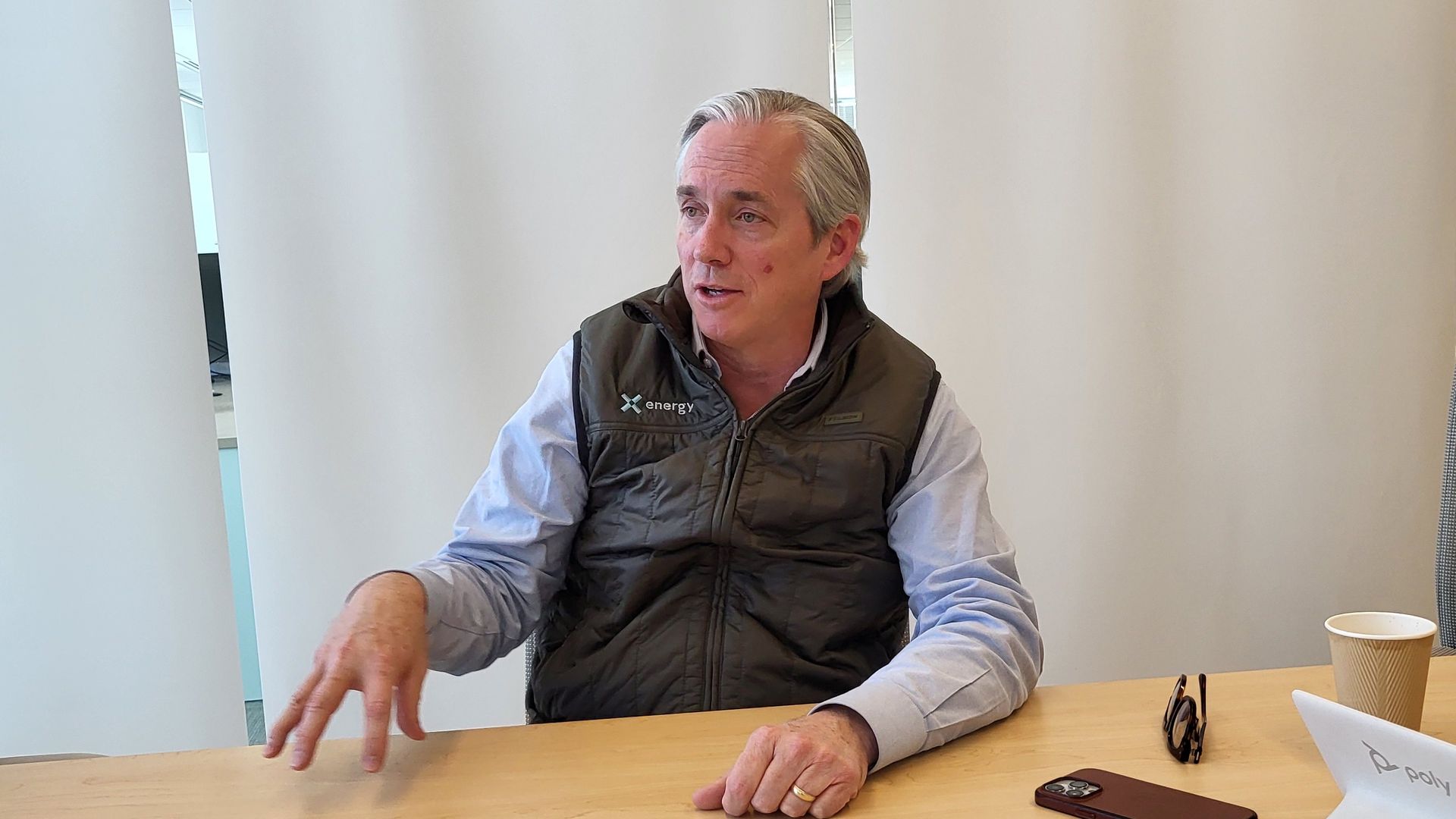
HOUSTON โ The small modular reactor startup X-energy's work with Amazon to deploy the technology won't be its only tie-up with a major tech player, CEO Clay Sell said.
- "There's more to come," he said in an interview yesterday on CERAWeek's sidelines.
Why it matters: Sell's confidence signals how interest in long-term data center power is creating markets for SMRs, which many tech giants have aspirations to eventually deploy.
State of play: He also described X-energy's policy goals. One is help from the Energy Department loan office for power customers looking to harness SMRs.
- Another is ensuring IRA nuclear tax credits continue as Congress weighs the 2022 law's fate, and get extended.
"The nuclear policies have historically always been an area of great bipartisan consensus, so we're hopeful that those will continue," Sell said.
- "If they didn't continue, that would certainly force all of our customers to reassess their calculus, and I think it would be very detrimental to our customer backlog," he said.
Catch up quick: X-energy already takes part in the DOE-financed Advanced Reactor Demonstration Program.
- The Trump team hasn't filled in many details about which programs it wants to maintain as Energy Secretary Chris Wright settles into the job.
- But ARDP was created under Trump 1.0. More broadly, Wright really likes nuclear.
The bottom line: It's a long, uncertain road to deployment of SMRs, which is years off. But Sell said SMRs can fill a clear need.
- "It starts with a recognition of, how much demand is there for clean from 24/7, pollution-free, reliable power?" he said.
- "And whatever you thought that demand was three years ago, there's evidence that it's substantially more than that now."
3. ๐ NOAA suspends monthly climate press calls, renames products

NOAA's new terminology for its climate reports suggests a possible reframing of these products to appeal to politically appointed staff at the agency and its parent, the Department of Commerce.
Why it matters: Less than two months into office, President Trump has shown a determination to comprehensively roll back many U.S. activities to address climate change.
- But NOAA is the top weather and climate agency in the U.S. and among the foremost worldwide.
Driving the news: As it suspended monthly press calls featuring agency scientists detailing global climate conditions, the agency said it would continue to publish climate data.
- "NOAA's National Centers for Environmental Information will continue to publish articles each month with data and analyses of U.S. and global temperatures and precipitation, according to its previously published schedule," the agency said in a statement.
- Until recently, these reports were referred to as U.S. and global climate reports, not "U.S. and global temperatures and precipitation."
Zoom in: While the global climate data is still being provided publicly, a reduction in press coverage could reduce public awareness of climate change trends and NOAA research.
Context: The monthly U.S. and global climate calls typically feature climate scientists from NOAA's National Centers for Environmental Information (NCEI) in Asheville, N.C.
- They have been held each month for years, including during the first Trump administration and George W. Bush administration, both of which sought to edit climate science reports.
- According to two sources outside the agency who were privy to deliberations from current employees, NCEI had trouble recruiting scientists to volunteer to be on the calls for fear of angering the administration by discussing human-caused global warming.
What they're saying: NOAA blamed the call suspension on a lack of staffing in the wake of cuts and in preparation for further layoffs.
4. ๐Catch up quick: Renewables and LNG
โ๏ธ U.S. solar and wind power generation overtook coal last year for the first time, per new data from the climate think tank Ember.
- The big picture: Those renewables provided 17% of U.S. electricity, while coal's share continued to decline, dropping to 15%.
๐ Via Reuters, "The board of the U.S. Export-Import Bank approved a nearly $5 billion loan for a long-delayed LNG project in Mozambique, clearing a key hurdle to restarting the project under development by French oil major TotalEnergies."
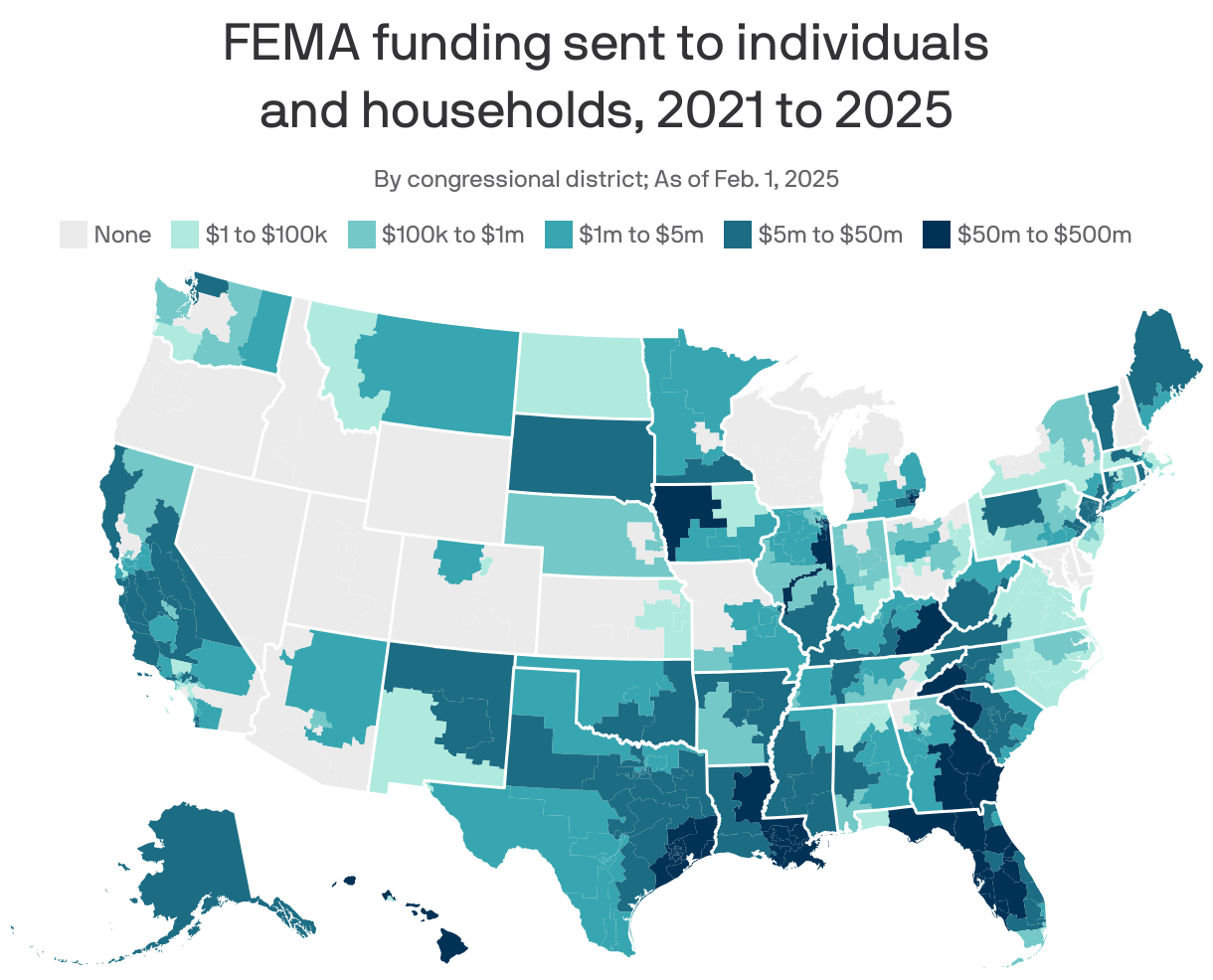
5. โ๏ธ Charted: Who would suffer without FEMA

Some of the most disaster-prone states could face the greatest financial burdens in a world with less federal relief assistance, a new analysis finds.
Why it matters: President Trump earlier this year floated "fundamentally overhauling or reforming" FEMA, or "maybe getting rid" of it entirely โ fueling concerns that U.S. disaster relief could be thrown into chaos just a few months before another hurricane season spins up.
Threat level: Certain states โ many of them red โ would be hit especially hard by reductions in federal relief funding, per analysis from the Carnegie Disaster Dollar Database.
- Louisiana, for example, received an average of about $1.4 billion annually in FEMA and HUD relief funding from 2015 to 2024, covering 14 disasters.
- That's equal to 6.3% of the state's approximately $21.9 billion in overall spending in fiscal 2023.
6. ๐งฎ Number of the day: $13 billion
That's how much Copenhagen Infrastructure Partners raised for its fifth fund, the big renewables investor and developer said this morning.
What's next: Fund V is staking large-scale new solar, wind and storage in "low-risk OECD countries."
- It made six final investment decisions, committing 60% of the fund, it said.
๐ง Did a friend, colleague or an AI chatbot send you this newsletter? Welcome, please sign up.
๐ Thanks to Chris Speckhard and Chuck McCutcheon for edits to today's edition, along with the brilliant Axios Visuals team.
Sign up for Axios Generate


/2025/03/14/1741913624256.gif?w=3840)