Axios Generate

October 20, 2022
🍩 It's almost Friday. Today's newsletter has a Smart Brevity count of 1,263 words, 5 minutes.Â
📬 Did a friend send you this newsletter? Welcome, please sign up.
🎶 A source of Ben's with excellent taste introduced him to Australian punk rockers The Chats, who have today's mouth-watering intro tune...
1 big thing: New ocean tech fund makes waves

Illustration: Lindsey Bailey/Axios
Propeller, a fund that invests in companies tackling climate change via ocean solutions, unveiled its first $100 million venture fund this morning, Andrew writes.
Why it matters: This is the first major blue economy venture fund, and it could help catalyze other players in the climate tech world to look to the sea for new opportunities.
- Blue climate solutions refer to utilizing ocean ecosystems to reduce the severity of climate change and its impacts.
The big picture: The new fund, led by Brian Halligan, co-founder and executive chairperson of HubSpot, will have a multiyear partnership with the prominent Woods Hole Oceanographic Institution in Massachusetts.
- Ocean research and innovation have mainly been funded by the government and philanthropic donors. These include prominent names in the tech world, including the Schmidt Ocean Institute and Salesforce's Marc Benioff.
Context: The oceans cover more than 70% of the planet, and have absorbed about 40% of the human-generated CO2 put into the atmosphere. They also take in more than 90% of the excess heat from greenhouse gases.
- Climate change threatens ocean health, with marine heat waves damaging tropical coral reefs and ocean acidification posing a danger to shellfish.
Zoom in: The Woods Hole partnership involves undisclosed multiyear funding as well as access to emerging research, intellectual property and advanced types of machinery such as the group’s ships and robotic submersibles.
- According to Peter de Menocal, president and director of Woods Hole, the Propeller partnership will provide the organization with “risk capital” to support scientists’ biggest ideas.
- One likely focus: enhancing the ocean’s ability to take up extra carbon.
- De Menocal said it is important to be able to measure and verify any additional oceanic carbon uptake and to know more about how ecosystems will respond.
Between the lines: Halligan envisions growing ocean-climate startups into unicorns — the tech-world term for companies with a billion-dollar valuation. But the ocean-focused investor calls them "narwhals."
- According to Halligan and Julie Pullen, chief scientist and partner at Propeller, companies that may be ripe for investment include those in the ocean carbon space, including ventures that are trying to solve carbon reduction measurement and verification.
- The fund also aims to invest in ocean organics, which seek to use microbes for energy sources and other applications.
What’s next: “I think we're going to have a wave of capital and a wave of talent moving into the industry over the next couple of years,” Halligan told Axios.
2. A new push for climate disaster PTO

Illustration: Natalie Peeples/Axios
In late 2017, a handful of U.S. tech companies started giving their employees paid time off to respond to climate disasters. Not long after, the emerging trend fizzled out before it really began, Axios' Ayurella Horn-Muller reports.
Why it matters: As Florida recovers from Hurricane Ian, and climate change threatens more rapidly strengthening storms like it, a few grassroots organizations are working to bring back that momentum.
What they're saying: Denise Diaz, co-director of Central Florida Jobs with Justice, told Axios that a coalition is putting pressure on Florida state legislators to enact workforce protections for extreme weather events in the wake of Ian.
- "We saw with this hurricane that workers were not given adequate time to prepare for this storm, or time off in order to be able to collect supplies and really be able to weather the storm," Diaz told Axios.
What we're watching: Last month, Rep. Cori Bush (D-Mo.) introduced the Worker Safety in Climate Disasters Act, which would require employers to offer employees two weeks of PTO in case of an extreme weather event.
The other side: "The only people this bill helps are the armies of trial lawyers who are waiting to file lawsuits against job creators,” Virginia Foxx (R-NC), education and labor committee Republican leader, told Axios in a written statement.
3. Inside the Saudi's pressure campaign
Illustration: Shoshana Gordon/Axios
Saudi Arabia privately pressed several Arab countries to issue statements supporting the recent OPEC+ decision to cut oil production, according to a former U.S. official and an Arab official, Axios' Barak Ravid reports.
Why it matters: The goal of the Saudi push was likely to avoid being isolated by the U.S. and show that the decision, which angered the Biden administration, was a collective decision by all Arab nations in OPEC+.
The big picture: The Biden administration blames Saudi Arabia for the move, which the U.S. claims will strengthen Russia.
- Saudi officials claim the U.S. anger has nothing to do with Russia but stems from domestic political concerns about gas prices ahead of the midterm elections.
Behind the scenes: Saudi officials in recent days approached Arab countries that are OPEC+ members and several Arab countries that are not, and asked for public statements of support.
An official from one of the countries said the pressure was on a very high level and the Saudis pressed very hard.
4. Battery materials cash flies from multiple angles
Illustration: AĂŻda Amer/Axios
There's more and more public and private money flowing into development of a U.S. battery supply chain and yesterday brought fresh evidence, Ben writes.
Driving the news: The Energy Department announced $2.8 billion in funding under the bipartisan infrastructure law for 20 manufacturing and processing companies.
Why it matters: It's part of wider efforts to speed development of the supply chain to meet automakers growing needs, and compete in the geopolitical race for what's becoming a huge market.
🔍 Zoom in: The projects span 12 states and several links in the chain, such as cathode material manufacturing, lithium and nickel processing, and more.
- They're also meant to support the market for domestic mining projects.
- Recipients include Albemarle U.S., Talon Nickel, Sila Nanotechnologies. DOE has project-by-project summaries and the AP has detailed coverage.
Driving the news, part 2: BMW announced $1.7 billion worth of new investments.
There's $1 billion to prepare its South Carolina plant to build EVs and $700 million for a new battery assembly plant in the state. Read more.
5. Tesla boss disputes demand headwinds
Illustration: Sarah Grillo/Axios
Tesla's stock fell after it narrowly missed Q3 revenue expectations yesterday, even as CEO Elon Musk last night shrugged off concerns about demand for his electric cars, Ben writes.
Driving the news: The world's largest seller of fully electric cars reported $3.3 billion in profit and $21.45 billion in quarterly revenue.
The big picture: "I can't emphasize enough, we have excellent demand for Q4, and we expect to sell every car that we make for as far in the future as we can see," Musk told analysts last evening.
But he said Tesla may fall slightly short of its target to boost 2022 deliveries by 50%.
Other takeaways...
đźšš Tesla expects to build 50,000 of its delayed long-haul semi truck next year after launching deliveries of the first model to PepsiCo this December.
🔋 Bloomberg spotted some other news, noting Musk confirmed plans to build a lithium refinery on the Texas Gulf Coast "in a bid to gain more control" over the battery supply chain.
6. Charted: Emissions growth slows

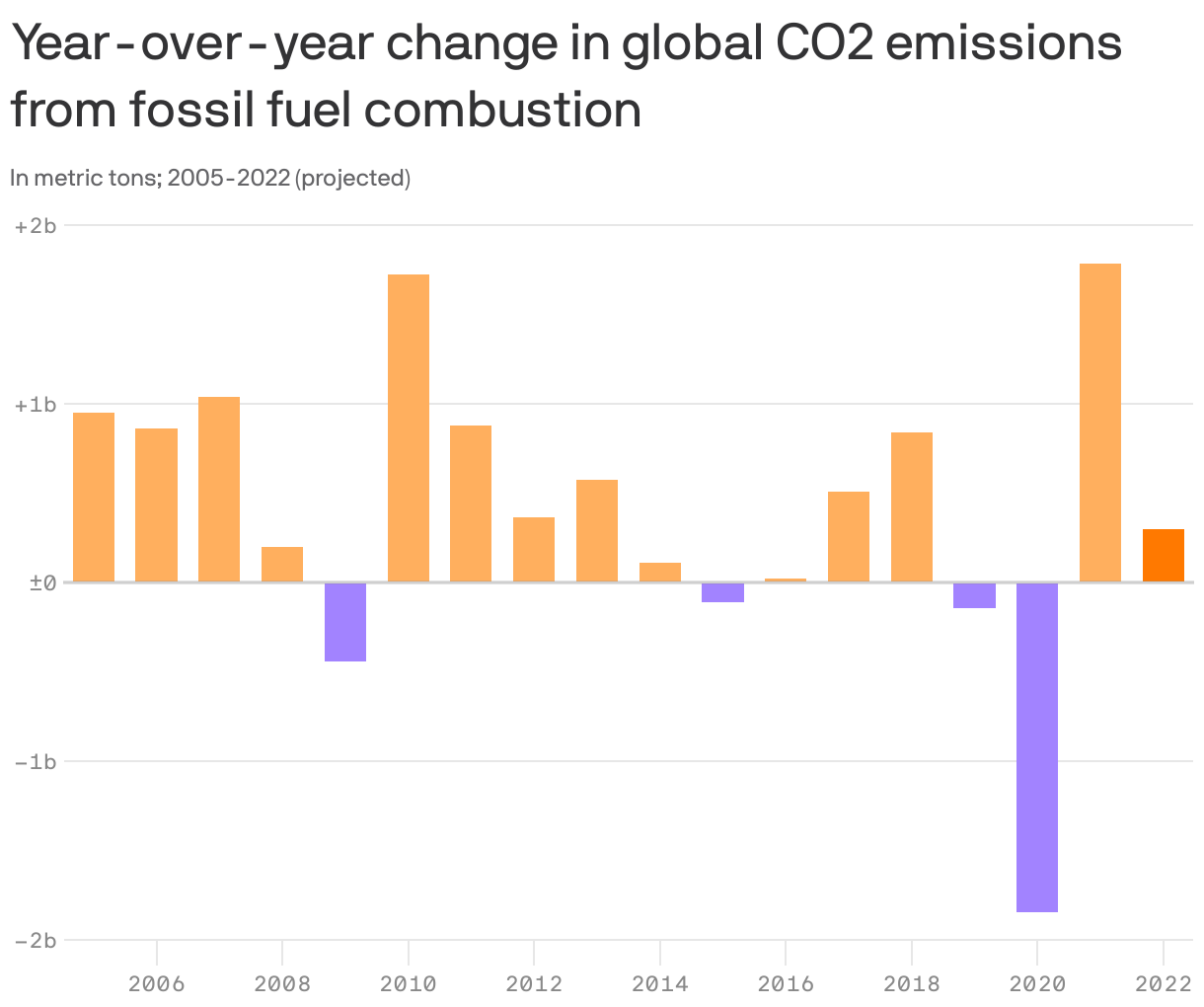
News that IEA sees carbon emissions growth slowing way down this year broke shortly before we hit send yesterday, so here are some graphics and context to paint a fuller picture, Ben writes.
Zoom in: Emissions jumped in 2021 amid the rebound from COVID, and to some degree that continues.
- "This year’s increase is driven by power generation and by the aviation sector, as air travel rebounds from pandemic lows," IEA found.
- But renewables growth is more than compensating for movement from gas to coal prompted by Russia's war on Ukraine, which has caused gas prices to rise sharply. The coal uptick appears "relatively small and temporary."
Yes, but: While IEA credits renewables for holding down emissions increases, another factor is Russia's war dampening economic growth.
🙏Thanks to Mickey Meece and David Nather for edits to today's newsletter. We'll see you back here tomorrow!
Sign up for Axios Generate

Untangle the energy industry’s biggest news stories