
Axios Generate

January 10, 2025

🌅 Good morning all. Today is a day of temperature reports with a particularly foreboding message.
- The stats come in the context of the devastation in LA County, where more Santa Ana winds are forecast into next week.
- Today we cover that and more in a swift 1,360 words, 5 minutes.
🎙️Today's intro tune pick comes from Andrew, via The National's NPR Tiny Desk Concert... "This Is the Last Time." (BONUS: Reply to the newsletter to find out what Andrew thought their song "Don't Swallow the Cap" said.)
1 big thing: 📈 2024 was Earth's hottest year, vaulting past Paris' 1.5°C threshold
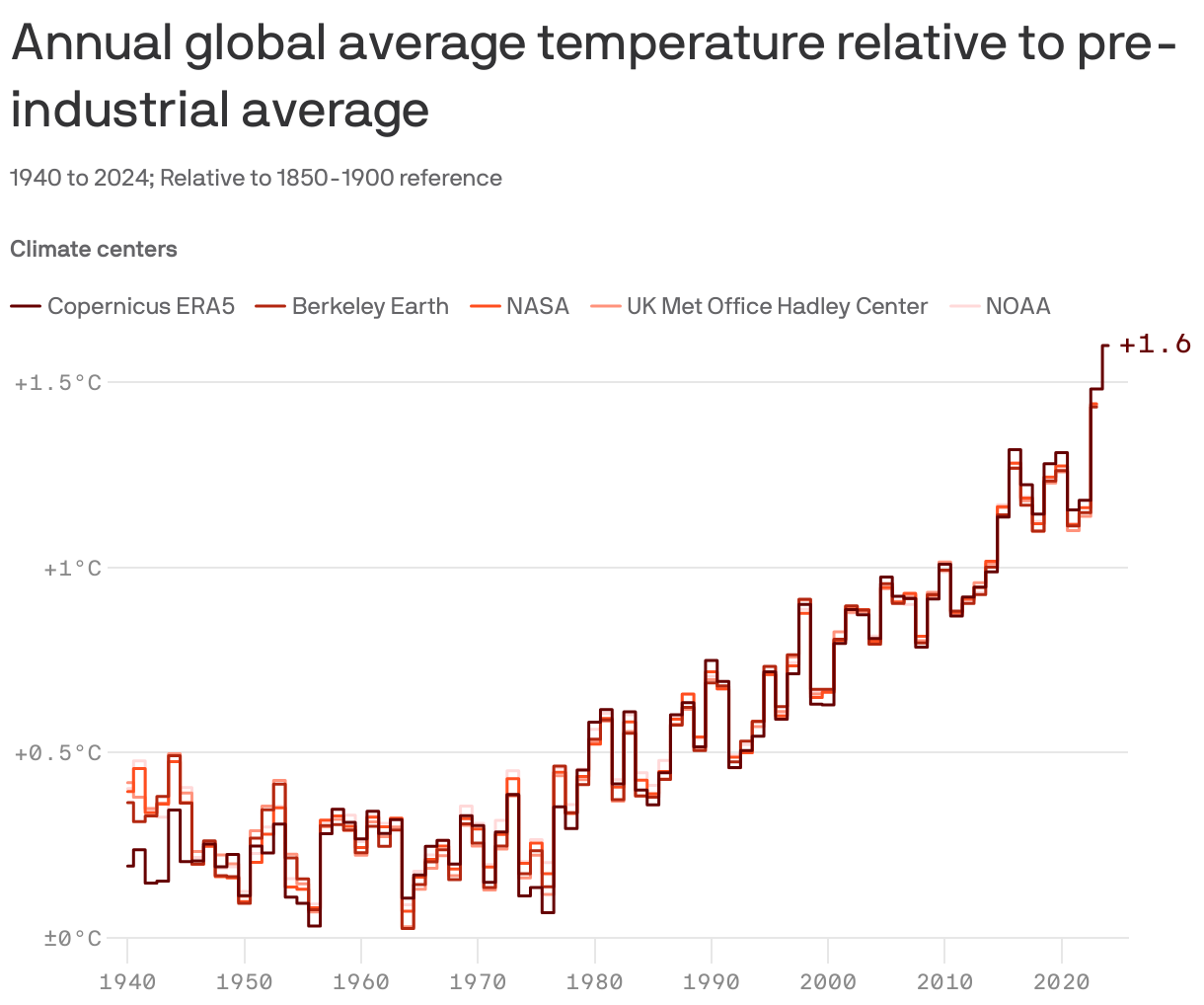
Last year was Earth's hottest on record, eclipsing 2023's record and for the first time exceeding the Paris target of 1.5°C above pre-industrial levels, the Copernicus Climate Change Service announced.
Why it matters: While climate scientists don't put too much stock into an individual year's record, the long-term trend is toward more rapid warming, and it is not entirely clear why 2024 was so hot and what it portends.
Zoom in: Last year was the hottest seen in instrument record-keeping but also much longer before that.
- In fact, as with 2023, the year was very likely the hottest in at least 125,000 years.
- Some daily global average temperatures, as measured using increasingly precise computer model data, exceeded 2°C above preindustrial levels — flirting with another temperature target in the Paris climate agreement.
According to Copernicus, an agency of the European Commission, each year in the last decade has been one of the 10 hottest on record.
- Data from U.S. centers, such as NOAA and NASA, show similar results. (Their final 2024 data comes out today.)
- Global average surface temperatures in 2024 were about 1.6°C above pre-industrial levels, Copernicus found, and about 0.12°C (.22°F) above 2023's record high.
Yes, but: The Paris Agreement's most stringent temperature target of holding warming to 1.5°C compared with pre-industrial levels refers to a long-term, 20-to-30-year average, rather than a single year or two.
- Still, 2024 shows the world is already exceeding the barrier that diplomats set at the Paris climate summit in 2015, and in fact the average of 2023 and 2024 falls above the 1.5°C threshold, Copernicus said.
- Studies show that if warming exceeds 1.5°C relative to preindustrial levels, the odds of potentially catastrophic impacts, such as the shutting of key ocean currents and melting of Arctic and Antarctic ice sheets, would increase considerably.
- Regarding exceeding the 1.5°C marker, Copernicus' news release stated: "Global temperatures are rising beyond what modern humans have ever experienced."
What they're saying: "Humanity is in charge of its own destiny but how we respond to the climate challenge should be based on evidence," Carlo Buontempo, the Copernicus Climate Change Service's director, said in a statement.
- "The future is in our hands — swift and decisive action can still alter the trajectory of our future climate."
Between the lines: One of the most impactful records seen during 2024 was unusually high amounts of water vapor in the atmosphere, at about 5% above the 1991-2020 average, beating previous highs.
- Extreme heat and high humidity is a deadly combination, and record large swaths of the globe saw "strong" to "extreme" heat stress, per Copernicus' data.
One hopeful thing: "The science is clear: every fraction of a degree of warming we prevent reduces suffering and saves lives," said Katharine Hayhoe, chief scientist at The Nature Conservancy, in a statement.
- "We already have the technology, the knowledge, and the ability to transition to a clean energy future, cut emissions, and build resilient communities."
What's next: New numbers from NASA, NOAA and Berkeley Earth, out today at 11 a.m. ET.
2. 🌊 Ocean heat content, a powerful metric, hits new high
The upper 2,000 meters (6,254 feet) of oceans set a global heat record in 2024, continuing recent trends.
- The oceans absorb more than 90% of the extra heat going into the climate system from human emissions of greenhouse gases.
Why it matters: Hotter oceans have far-reaching effects, from altering fisheries to affecting people on land through precipitation extremes, rising sea levels and more humid heat waves.
Zoom in: As detailed in a report in the journal Advances in Atmospheric Sciences, the new data finds that from 2023 to 2024, ocean heat content (a measure of the heat stored in the oceans) increased by about the same amount that it has during the past five years — 16 zettajoules, or more than 100 times the total amount of electricity generated worldwide in 2023.
- This steady upward trend in heat content and sea surface temperatures indicates "unabated trends of global heating," the study states.
- The research also shows sea surface temperatures have been increasing more rapidly during the past few years, despite the occurrence of both El Niño and La Niña cycles, which usually cause more variability in surface water temperatures.
Between the lines: Ocean heat content measurements are in some ways a superior metric for tracking how much extra heat is going into the climate.
- Study co-author John Abraham of the University of St. Thomas tells Axios that using ocean heat content as a metric for climate change helps avoid "the ups and downs 'noise' of air temperatures."
- "The OHC measurements are a result of how much heat is being added each year," he told Axios in an email.
3. 🚨 Constellation to buy Calpine in $26.6 billion deal
JUST IN: Constellation Energy has agreed to buy power producer Calpine Corp. for $26.6 billion in a cash and stock transaction, which would make it the largest power acquisition in about two decades.
Why it matters: This megadeal comes in the context of rising power demand in the U.S. due to the increased electrification of homes, cars and businesses, new factory builds, and especially AI data centers.
Zoom in: The deal would combine Baltimore's Constellation, which has an extensive nuclear power fleet that it touts in a new ad campaign, with Houston-based Calpine, an operator of natural gas plants and the largest geothermal generation operation in the U.S., per a statement announcing the agreement.
4. 🏜️ California's wildfire catastrophe: emphasizing whiplash
With additional Santa Ana wind events forecast for Southern California in coming days, it is important to understand how we got to this point: what could cause such a cataclysmic conflagration?
The big picture: As we detailed yesterday, a key ingredient behind the fires is what climate scientists call "hydroclimate whiplash," in which very wet conditions are immediately followed by a shutoff in the atmospheric faucet.
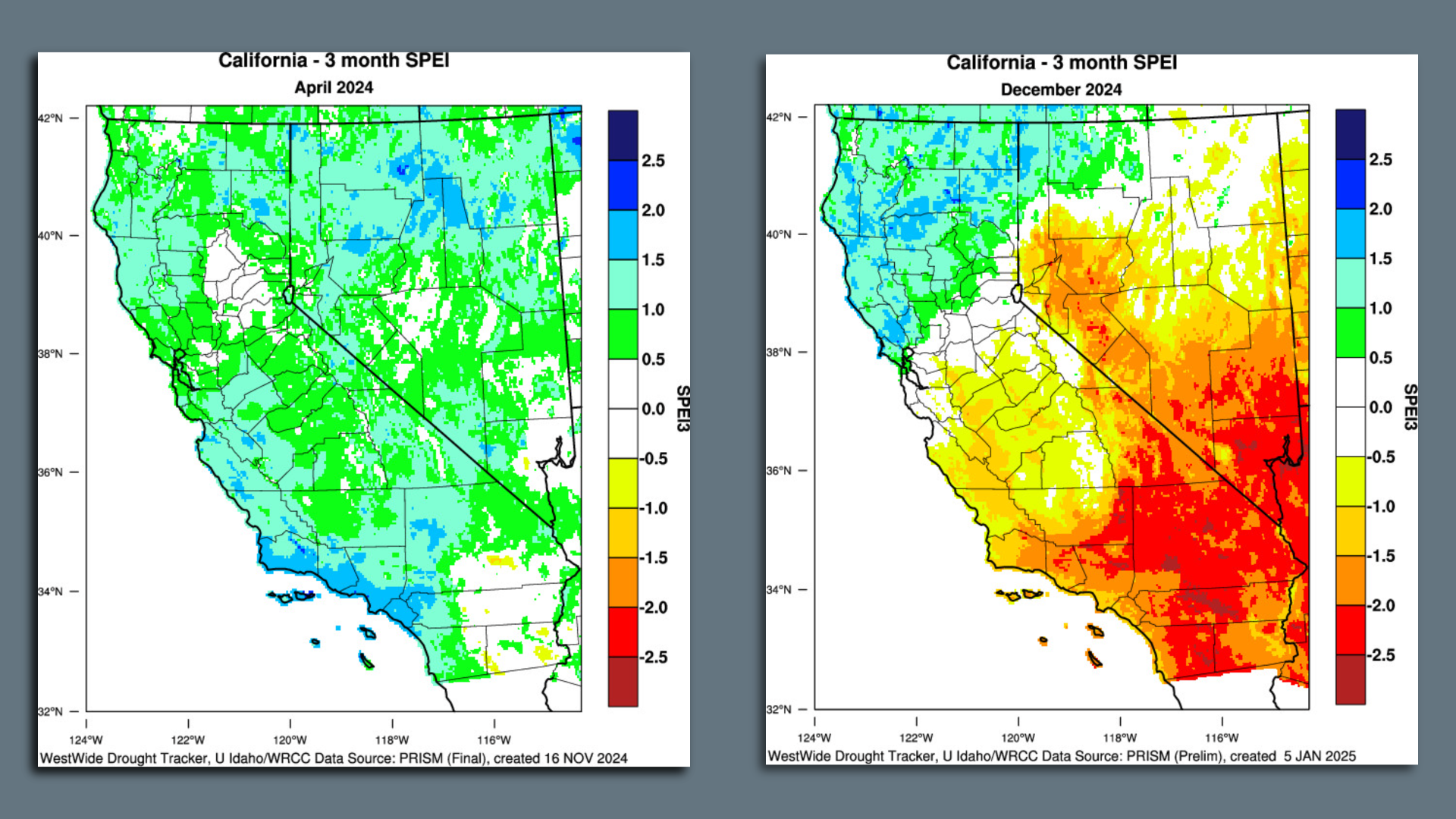
Zoom in: Climate researcher Daniel Swain posted two maps on Bluesky last night that show this phenomenon at work in Southern California, writing:
- "In 2024, Southern California experienced an exceptional episode of wet-to-dry hydroclimate whiplash. Very wet conditions in winters of 2023 and 2024 gave way to a record-dry start to 2025 wet season (with periods of record warmth and evaporative demand in between)."
The bottom line: Climate change is causing more overlaps between extremely dry conditions from whiplash events deeper into Santa Ana wind season, raising the likelihood of major fires.
Yes, but: Even with that trend in the background, it takes a rare combination of extreme weather, land management and other factors to cause the ongoing devastation.
5. ⛔ Trump's wind ban claim comes amid soaring energy needs

President-elect Trump's claim of no new wind farms comes at a time of soaring demand for clean electricity.
Why it matters: Wind is one of the fastest-growing and lowest-cost energy sources in the U.S., with gigawatts of planned projects in the works.
Zoom in: It remains to be seen if Trump's view on wind power is a threat or a promise. Stopping it cold is unlikely to happen.
- In 2023, wind farms accounted for 22 percent of the electricity generated in Texas and 59 percent of the power produced in Iowa, according to the New York Times.
- There are nearly 40 gigawatts of land-based and offshore wind projects that are under construction or in advanced development in the U.S. as of late last year, according to the American Clean Power Association (ACP).
Zoom out: The pipeline of onshore wind projects is spread across states in the Southwest and Midwest like New Mexico, Texas, Wyoming, Oklahoma, and North Dakota.
- Offshore wind projects would mostly benefit East Coast states like Massachusetts, Rhode Island, Virginia, and New York.
- Trump's nominee for Interior Department secretary, North Dakota Gov. Doug Burgum, oversaw a wind boom in his state. Wind provided 36% of North Dakota's power generation in 2023.
By the numbers: Rising demand for clean electricity from data centers, EVs and manufacturing will continue to drive the installation of wind turbines on and offshore.
- Last month a Department of Energy report predicted that data centers will account for up to 12% of U.S. electricity consumption by 2028, or 132 gigawatts annually, triple what data centers consumed in 2023.
Our sister newsletter Axios Pro: Climate Deals has more. Consider subscribing for a steady diet of scoops and smart analysis.
Did a friend, colleague or someone whose LinkedIn profile makes you second-guess your career choices send you this newsletter? Welcome, please sign up.
🙏 Thanks to Chris Speckhard and Chuck McCutcheon for edits to today's edition, along with the brilliant Axios Visuals team.
Sign up for Axios Generate


/2025/01/09/1736457249392.gif?w=3840)