
Axios Generate

July 10, 2023
š³ Good morning! Today's newsletter has a Smart Brevity count of 1,246 words, 4.5 minutes.
šø This week marks 40 years since Scottish rock greats Big Country released their debut album, which provides today's intro tune...
1 big thing: The U.S. climate law's global spillover

Illustration: AĆÆda Amer/Axios
The new U.S. climate law could eventually spur lots of emerging tech adoption in other countries too, Ben writes.
State of play: Lots of studies explore how the law will speed near-term uptake of existing climate tech in the U.S. ā renewables, electric vehicles, and more.
- But a new report from the Rhodium Group ā using methodology developed with the Bill Gates-led Breakthrough Energy ā tries something different and tricky.
- It games out long-term effects of subsidies for three nascent tools ā direct air capture, "clean" hydrogen, and sustainable aviation fuels ā at home and abroad.
What they found: The law helps reduce costs that eventually push lots of global deployment of those emerging technologies.
- Between 2030 and 2050, it drives between 99 and 193 million metric tons of additional emissions cuts in the U.S., with a lesser amount abroad.
- But non-U.S. deployment "really picks up steam after 2050" as costs fall, and countries adopt stronger policies.
- By 2080-2100, it's spurring 401 million to 847 million tons of avoided emissions annually outside the U.S. And that's just three technologies modeled in the law that backs a wider set of tools.
The big picture: "Thatās on par with the impact of the legislation as a whole in 2030," the study finds.
Why it matters: The U.S. is the second-largest emitter right now, but global climate goals will eventually require steep cuts worldwide.
Yes, but: The authors acknowledge limitations of their model, which makes key assumptions about individual nations' policy decisions, and more.
The bottom line: "[A]s the U.S. share of global emissions continues to decline, it will be increasingly important for policymakers to evaluate the impact of domestic policy on the pace of global low-GHG technology diffusion directly ā by reducing costs and expanding production scale."
2. As global heat records fall, regional records in danger too
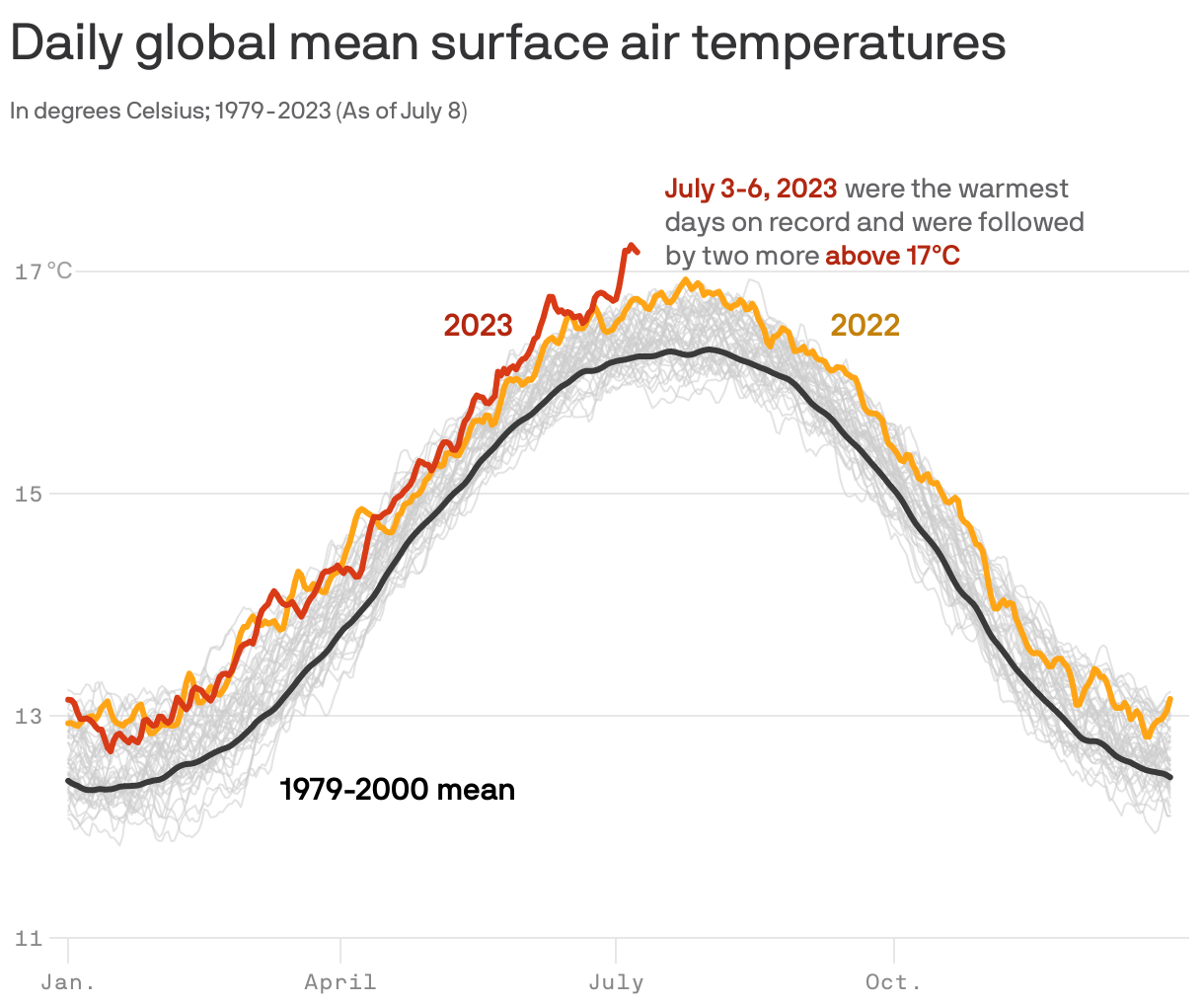
The globe's historic heat records have received massive media attention, Andrew writes.
Why it matters: There have been four straight days of records set or tied since July 3, along with seven straight days of average temperatures breaching 17°C (62.6°F). But the numbers mask local details, including life-threatening heat waves.
Context: Climate change is causing heat waves to be more likely and intense.
The big picture: Dangerously sweltering conditions are expected to intensify this week across the Southwest. That puts daily, monthly and some all-time records in jeopardy from Arizona to southwestern Texas.
- In Arizona, the NWS warns that residents of Phoenix be prepared for temperatures into the 110s°F for this week and into next, with the city's milestone for the most consecutive 110-degree days likely to fall.
- The heat is likely to worsen to "extreme" levels, per the NWS, into the weekend as an area of high pressure aloft, or heat dome, moves overhead and strengthens. At that time, a rare high temperature of 120°F may be within reach,
- Long-lasting heat waves are especially dangerous for public health.
Zoom in: Florida is on a hot streak as well, and temperatures well above average are forecast to continue this week and next for much of the state.
- It is unusual for the Sunshine State to see heat indices up to 110°F, but that is likely to continue during this event.
- Extremely high ocean temperatures along the Florida coast, with readings of 90°F or greater , are helping to fuel the heat.
3. Bonus: hot plans and politics
The White House is planning new steps aimed at protecting people from heat waves āĀ and knocking Republicans in the process, Ben writes.
Driving the news: This week, the Biden administration will convene a meeting with property owners, developers and others on ways to "reduce the risks posed by extreme heatĀ andĀ support climate-resilient affordable housing," a White House official tells Axios.
The intrigue: Look for political overtones. The White House plans to "blast Republican lawmakers for theirĀ dangerous and shortsighted efforts to sabotage the fight against climate change," the official said.
4. Sweden is building the worldās largest wooden city
Rendering courtesy of Atrium Ljungberg/White Arkitekter
Swedish developers are preparing to build the worldās largest wooden city, Axios' Ayurella Horn-Muller reports.
Why it matters: The use of timber in urban construction has been found to produce much lower carbon emissions than conventional materials ā but also brings new risks.
Driving the news: The "world's largest urban construction project in wood" will be built in Stockholm, real estate developer Atrium Ljungberg announced.
- It will feature 7,000 office spaces and 2,000 homes across over 250,000 square meters at a cost of roughly $1.4 billion.
- Construction is slated to begin in 2025 and last a decade.
The big picture: With the building and construction industry responsible for almost 40% of global CO2 emissions, there's a climate case for building with mass timber.
- Studies have found that swapping in mass timberĀ for steel and concrete in mid-rise structures can reduce emissions associated with manufacturing, transporting and installing building materials by up to 26.5%.
Yes, but: Some researchers argue building with mass timber may be more emissions-intensive than previously understood.
- A lack of clarity and incongruous fire safety regulations can be another sticking point.
What they're saying: "Where are you going to build an all-wood city? It's probably going to need to be somewhere where there is relatively low risk from wildfire, because you wouldn't necessarily want an all-wood city in a wildfire-prone region," said Urban Institute housing and climate hazards researcher Andrew Rumbach.
5. šš½āāļøCatch up fast: Renewable finance, oil, EVs
šµ Copenhagen Infrastructure Partners, a major renewables investor, announced the first close of its fifth fund at over $6 billion, Ben writes.
- Why it matters: The firm said the fund is "on track" to exceed $13 billion and "become the worldās largest dedicated greenfield renewable energy fund."
š¢ļø Iraq and TotalEnergies signed a $27 billion energy deal that spans oil, gas and renewables. (Reuters)
š "Mercedes-Benz is the latest automaker to commit to adopting Teslaās electric vehicle charging connectors for its vehicles, bringing Elon Muskās company one step closer to total EV charging dominance." (The Verge)
6. U.S. to China: open your wallet on climate
Illustration: Eniola Odetunde/Axios
Treasury Secretary Janet Yellen is pressing China to support multilateral climate funds to help developing nations cut emissions, Ben writes.
Driving the news: Over the weekend, Yellen wrapped up a multi-day visit to the world's second largest economy, designed to strengthen ties as Sino-American relations hit rough shoals on multiple fronts.
- "I believe that if China were to support existing multilateral climate institutions like the Green Climate Fund and the Climate Investment Funds alongside us and other donor governments, we could have a greater impact than we do today," she said.
State of play: In appearances and interviews, Yellen said climate cooperation between China and the U.S. ā the world's two largest emitters ā is a ripe area, despite tensions.
Quick take: Her comments are noteworthy in part because they're specific ā calls for U.S.-China "cooperation" are often vague and gauzy.
Of note: China has delivered 10% of its pledged $3.1 billion to the Green Climate Fund, the New York Times reports, citing studies on the topic, but also notes other Chinese aid to developing nations.
What they're saying: Pete Ogden, VP for climate at the United Nations Foundation, said China doesn't have the same finance commitments under the UN process as developed nations.
- Ogden, an Obama-era climate aide, notes the U.S. has long supported widening the donor base to include China and others with the capacity to contribute.
- "But itās certainly notable that it would be one of the major messages that Secretary Yellen delivered to Chinaās leadership in Beijing," he said via email.
What we're watching: U.S. climate envoy John Kerry plans to visit China this month, the NYT and Bloomberg report.
š¬ Did a friend send you this newsletter? Welcome, please sign up.
š Thanks to Chris Speckhard and Javier David for edits to today's edition, along with the talented Axios Visuals team.
Sign up for Axios Generate

Untangle the energy industryās biggest news stories