
Axios Generate

November 13, 2024

🧑🍳 Today's menu is wide but light, with just 1,341 words, 5 minutes.
🎹 This week in 1975, Earth, Wind & Fire released the album "Gratitude," and we're thankful for today's intro tune...
1 big thing: Carbon emissions from fossil fuels hit record highs in 2024
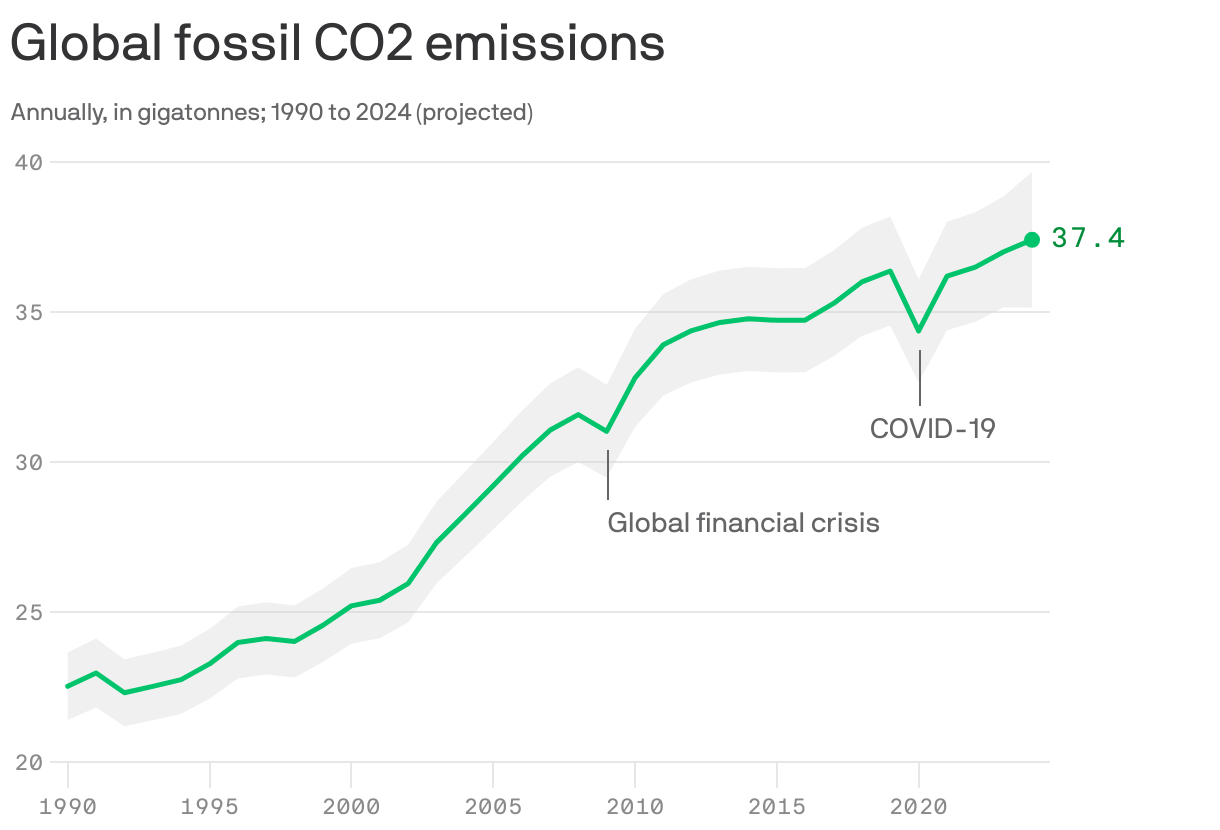
Global carbon dioxide emissions from the burning of fossil fuels such as oil, coal and natural gas grew yet again in 2024, according to a new assessment.
Why it matters: A peak in global emissions is necessary in the near-term, followed by steep reductions to net zero by 2050, to avoid potentially catastrophic consequences from human-caused global warming.
- Global fossil-related CO2 emissions are expected to increase by 0.8% this year to 37.4 billion metric tons, the report found. This is higher than the average annual growth rate seen during the last decade.
Driving the news: The new, comprehensive report on the global carbon cycle comes from the international Global Carbon Project, a group of scientists that tracks emissions sources and sinks.
- It was released yesterday evening to coincide with the COP29 climate summit in Baku, Azerbaijan.
- The report shows that a much-discussed peak in global CO2 emissions is proving elusive, as the continued burning of fossil fuels is swamping the now-rapid deployment of renewable energy sources.
- Carbon dioxide emissions tied to burning fossil fuels are now 8% higher than they were in 2015 when the Paris Agreement was first negotiated, the assessment found.
What they're saying: "The scene is set for peak global fossil CO2 emissions, but the world continually finds ways to burn ever more fossil fuels," said report co-author Glen Peters, a senior researcher at the CICERO Center for International Climate Research in Norway.
By the numbers: Global CO2 emissions from coal use are slated to grow this year by 0.2%, the report finds, reaching a record high despite its declining use in many countries.
- Increasing coal use in China and India has offset curbs elsewhere, such as a large decline in the European Union.
- The new report finds China's overall fossil-related CO2 emissions grew by a small amount this year, on the order of 0.2%, which could signify its emissions are peaking.
- "Whether that is just a one-off or a sign of a trend, we'll have to wait and see," Peters told Axios.
Zoom out: According to a recent UN report, global greenhouse gas emissions must now be cut by about 7.5% per year through 2035 to meet the Paris Agreement's most aggressive target.
- There are, however, clear signs that some countries are reducing emissions.
- A total of 22 countries saw CO2 emissions tied to burning fossil fuels come down while they grew their economies.
The bottom line: "Things are happening," Peters said, "but not enough to get emissions to turn around yet."
2. 🛢️ What the oil industry does — and doesn't — want from Trump

How does the oil sector maneuver Trump 2.0? Carefully.
Why it matters: A new industry policy blueprint and briefing showed lots of alignment with Trump's agenda — and some delicately stated ambiguity.
📢 Driving the news: The powerful American Petroleum Institute yesterday offered the first details of its post-election goals, like...
- Nixing EPA's new fee on methane emissions and President Biden's tailpipe CO2 rules.
- Ending the pause on new LNG export licenses to major markets.
- Far more offshore oil and gas leasing than Biden officials scheduled.
The intrigue: API head Mike Sommers threaded the needle when asked about the Paris climate agreement, which President-elect Trump plans to abandon.
- "We support the ambition of the Paris climate accord, but regardless of whether we stay in or out, our focus will be on the dual challenge of emissions reduction and on meeting the world's energy needs," he told reporters.
- Exxon boss Darren Woods told reporters at COP29 that Trump should not pull out of Paris, or scrap Biden's methane emissions regulations.
Asked about tariffs, a Trump favorite, Sommers replied:
- "This industry has long benefited from free trade, and we want to make sure that our trade policies benefit consumers and will continue to keep prices low."
- He also offered support for IRA carbon capture and hydrogen incentives.
🔭 What we're watching: Sommers hopes the window hasn't shut on the bipartisan Manchin-Barrasso permitting bill in the lame duck session.
- The plan meets 75% of API's permitting goals, he said, adding more could follow with the new president and Congress.
Go deeper: S&P Global Commodity Insights has more.
3. 🎉 Bonus petro-notes: COP29, OPEC, methane
🌪️ Ali Zaidi, a top White House climate aide, tells Bloomberg the U.S. oil and gas surge is a "facilitator of decarbonization, not something that slows it down."
- State of play: He argued at COP29 that it helps prevent "shocks" and "upward price pressure" while U.S. policies and investment favor energy transition.
- Why it matters: Convincing other nations to get tougher on climate is tricky when you're the world's largest oil and gas producer — and output keeps climbing.
📉 OPEC has once again trimmed its outlook for oil demand growth this year and in 2025, thanks to downward revisions in Chinese consumption.
- The big picture: The latest outlook change is small — roughly 100,000 barrels per day. But it won't dampen speculation that OPEC will once again push back plans to start unwinding voluntary production curbs.
- What's next: The latest International Energy Agency estimates arrive tomorrow morning. IEA is more bearish on demand growth than OPEC.
📫 Reuters obtained a letter from Biden officials to the EU asking them to ensure U.S. LNG shipments that meet U.S. methane rules "automatically comply with Europe's standards for imports."
- Why it matters: Linking the standards would help cement Biden's emissions rules even if they're eventually repealed by Donald Trump's incoming regulators, the piece notes.
4. 💬 What they're saying: Tesla and Trump

More analysts are exploring what the Donald Trump-Elon Musk BFF situation means for Tesla, which has a market cap back above $1 trillion in the election's wake.
What they're saying: A Deutsche Bank note titled "to the victor belong the spoils" lays out a few ways Trump 2.0 could help Tesla.
- They see potential for federal efforts that ease the path for robotaxis now subject to a patchwork of state policies.
- "We could envisage the new administration setting standards at the national level to make approval of deployment faster/simpler," their note states.
- The DB analysts are also among the voices arguing that Tesla is much better positioned than its competitors if Trump succeeds in paring back federal EV incentives.
On those humanoid robots Musk wants to produce, "We could envision policy support similar to that given to the semiconductor industry where grants or loans are handed out for building out infrastructure."
🏃Catch up quick: Trump said yesterday that Musk and Vivek Ramaswamy will lead a new Department of Government Efficiency. But it's not a formal government agency, which Congress would need to create.
The bottom line: "[S]hould JD Vance take the reins after Mr. Trump, Elon Musk could have a close political ally in the White House for potentially 8-12 years," the DB note states.
5. 👟 Catch up quick: new goals edition
💵 The World Bank and other multilateral development banks hope to jointly provide $120 billion annually in climate finance for developing nations by 2030.
- Why it matters: It's more money — up from $75B last year — but far short of the estimated trillions needed for adaptation and cutting emissions.
- The big picture: The banks said as much in the pledge at COP29, noting their "catalytic effect" on private finance and other sources is vital.
- What's next: World Bank President Ajay Banga tells Bloomberg the bank is working to streamline loan guarantee provisions, looking to take a "first loss" in some projects to de-risk private investment, and more.
⚛️ The White House unveiled a roadmap aimed at tripling U.S. nuclear power by 2050 by adding another 200 gigawatts, up from roughly 100 today.
- Why it matters: It's a nod toward fast-rising U.S. power demand and Biden officials' push to meet it with climate-friendly energy.
- State of play: The plan uses existing executive powers. But it doesn't provide funding and would rely on Congress and the Trump administration to carry it out.
- What we're watching: Trump 2.0's approach to nuclear power. Go deeper.
6. 🚗 Number of the day: up to $5.8 billion
That's the size of Volkswagen's investment in EV startup Rivian as part of their newly formalized joint venture.
Why it matters: It's $800 million more than the initial announcement in June. Rivian's shares rose 11% pre-market. The NYT has more.
📨 Did a friend, colleague or even a frenemy send you this newsletter? Welcome, please sign up.
🙏 Thanks to Chris Speckhard and Chuck McCutcheon for edits to today's edition, along with the brilliant Axios Visuals team.
Sign up for Axios Generate