Axios Generate

August 29, 2024


📡 A holiday weekend is appearing on radar. We'll get you closer with just 1,113 words, 4 minutes.
🎸 This week marks 15 years since The Black Crowes released "Before the Frost...Until the Freeze," which provides today's intro tune...
1 big thing: Canada's carbon budget warnings
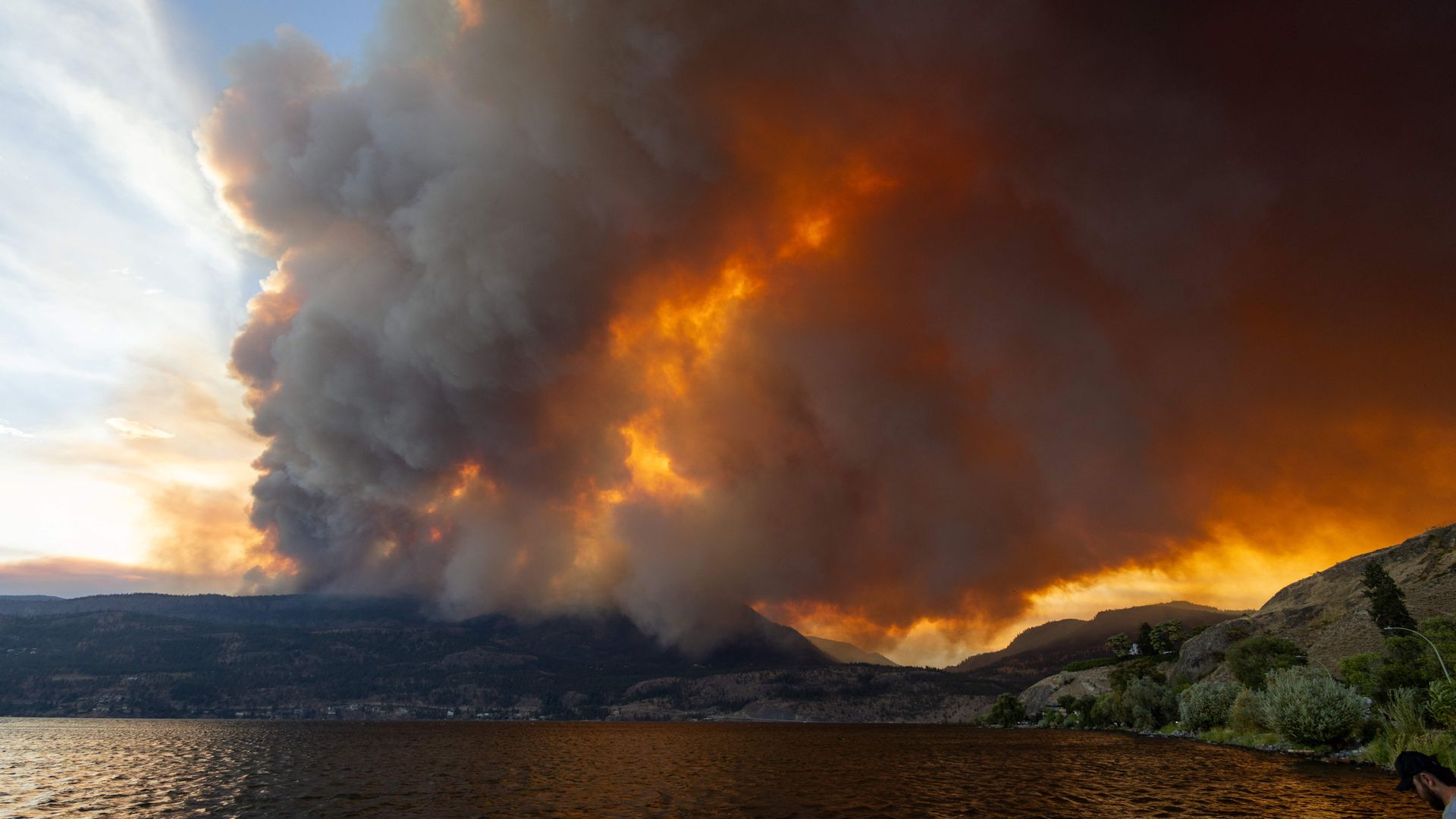
Canada's record 2023 wildfire season emitted so much carbon into the atmosphere that it put the country on par with the annual fossil fuel emissions of India, a new study finds.
Why it matters: The fires burned 4% of the nation's vast forest area and demonstrated the effects extreme heat and drought have on the boreal forests that ring the Arctic. They've also illustrated the fraught politics of carbon accounting.
Zoom in: The paper, published in the journal Nature, provides a warning about designing carbon offset programs around ecosystems long thought to be relatively stable.
How they did it: The study used a "top-down" approach to estimate emissions by examining estimates of trace gas emissions in fire plumes from satellite-based wildfire sensors.
- They also looked at bottom-up approaches, which rely on satellite detections of heat signatures from wildfires and use knowledge of vegetation and other factors to determine carbon emissions.
What they found: In just five months, Canada emitted enough carbon from wildfires in 2023 — 647 million metric tons — to be comparable to the annual fossil fuel emissions from the top 10 largest emitters.
- The research also notes that climate projections show an increasing tendency for extreme fire weather conditions to occur and lead to larger and more intense blazes.
Zoom out: The study notes that Canada does not currently report its emissions from wildfires, treating them as "natural disturbances" despite the ample evidence of how human-caused climate change is worsening these blazes.
- "Certainly, to achieve the goal of limiting global warming, all emissions and removals of carbon across the globe are important," Brendan Byrne, a scientist with NASA's Jet Propulsion Laboratory in California and lead author of the study, told Axios via email. "So even if Canada does not count these emissions, they are relevant to reach warming targets."
- In addition, many companies and governments are choosing to offset their carbon emissions by purchasing carbon credits earned from leaving healthy forests intact.
Yes, but: With climate change causing wildfire seasons to become more severe in the U.S., Canada and elsewhere, some of the forests used for offsets have gone up in flames — negating the carbon benefits.
- That was the case this summer with the California carbon market, when some forests used for carbon offsets burned in the Park Fire, releasing planet-warming greenhouse gases into the atmosphere.
- In addition to the increasing threat of wildfires, other research indicates that ecosystems, including Canada's northern forests, may become less adept at absorbing carbon as the climate warms.
What they're saying: "Climate change will certainly impact all ecosystems and it is very challenging to model or predict how these changes will impact ecosystems' ability to sequester carbon," Byrne told Axios. "I think it is very important to understand the uncertainties about long-term carbon sequestration in forests."
2. U.S. looks to thread the finance needle at COP29

U.S. officials have a Goldilocks approach to fraught negotiations over global climate finance at the annual, late-year UN talks.
Why it matters: Aid to poorer countries will top the agenda at November's COP29 summit in Azerbaijan as negotiators look to replace the $100 billion annual goal that was set in 2009 — and only recently achieved.
Driving the news: The U.S. strategy toward the "New Collective Quantified Goal" is detailed in a document quietly filed with the UN this month.
- "There is a fine line between a support goal that stretches contributing Parties and one that is so unrealistic that it actually diminishes incentives and potentially undermines the Paris Agreement process," it states.
State of play: A senior State Department official briefed reporters yesterday about NCQG.
- Nationally mobilized finance is a core piece — or "inner layer" — of the annual $1 trillion-plus needed to meet Paris Agreement temperature and resilience goals, the official said.
- The larger global investment goal from an array of sources should form the "outer layer" NCQG around the smaller public "support goal," the U.S. argues.
Yes, but: "[I]f the NCQG were only to set forth a realistically achievable support goal, it would not convey the enormity of the finance task before us," the document states.
- Elsewhere, the official said countries are converging around 2035 as the NCQG timeframe.
Reality check: Republican presidential candidate Donald Trump, if victorious, would likely seek to cut U.S. international climate aid, which the official said reached $9.5B last year.
- He could again withdraw from the Paris Agreement too.
What we're watching: Negotiations with China.
- The U.S. argues the world's largest emitter should contribute to the "inner layer," the official said.
- John Podesta, the top U.S. climate diplomat, travels to China for meetings soon, per U.S. officials and Bloomberg.
3. 🏃Catch up quick on renewables: offshore wind woes and solar permitting
🛑 Energy giant Equinor is scrapping planned offshore wind projects in Spain and Portugal, adding to its exit from Vietnam, Reuters reports.
☀️The Interior Department will today release new policies to speed up solar development on public lands, the White House said.
- The big picture: It will "expedite reviews" by steering projects to areas with high potential and "low wildlife and land conflicts," a summary states.
4. Americans' likes and dislikes on climate policy

Favoring action to fight climate change is still a political winner, but the devil is in the details, new polling shows.
Why it matters: Resources For the Future, a nonpartisan think tank, and Stanford tested high-level messaging as well as a constellation of specific policies.
The big picture: Hearing a statement that says fossil fuels are helping warm the planet and supports newer forms of energy (among other things) made respondents 57% more likely to support a hypothetical Senate candidate.
- That's down from 65% in 2020. But it does better than hearing a statement that calls global warming a hoax and argues against renewables, which boosted support for the hypothetical candidate only 21%.
Yes, but: It's worth noting that the "green" statement included an economic message too, touting low-carbon energy that will "create jobs and entire industries."
What's inside: On to specifics ... carbon and energy taxes continue to poll between meh and terribly.
- Fifty-four percent favor a tax on companies for their emissions, but higher taxes on consumer electricity poll at 15% and higher gasoline taxes at 28%.
- There's way more support for incentives, which helps explain why the IRA is based on carrots not sticks.
- For instance, 72% favor giving utilities tax incentives for producing renewable energy, and there's high support for building efficient appliances.
- 78% favor the government helping pay for job training for people affected by the transition from fossil fuels.
5. 💬 Quoted: big auto's EV woes
"In industry after industry, legacy businesses react slowly — and then too frantically — to start-ups that are willing to endure massive losses attempting to change the rules of the game."— Washington Post columnist Adam Lashinsky, taking stock of Detroit automakers' struggles with the EV transition.
📨 Did a friend, colleague or even a frenemy send you this newsletter? Welcome, please sign up.
🙏 Thanks to Chris Speckhard and George Moriarty for edits to today's edition, along with the brilliant Axios Visuals team.