Canada's 2023 wildfires emitted enough carbon to equal India's annual emissions

Add Axios as your preferred source to
see more of our stories on Google.
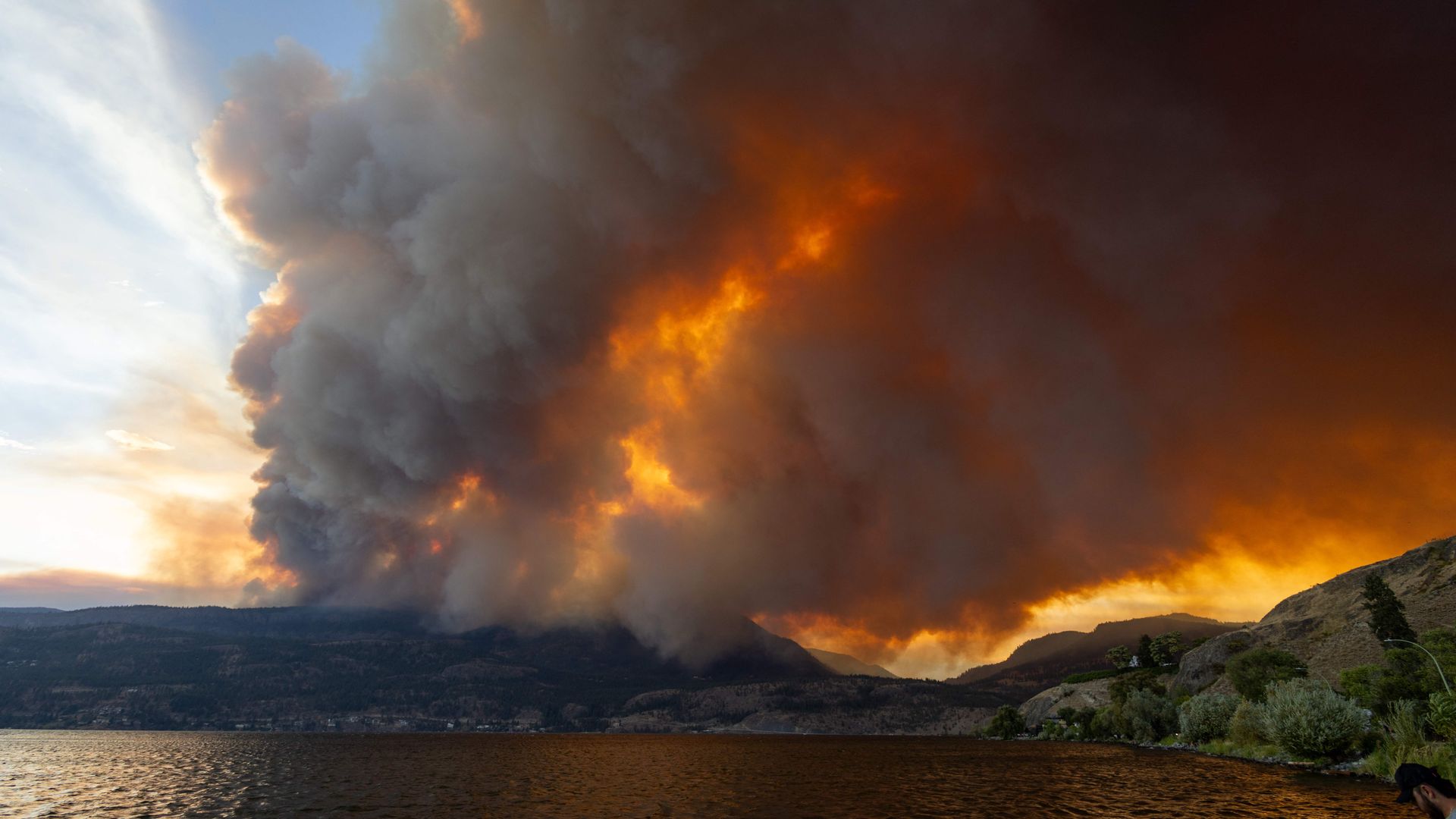
The McDougall Creek wildfire burns in West Kelowna, British Columbia, Canada, on Aug. 17, 2023. Photo: Darren Hull/AFP via Getty Images
Canada's record 2023 wildfire season emitted so much carbon into the atmosphere that it put the country on par with the annual fossil fuel emissions of India, a new study finds.
Why it matters: The fires, which burned 4% of the nation's vast forest area, demonstrated the effects that extreme heat and drought have on the boreal forests that ring the Arctic — greatly increasing their tendency to burn.
- The study's results also illustrate the fraught politics of carbon accounting, since Canada does not report wildfire-related emissions to the U.N. under the Paris Agreement.
Zoom in: The paper, published in the journal Nature by an international team of researchers, provides a warning about designing carbon offset programs around ecosystems long thought to be relatively stable.
- The 2023 fire season was the hottest and driest in the 44-year record examined in the study. The carbon emissions estimates were far higher than the second-worst season on record, which was surprising, according to lead author Brendan Byrne of NASA's Jet Propulsion Laboratory.
How they did it: The study used a "top-down" approach to estimate emissions by examining estimates of trace gas emissions in fire plumes from satellite-based wildfire sensors, such as TROPOMI.
- They also looked at bottom-up approaches, which rely on satellite detections of heat signatures from wildfires and use knowledge of vegetation and other factors to determine carbon emissions.
What they found: In just five months, Canada emitted enough carbon from wildfires in 2023 — 647 million metric tons — to be comparable to the annual fossil fuel emissions from the top 10 largest emitters.
- The wildfire-related emissions were more than four times larger than Canada's annual fossil fuel emissions.
- The research also notes that climate projections show an increasing tendency for extreme fire weather conditions to occur and lead to larger and more intense blazes. This could hurt the ability of Canada's ecosystems to be a net absorber, or "sink," of carbon.
Zoom out: The study notes that Canada does not currently report its emissions from wildfires, treating them as "natural disturbances" despite the ample evidence of how human-caused climate change is worsening these blazes.
- "Certainly, to achieve the goal of limiting global warming, all emissions and removals of carbon across the globe are important," Byrne told Axios via email. "So even if Canada does not count these emissions, they are relevant to reach warming targets."
- In addition, many companies and governments are choosing to offset their carbon emissions by purchasing carbon credits earned from leaving healthy forests intact.
Yes, but: With climate change causing wildfire seasons to become more severe in the U.S., Canada and elsewhere, some of the forests used for offsets have gone up in flames — negating the carbon benefits.
- That was the case this summer with the California carbon market, when some forests used for carbon offsets burned in the Park Fire, releasing planet-warming greenhouse gases into the atmosphere.
- In addition to the increasing threat of wildfires, other research indicates that ecosystems, including Canada's northern forests, may become less adept at absorbing carbon as the climate warms.
- The record heat and drought seen in Canada last summer may be an outlier now, but Byrne said projections under a moderate emissions scenario show they could be the norm there by midcentury.
What they're saying: "Climate change will certainly impact all ecosystems and it is very challenging to model or predict how these changes will impact ecosystems' ability to sequester carbon," Byrne told Axios. "I think it is very important to understand the uncertainties about long-term carbon sequestration in forests."
