Axios Generate

August 01, 2024

🍟 Let's get into the Paris Olympics spirit! We'll sprint into Thursday with a quick 1,008 words, 4 minutes.
🎶 Happy birthday to blues great Robert Cray, who has today's intro tune...
1 big thing: A troubling picture on methane
Two new reports have bad news on methane emissions in the U.S. and worldwide.
Why it matters: Methane is a powerful planet-warming gas.
- Failure to slash emissions from agriculture, oil production and elsewhere will likely keep Paris Agreement temperature goals out of reach.
Driving the news: Big U.S. oil and gas fields are releasing four times as much methane as EPA tallies that are based on industry data, an Environmental Defense Fund analysis claims.
- The findings are based on high-tech aerial surveys in 2023 using a specially equipped airplane.
- It previews what's possible globally with the recently launched MethaneSAT satellite, EDF said.
Meanwhile, a paper in Frontiers in Science finds an "abrupt and rapid increase" in the growth rate of atmospheric methane in the early 2020s.
- It cites two main reasons: higher levels from fossil fuel production, and wetlands releasing more in a warming climate.
- Methane, along with CO2, must "drop rapidly" to limit warming to 1.5°C-2°C above preindustrial levels, the paper notes.
- Costs of stemming the gas are low compared to harms from warming, but "legally binding regulations and methane pricing are needed to meet climate goals," it argues.
Zoom in: EDF finds oil and gas companies' methane "intensity" — the amount escaping per unit of energy produced — far exceeds industry goals.
- The aggregate "loss rate" in the 12 U.S. oil and gas basins EDF surveyed is 1.6%.
- EDF notes that's far above the target of 0.2% in 2030 adopted by the Oil & Gas Decarbonization Charter launched at last year's UN climate talks.
- An older industry group, the Oil and Gas Climate Initiative, adopted the same goal several years ago.
Friction point: While measurements are improving, there are varying — and hotly debated — estimates of industry emissions.
- "We look forward to reviewing the [EDF] report," EPA told Axios.
- The American Petroleum Institute said its members are reducing emissions. It cited research showing substantial cuts from 2015-2022.
- "We can build on this progress through a sound EPA reporting framework, effective federal regulations and the deployment of advanced detection technologies," VP of upstream policy Holly Hopkins said in a statement.
What we're watching: The effectiveness of U.S. policy and global climate talks.
- EPA issued regulations in late 2023 to cut oil industry emissions, while the 2022 climate law also has methane provisions.
- The 2021 UN climate summit brought a multinational pledge to slash methane emissions by 30% by 2030.
2. Zooming in on U.S. methane

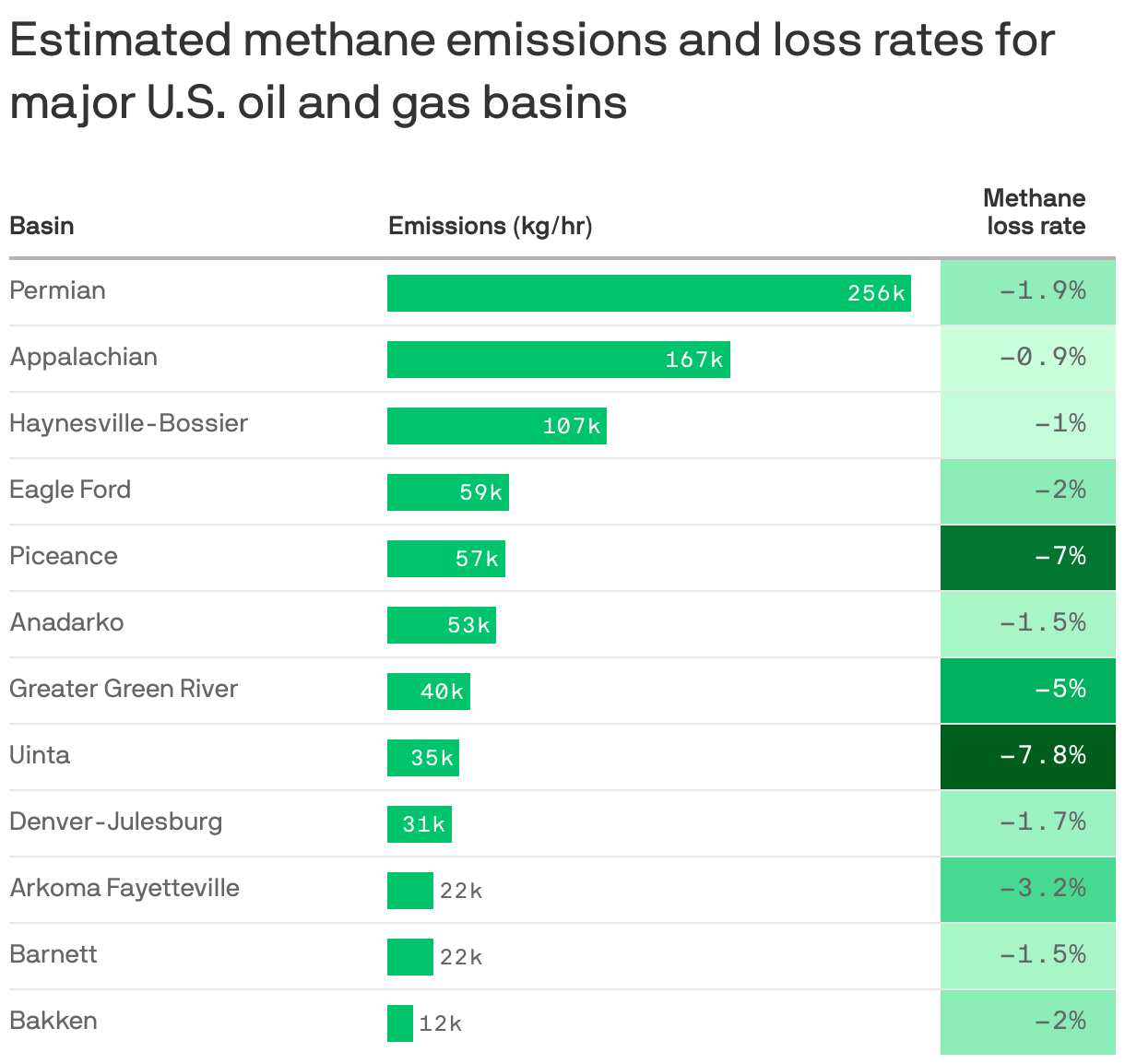
This chart ☝️ summarizes findings from the EDF analysis of major basins in the lower 48 states.
The big picture: The Permian, by far the country's largest oilfield, has the highest absolute emissions.
Yes, but: Amounts escaping per unit of energy produced is a trickier story.
- "Gas-dominant" basins with high well-site productivity have comparatively low rates.
- Areas heavy on oil production are higher. This could stem from losses of "associated" gas, "possibly due to inefficient flaring and/or insufficient gas gathering or takeaway capacity."
3. Coast-to-coast heat wave intensifies


A potentially deadly heat wave is expanding from the Central U.S. to both coasts, with nearly 150 million people under heat warnings and advisories this morning.
Why it matters: The extreme heat poses an acute public health risk, particularly since it will last more than a week in some places.
- It will also increase fire risks in the West, where deadly blazes are already burning.
Zoom in: As a strong area of high pressure aloft, or heat dome, intensifies and stretches its influence across the Lower 48 states, cities from Washington to Sacramento could near or surpass 100°F as early as today.
- The heat may last longest in the West, where the NWS shows at least a slight risk of extreme heat through Aug. 10.
Threat level: The extreme heat will yield more dangerous fire weather conditions that may help the historic Park Fire in northern California expand further, as well as the significant Borel Fire in the same state.
- Firefighters from the U.S. and abroad are battling blazes across the West. Forecasters worry that a surge of moisture from the Gulf of California could spark an outbreak of thunderstorms this weekend.
- Any lightning strikes may start new wildfires.
Context: Climate change is leading to more frequent, severe and longer-lasting heat waves, and is also driving an uptick in large wildfires, among other trends.
4. Exclusive: Key Republican slams Uber-BYD tie-up
The GOP head of the House select committee on China is bashing Uber's new partnership with Chinese EV heavyweight BYD, but it's unclear if he'll go further.
Why it matters: The statement from Chairman John Moolenaar (R-Mich.) comes amid wider Capitol Hill concerns about tie-ups between U.S. and Chinese companies.
- For instance, the select committee has probed Ford's work with Chinese battery giant CATL.
What they're saying: "There is no such thing as a private company in China. Partnering with BYD means partnering with the Chinese Communist Party and condoning the extensive forced labor that taints BYD's supply chains," Moolenaar told Axios in a statement.
- He said it aids the party's goal of "creating worldwide dependence on Chinese EVs."
- Moolenaar also alleged security risks, saying Uber customers' data on rides and conversations could be collected and shared with Chinese officials.
Yes, but: His office didn't indicate if he'll take any steps beyond the criticism.
Catch up quick: The companies yesterday announced a partnership to bring 100,000 new BYD vehicles onto the Uber platform in global markets, starting with Europe and Latin America.
- It does not include the U.S., which has imposed tariffs on Chinese-made EVs of over 100%.
The other side: "[W]e will not share any rider or trip data in any market. The partnership applies to vehicles that are already approved, regulated, and available for sale in these international markets," an Uber spokesperson tells Axios.
5. 🧮 Number of the day: 15-4
That's the easy passage of bipartisan permitting legislation through the Senate's energy committee yesterday.
Why it matters: The bill aims to speed development of fossil fuels, renewables and transmission.
Reality check: Don't conflate the lopsided vote with a glide path to becoming law.
The Capitol Hill calendar, election-year politics, climate activists' opposition, and more could easily derail it. E&E News has more.
📨 Did a friend, colleague or even a frenemy send you this newsletter? Welcome, please sign up.
🙏 Thanks to Chris Speckhard and Kate Marino for edits to today's edition, along with the brilliant Axios Visuals team.
Sign up for Axios Generate


/2024/07/31/1722462663736.gif?w=3840)