Axios Generate

February 24, 2023
๐ฅ Friday. Yes. Today's edition has a Smart Brevity count of 1,229 words, 5 minutes.
๐ฌ Did a friend send you this newsletter? Welcome, please sign up.
๐น Happy birthday to the late and brilliant rock pianist Nicky Hopkins, whose playing animates this week's final intro tune...
1 big thing: Unpacking Biden's World Bank surprise

Illustration: Annelise Capossela/Axios
White House officials say Ajay Banga โ President Biden's choice to head the World Bank โ is poised to transform its climate work, but his resume is something of a Rorschach test on this claim, Ben reports.
Catch up fast: Banga is a former Mastercard CEO and is currently vice chairman at private equity giant General Atlantic.
- Banga's extensive corporate background includes roles at Citigroup and other big companies.
- He would replace the outgoing David Malpass, who announced last week that he's departing before his term ends.
The big picture: A few key things to know...
๐ He has a climate background โ in the background. Banga's not a prominent figure in global warming circles, but he boosted climate initiatives at Mastercard.
- He's also an adviser to BeyondNetZero, a major climate investment fund General Atlantic launched in 2021.
๐ The White House rollout elevated climate. Officials made clear Thursday that they want Banga to deliver on the bank's "roadmap" to make climate central to its mission.
- They argue his private sector resume is fit for the goal of transforming the bank, a big ship to turn. "The climate crisis requires new thinking and creative vision regarding finance," climate envoy John Kerry said.
- Treasury Secretary Janet Yellen said he's got a history forging ties between the private and public sectors and NGOs that "equips him to help mobilize the private capital and press for the reforms needed to meet our shared ambitions."
๐ฃ๏ธ The climate movement response was mixed. Some progressive groups attacked the choice, disputing White House arguments that his corporate background is an asset.
- Friends of the Earth called for a "female candidate with extensive background in human rights, environmental advocacy and sustainable energy development."
- But others praised the choice. Sonia Dunlop of the think tank E3G cited his statements on the urgency of climate action, and said he'll be a "fresh pair of hands at the wheel" of what she hopes will be a greener bank.
What's next: Banga, if approved by the bank's board, will be under pressure to make good on elevating climate โ which has already had a rising profile at the bank โ alongside its traditional anti-poverty focus.
- Yellen wants development banks to better address "borderless" challenges and further expand beyond traditional country-based lending models.
- Another thing to watch: Barbados Prime Minister Mia Mottley's high-profile proposal for greater climate finance from multilateral development banks and on more favorable terms.
The intrigue: Axios' Felix Salmon points out that fighting climate change demands far more money than even a more climate-focused bank can provide.
- For instance, he notes Mottley's goal of an additional $1 trillion for climate resilience would require plenty of private-sector money โ and Banga's decades at Citigroup, Mastercard, and General Atlantic will come in very handy.
2. Charting the World Bank's climate challenge
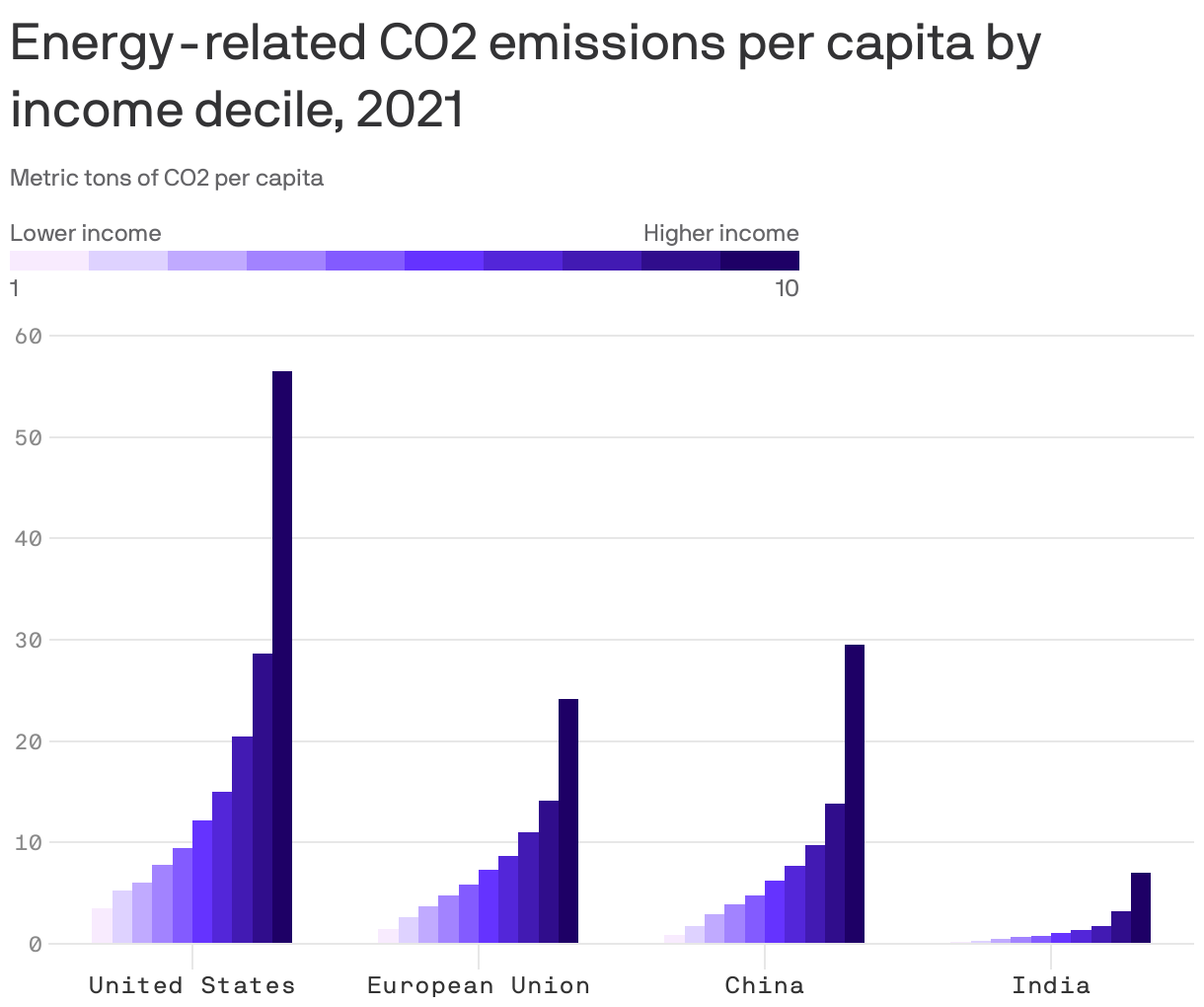
One of the World Bank Group's central challenges is how to reconcile the goals of boosting prosperity in developing nations while also trying to curb emissions, Ben writes.
Why it matters: Emissions are strongly correlated with income on a global scale, as a newly released International Energy Agency analysis shows.
Zoom in: The very top income brackets are responsible for a vastly outsized share of emissions.
- But, more relevant to the bank's work, the analysis also shows how carbon and wealth generally move in tandem as quality of life improves.
- "The bottom 10% of emitters globally live in developing economies in Africa and Asia, where they consume relatively small amounts of goods and services, and in many cases lack access to electricity and clean cooking."
3. Temperature records out of balance

A person runs past blooming cheery blossoms on an unseasonably warm day in Washington, D.C. Photo: Andrew Caballero-Reynolds/AFP via Getty Images)
More than three dozen warm temperature records were set or tied in the East on Thursday, as the mercury soared into the 80s all the way to the Mid-Atlantic, Andrew writes.
Why it matters: The unseasonable warmth is in line with long-term trends toward milder winters with shorter, less intense cold snaps.
Yes, but: The warmth in the East was related to a sharp plunge in the jet stream across the West, where Arctic air is entrenched and setting records of its own.
Between the lines: Climate scientists look to the long-term ratio between warm and cold temperature records for signs of a shifting climate.
- A climate that is not warming would have about a 1:1 ratio of warm to cold records.
By the numbers: Since Jan. 1, 5,568 warm temperature records have been tied or broken in the Lower 48 states, according to a NOAA database. That compares to 3,881 cold records.
- The ratio is even more off-kilter when viewed over a longer time period, with 83,068 warm records and 43,177 cold records set or tied in the past 365 days ending Feb. 22.
- Of these, 510 records have been all-time warm milestones set or tied, compared to less than 100 all-time cold records.
4. One tech thing: Pairing geothermal and carbon removal
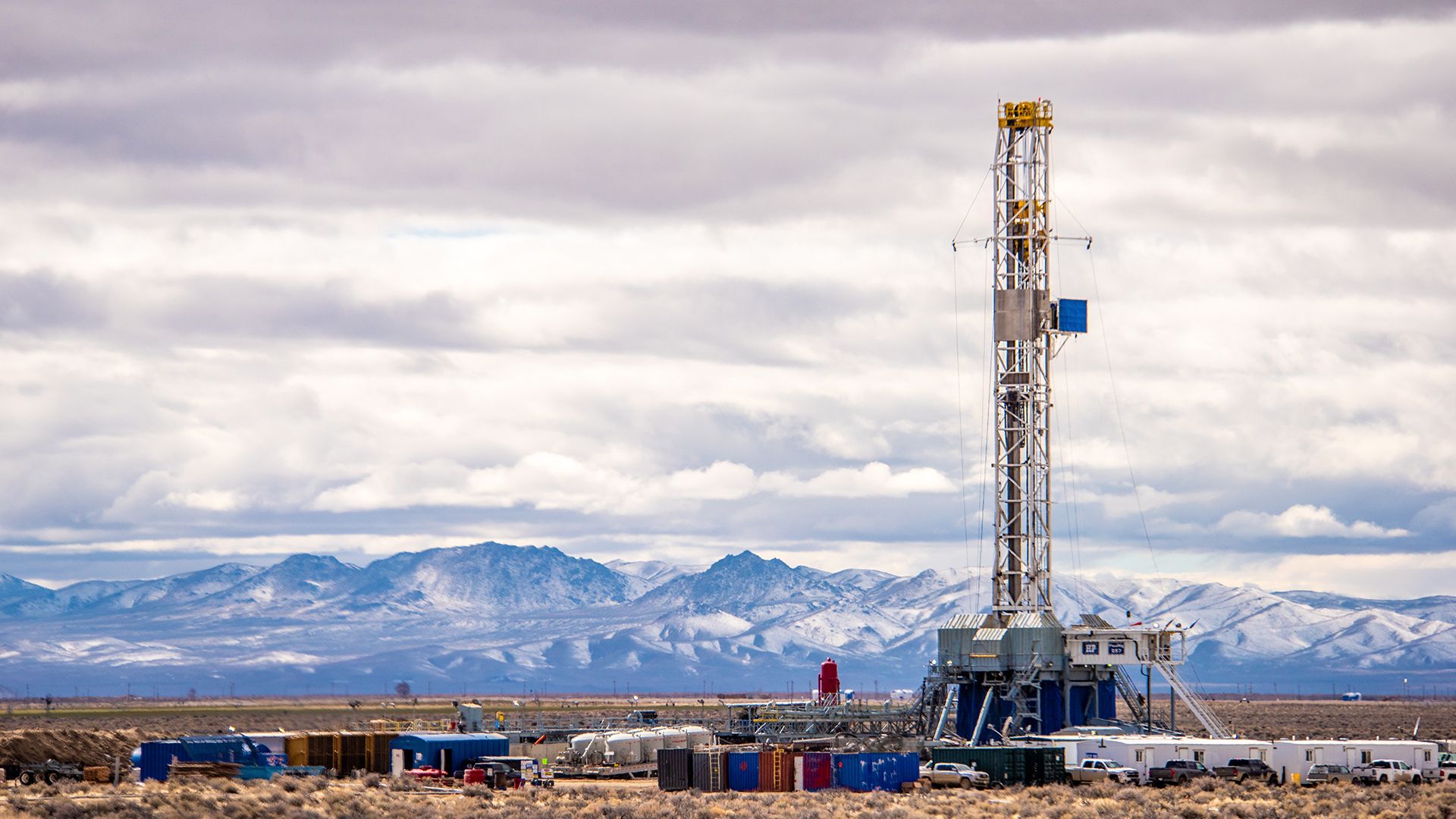
A Fervo Energy geothermal rig. Photo courtesy of Fervo Energy
Geothermal energy and carbon removal could be, to date myself badly, two great tastes that taste great together if a planned project comes to fruition, Ben writes.
Driving the news: Geothermal startup Fervo Energy plans to design and engineer a "fully integrated" facility that uses draws on subsurface heat to power direct air capture (DAC) machines.
Why it matters: DAC could one day scale to become part of the toolkit against global warming โย but what powers the energy-hungry machines is important.
- "To operate economically and sustainably, DAC requires a reliable source of carbon-free electricity and heat," the announcement states.
What's next: Fervo CEO Tim Latimer said via email they plan to deploy DAC at pilot scale at one of Fervo's geothermal sites already under development as soon as 2026, and then seek to move to commercial scale.
What we're watching: If and when geothermal becomes a common part of DAC as it expands.
- "[A]ny DAC companies with an amine sorbent are likely to be looking at geothermal," Anu Khan, deputy director of science and innovation at the group Carbon180, tells Axios via email.
- She's referring to a CO2 absorption substance that multiple DAC startups are employing.
Go deeper: The Washington Post has an in-depth story on the Fervo plan.
5. Catch up fast on electric vehicles
Illustration: Annelise Capossela/Axios
๐ Nissan this morning said it's using two electric-powered heavy-duty trucks to move cars from Port of Los Angeles to dealerships in the Los Angeles region, Ben writes.
- Driving the news: "Two major manufacturers of electric heavy-duty trucks, Nikola and Kenworth, will each provide trucks that will pull traditional car haulers," Nissan said.
- Why it matters: Ports have major pollution problems, so electrifying what's now mostly diesel transport can help clean the air and cut carbon.
๐ฌ Lordstown Motors said Thursday it stopped production and customer delivery to address quality and performance issues, Axios' Megan Hernbroth reports.
- The big picture: Several startups are struggling. Lordstown joins other EV makers like Canoo that have struggled to ramp up production and get vehicles in the hands of customers. Full story.
๐ญ "Volkswagen-owned Audi may build a factory in the United States, alone or with the Volkswagen Group, to take advantage of subsidies offered by the Inflation Reduction Act (IRA), the premium carmaker said on Friday," Reuters reports.
6.๐ข๏ธQuoted
"Weโve seen anywhere between 30 and 50 percent inflation โ depending on which cost category youโre talking about โ thatโs what weโre walking into in 2023."โ Jeff Ritenour, chief financial officer of shale producer Devon Energy, via the Financial Times
The FT reports that "persistent cost inflation is putting pressure" on U.S. shale producers, even as they report huge 2022 profits.
๐ Thanks to Nick Aspinwall and David Nather for edits to today's edition.
Sign up for Axios Generate

Untangle the energy industryโs biggest news stories