Axios Generate

May 28, 2024

π Welcome back! This morning we've got 1,314 words, 5 minutes.
π§ 40 years ago this week, the late great Tina Turner released the album "Private Dancer," which provides today's intro tune...
1 big thing: The Biden plan to tame βΒ and expand β carbon credit markets
The White House just launched efforts to clean up the Wild West of carbon credit markets β and help them grow.
Why it matters: These credits can help companies cut emissions by financing renewables projects, forest protection, and more.
- But the market has long been sketchy and stunted, with investigations and studies showing some promised cuts to carbon dioxide don't happen, or can't be verified.
The big picture: This morning the Biden administration unveiled its principles for "responsible participation" in "high integrity" voluntary carbon markets.
- VCMs can "help unlock the power of private markets to reduce emissions," but only if "significant existing challenges" are tackled, Treasury Secretary Janet Yellen said in a statement.
Zoom in: Principles for suppliers and buyers include:
- Ensuring credit-generating projects bring CO2 cuts that wouldn't have occurred otherwise, and that results are verified by accredited third parties.
- Ensuring projects don't harm local communities and share benefits.
- Corporate buyers should prioritize credits that wring emissions from their own value chains.
By the numbers: VCMs are small today, around $2 billion annually, partly because of their dicey reputation.
- But there's potential to steer far more private capital into climate projects via VCMs. For instance, the Boston Consulting Group sees a market up $40 billion by 2030, while Morgan Stanley sees up to $250 billion in 2050 (h/t CSIS).
- The new principles join private sector efforts like the Voluntary Carbon Markets Integrity Initiative.
Catch up quick: Federal agencies are increasingly involved.
- USDA funds "climate smart" practices that create credits, and has a program to help farmers, ranchers and forest owners take part in VCMs.
- DOE funds CO2 removal projects, is working to link credit buyers and sellers, and has a $35 million competition for selling removal credits directly to the agency.
- The Commodity Futures Trading Commission is crafting standards for credit contracts on commodity exchanges.
- The State Department launched the public-private, credit-focused "Energy Transition Accelerator" in late 2022.
What they're saying: Center for Climate and Energy Solutions president Nat Keohane, whose group works to improve VCMs, says they can become a powerful tool.
- They provide project finance akin to grants instead of loans, but a "lack of confidence" is leaving them untapped, he said.
- The federal principles, Keohane tells Axios, create "alignment and convergence" around how they should operate.
The bottom line: "This can start to give us the foundation of integrity we need to scale up the voluntary carbon market in a way that makes a real contribution to climate solutions."
2. Deadly weekend of tornadoes, extreme heat
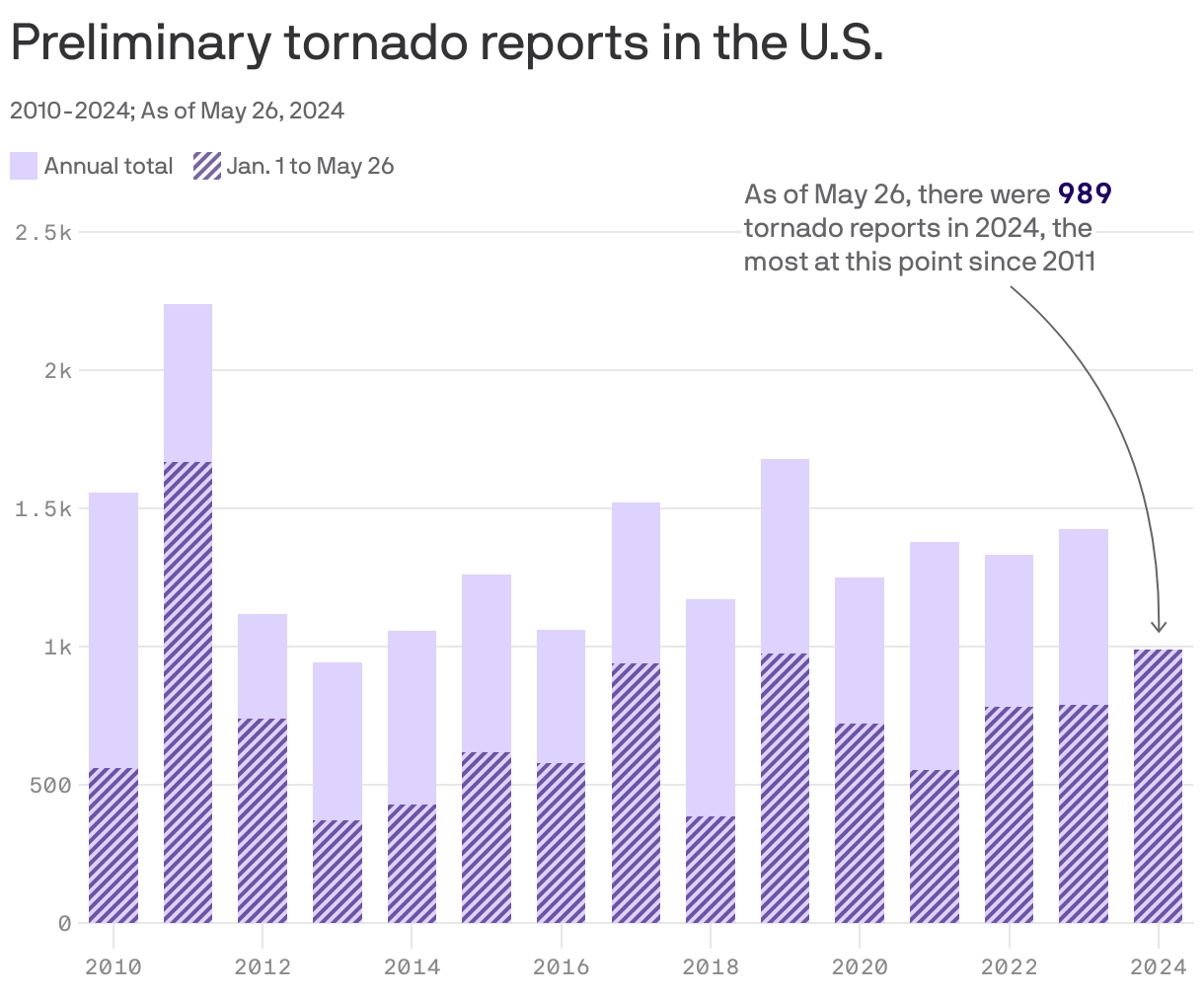
At least 23 people were killed as severe storms struck multiple states this weekend.
Why it matters: This year now sits at second place for reported tornadoes to date, behind 2011's record-setting year.
Zoom in: Damaging and deadly twisters occurred in Texas and Oklahoma Friday night, then moved eastward. Sunday night, tornadoes struck some of the same areas in Kentucky that were hit by the Mayfield tornado in 2021.
Between the lines: Climate change is altering the environment in which tornadoes form, in ways that raise the odds of sparking dangerous severe weather outbreaks.
- Such outbreaks may become more prolific, studies have shown, but may become less frequent.
- Tornado risks are already increasing outside of the traditional "Tornado Alley" region, and the destructive weather phenomena are becoming more variable each year.
- A 2021 study shows as average temperatures increase, so do key ingredients for severe weather outbreaks, such as atmospheric instability.
The big picture: The repeat storms in the Plains, Mississippi River Valley and Ohio Valley this season are related in part to a stagnant, powerful heat dome over Mexico.
- All-time high-temperature records have been broken in Mexico and Central America, including Mexico City's all-time highest temperatures on record, and the heat has encroached into the U.S.
- Mexico's climate-change-worsened heat wave has turned deadly and threatens to dry up Mexico City's water supplies.
- This weekend, excessive heat warnings and heat advisories stretched from South Texas to New Orleans. The jet stream flowing around this extreme heat and across the Central U.S. helped spark the severe weather.

3. Oil decisions loom this week: Exxon, Guyana, OPEC
π³οΈ Hess Corp. shareholders will vote today on Chevron's $53 billion acquisition, one of several megadeals reshaping the industry.
- Why it matters: The vote is "expected to be tight as a growing number of investors express concerns over the deal," the Financial Times reports.
- Catch up quick: Other hurdles loom as Exxon has filed for arbitration, arguing first refusal on Hess' stake in mammoth fields off Guyana.
π Exxon's annual meeting tomorrow is a referendum on the company's litigation against activist shareholders.
- State of play: Some high-profile investors will vote against some (or all) board members to protest the case they say could chill advocacy.
- The bottom line: A shakeup is unlikely. But the votes gauge shareholder sentiment on litigation Exxon calls needed to prevent abuses of the resolution process.
π OPEC+ meets virtually on Sunday, where they're expected to extend 2.2 million barrels per day of voluntary production cuts beyond mid-year.
- What we're watching: Analysts expect a no-drama event, but OPEC+ has surprised before.
4. Bonus: the latest on Dems vs. oil companies
The American Petroleum Institute just responded to a senior Democrats' query about industry execs' April meeting with Donald Trump.
Friction point: In a letter to Rep. Jamie Raskin, the API rejected allegations that policy talks with a candidate are wrong because the politician also wants electoral support.
- The accusations are "simply an attempt by political opponents to chill protected First Amendment speech with which they disagree," the letter states.
- API said it does not contribute to presidential candidates.
Why it matters: The event with Trump is playing a central role in election-year oil politics.
Catch up quick: Raskin, the top Oversight Committee Democrat, is probing the dinner where Trump pitched his agenda while urging the industry to raise $1 billion for his campaign.
- It raises "significant potential ethical, campaign finance, and legal issues," state his May 13 letters to API and various companies.
- It's part of multiple Democratic investigations into the industry.
5. G7 finance ministers help set course for Baku
The weekend meeting of Group of Seven finance ministers in Italy sent mixed signals about one of the biggest topics on the agenda for COP29 in Baku, Azerbaijan.
The big picture: There is wide recognition that far more funding is needed to help developing countries shift their energy systems to cleaner sources while also withstanding the increasingly severe hits from extreme weather events.
- The G7 finance ministers stated in their communique that a policy menu of options is needed for countries to get to net zero emissions.
Yes, but: The group did not agree to take significant new steps to reform the World Bank and other multilateral development banks to make them more capable of assisting countries with their climate goals.
- "The G7 Finance Ministers' Meeting leaves us with frustration and disappointment β and in fact, astonished about their lack of action on climate finance," said Andreas Sieber, Associate Director for Global Policy and Campaigns at the climate advocacy group 350.org.
6. Catch up quick on electric vehicles
βοΈ Lucid Group is cutting its workforce by 6%, or 400 people, as part of a restructuring, the electric vehicle maker disclosed Friday.
- Why it matters: EV startups like Lucid β which makes the luxury Air sedan β face slower demand growth and the challenge of cost-efficiently achieving commercial scale.
- State of play: CEO Peter Rawlinson told employees in an email the SUV launching this year will "dramatically expand our total addressable market." But "we must remain vigilant about costs." TechCrunch has more.
π΅ Via the Canadian Press, "Canada is looking at the massive new U.S. import tariffs on Chinese-made electric vehicles imposed by President Joe Biden earlier this month, but is not making any commitment to following suit north of the border."
π³οΈThe WSJ has a data-driven look at how political affiliation overlaps with U.S. views on EVs.
- The big picture: A Morning Consult poll for the paper shows 31% of conservatives have a favorable view of EVs, compared with 66% of liberals.
π§ Did a friend send you this newsletter? Welcome, please sign up.
π Thanks to Chris Speckhard and Javier E. David for edits to today's edition, along with the brilliant Axios Visuals team.
Sign up for Axios Generate


/2024/05/27/1716838305583.gif?w=3840)

/2024/05/28/1716855379966.gif?w=3840)