
Axios Generate

March 14, 2024
🗞️ It's a very newsy Thursday morning! We've got you covered with a Smart Brevity count of 1,273 words, 5 minutes.
🚨 Breaking: The Energy Department has offered Lithium Americas a $2.26B conditional loan commitment for the Thacker Pass lithium project in Nevada.
🎸 This week marks 40 years since Dire Straits released the live album "Alchemy," which provides today's intro tune...
1 big thing: A "swing" may hit hurricane season
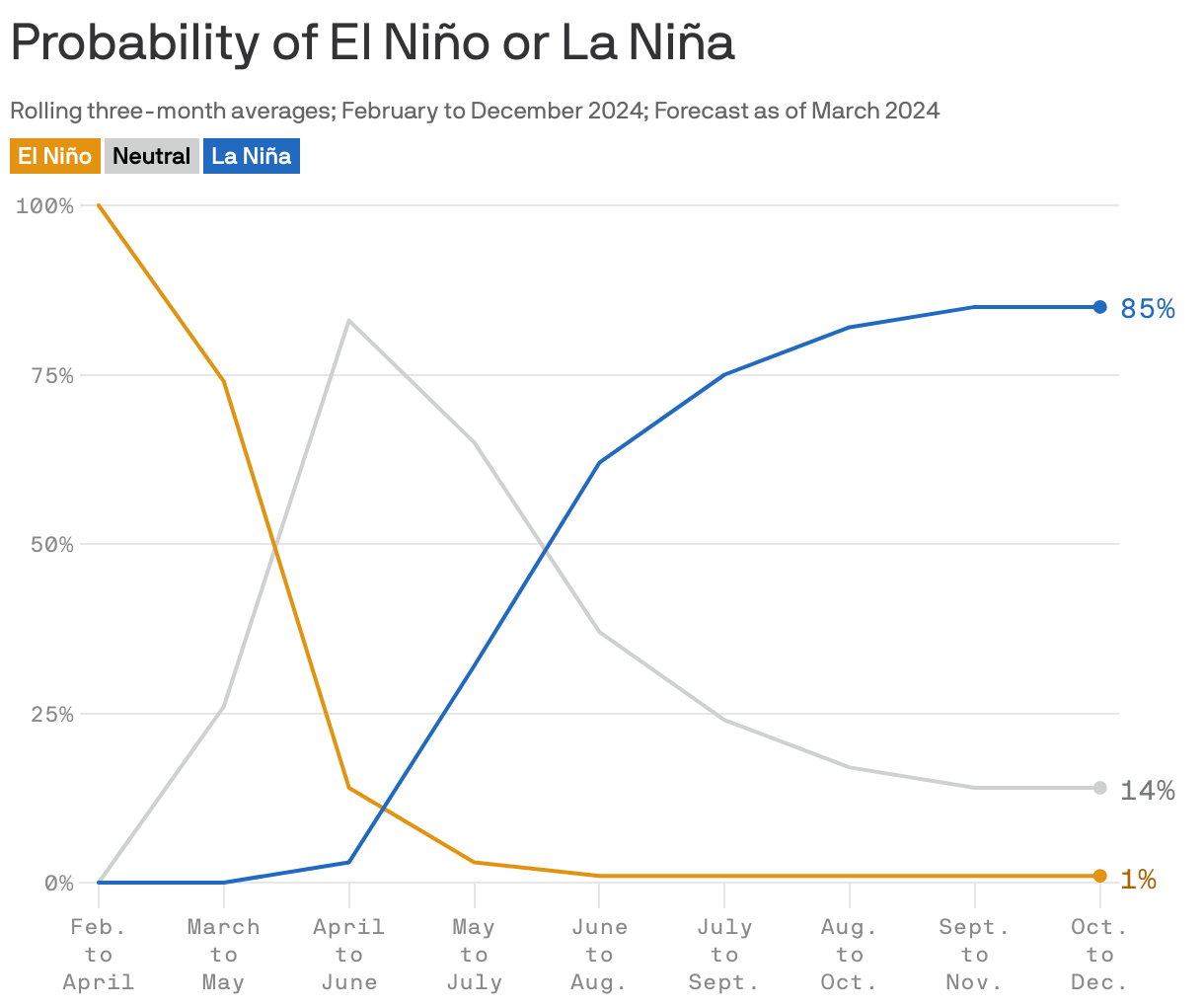
The tropical Pacific Ocean is in the process of lurching from a strong and planet-warming El Niño to a cooling La Niña, Andrew writes.
Why it matters: La Niña events may supercharge the Atlantic hurricane season, while also somewhat reducing global average temperatures.
Driving the news: A new NOAA forecast increases the odds for both a rapid transition to "El Niño-Southern Oscillation neutral conditions" (when neither El Niño nor La Niña are present) during the next two months and the development of La Niña as early as the June through August period.
How it works: La Niña systems feature cooler-than-average waters in the central and eastern tropical Pacific. They can reduce upper-level winds across the Atlantic during hurricane season.
- This decreases atmospheric wind shear; in turn, it tends to favor the development and intensification of tropical storms and hurricanes.
Context: NOAA's outlooks show a remarkably quick switch away from El Niño, but experts told Axios this has been seen before with strong events.
- "Big El Niños especially can end abruptly, creating conditions favorable for a rapid onset of La Niña," Michael McPhaden, a NOAA senior scientist, told Axios via email. "One way to think about the El Niño to La Niña transition is in terms of a playground swing."
- "The higher up you are on the backswing (El Niño), the faster you'll come down and your momentum at the bottom of the swing will propel you quickly forward and upward (La Niña)," McPhaden said.
Between the lines: La Niña is not the only factor worrying forecasters. Ocean temperatures in the tropical Atlantic are at the highest level on record for this time of year, and it is looking less likely that they will moderate before the hurricane season starts on June 1.
Yes, but: The development of La Niña is not certain, and forecasts made at this time of year can be less accurate due to what meteorologists call the spring predictability barrier.
The intrigue: Right now, though, forecasters are more confident than they would typically be at this time of year.
2. Shell weakens one emissions goal but adds a new one
Shell logo at a 2023 oil conference in Abu Dhabi, United Arab Emirates. Photo: Christopher Pike/Bloomberg via Getty Images
Shell is easing one 2030 climate goal and scrapping a 2035 target, but adding a new one for emissions from customer use of oil products, Ben writes.
Why it matters: Oil majors are juggling climate pressure and strong fossil fuel demand, while seeking low-carbon markets where they're competitive.
The big picture: Shell plans to cut CO2 emissions intensity from its product mix by 15%-20% by 2030 relative to 2016, a tweak from the prior 20% target.
- An updated transition strategy cites a "focus on value" that means more attention to commercial power customers and less on retail.
- It also dropped a 2035 target for cutting overall net carbon intensity by 45%, citing "uncertainty" in the pace of energy transition.
Yes, but: Shell affirmed its "net zero" by 2050 goal while cautioning this depends on "society as a whole" getting there.
- It introduced a new goal too: cutting customer emissions from use of its oil products by 15%-20% by 2030, relative to 2021.
- This reflects plans to boost low-carbon fuel sales and reduced petro-product sales.
Friction point: The plans drew criticism from climate activists, who say oil majors need to move much faster.
The bottom line: Shell, like its European peers, is adjusting on the fly to convince investors it can pull off a balancing act.
3. IEA sees "unwavering focus" on oil security

Illustration: Tiffany Herring/Axios
The International Energy Agency vows an "unwavering focus on oil security" as the energy transition unfolds, Ben writes.
Why it matters: On the surface, it's just anodyne stuff from the multilateral body born out of 1970s oil crises.
- But the post follows criticism from OPEC and some analysts, who call the agency's transition outlook too rosy and reject IEA's view that oil demand will peak this decade.
The big picture: "[T]he journey to a clean energy economy may not be a smooth one, and oil consumption will not vanish overnight," IEA analysts write.
What they're saying: "[W]e are encouraged by this message and the reference to the continuing importance of oil to the world," OPEC said.
The intrigue: IEA tells Axios the post — the latest of several commentaries marking IEA's 50th anniversary — wasn't a response to critiques.
What's next: Oil supply disruptions are more likely in decades ahead, IEA warns.
4. Catch up quick on tech: Geothermal, DAC, electric planes

Illustration: Annelise Capossela/Axios
♨️ Quaise Energy, a startup looking to unlock ultra-high temperature geothermal resources miles deep, just raised another $21M in Series A financing led by Prelude Ventures and Safar Partners, Ben writes.
- Why it matters: It's the latest bet that geothermal can move beyond its niche status by exploiting deeper and hotter regions with emerging drilling and conduction tech. Several startups with various methods have been attracting finance in recent years.
- State of play: Quaise is targeting "supercritical" resources with a "millimeter wave" drilling system to tap high-energy resources north of 374°C at depths up to around 12 miles.
🛩️ The electric aviation firm Lilium has a deal with Atlantic Aviation, a big private aircraft terminal operator, to prepare Atlantic's network for Lilium's eventual service launch.
- Why it matters: Promoting battery-powered flight will require preparation like charging capabilities and more. Go deeper on the tie-up via Flying Magazine.
☎️ AT&T has an agreement with 1PointFive, the direct air capture subsidiary of Occidental Petroleum, to buy CO2 removal credits from the "Stratos" DAC plant Oxy's building in Ector County, Texas. Terms were not disclosed.
5. Methane emissions are triple government estimates: study

Illustration: Allie Carl/Axios
A new study reveals methane emissions are on average about three times higher than government estimates, Andrew writes.
Why it matters: Curbing use of the powerful, short-term warming agent could reduce the severity of near-term climate change.
Zoom in: The study, published in the journal Nature yesterday, used aerial surveys to detect methane emissions across oil and gas production sites across six regions of the U.S., from New Mexico to Pennsylvania.
Staggering stat: The emissions counted in the study amount to a loss of about $1 billion in commercial gas value, and when incorporating climate change-related damage, about a $9.3 billion annual social cost, the study found.
6. GOP press Biden on Podesta's climate gig

John Podesta. Photo illustration: Brendan Lynch/Axios. Photo: Drew Angerer/Getty Images
House Oversight Committee Chairman James Comer alleges the Biden administration is circumventing recent law that subjects special envoys for climate and other roles to Senate confirmation, Ben writes.
Why it matters: His new push for internal communications signals widening GOP inquiries into President Biden's replacement of John Kerry with John Podesta as top U.S. climate diplomat — and could put decision-making documents into the public realm.
State of play: Technically, Podesta won't have Kerry's special envoy title and will remain at the White House, where he's already a top energy and climate adviser.
Catch up quick: Comer's letter to the State Department comes soon after Republicans in the House and Senate began pressing Biden to explain Podesta's role.
The other side: The White House says it's not violating the 2022 defense policy bill that requires Senate confirmations, noting existing special envoy climate staff remains at State and reports to a senior official there.
7. Bonus policy notes: SEC and energy loans

Illustration: Annelise Capossela/Axios
⚖️ The Sierra Club just filed litigation against the SEC's newly minted climate disclosure rule, alleging the regulators unlawfully weakened the requirements before issuing it, Ben writes.
- Why it matters: The heavily lobbied regulation now faces legal attacks from the left and right. The latter includes a suite of GOP attorneys general, who say it oversteps the SEC's mission.
☀️ DOE's Loan Programs Office has a preliminary agreement to provide up to $72.8 million partial loan guarantee for a solar-plus-storage microgrid on the tribal lands of the Viejas Band of the Kumeyaay Indians.
- Why it matters: It's the first conditional commitment offered through the loan office's Tribal Energy Financing Program, officials said. PV Magazine has more.
📬 Did a friend send you this newsletter? Welcome, please sign up.
🙏 Thanks to Chris Speckhard and Javier E. David for edits to today's edition, along with the brilliant Axios Visuals team.
Sign up for Axios Generate

Untangle the energy industry’s biggest news stories


