Axios Generate

June 18, 2025

🥞 Good morning! We're opening today with revealing new EV estimates and then have a quick spin through the latest on oil, the IRA, climate data and more — all in just 1,061 words, 4 minutes.
🗓️ Programming note: We're off tomorrow to celebrate Juneteenth. Generate returns Friday.
📻 Exactly 25 years ago, the late R&B prodigy Aaliyah was No. 1 on Billboard's Hot 100 with today's intro tune...
1 big thing: The dimming future of U.S. EV sales


Analysts are slashing estimates for U.S. EV sales in coming years as GOP lawmakers and Trump officials scuttle tax credits and emissions rules.
Why it matters: Transportation is the biggest U.S. share of CO2. And dimming sales forecasts show a market that remains tethered to fast-changing policies.
Driving the news: Today the research firm BloombergNEF estimated that EVs will be 27% of U.S. passenger vehicle sales in 2030, down from nearly 48% in last year's version of the annual look-ahead.
- Plans to roll back fuel economy and emissions rules, end the $7,500 consumer credit, cut funding for charging infrastructure, and auto import tariffs are all dragging down the outlook.
- And BNEF's outlook assumes that California's plans to phase out gas-powered car sales by 2035 — which are under threat — remain in place.
Catch up quick: It comes a month after the International Energy Agency revised its future U.S. sales estimates sharply downward.
- IEA now sees EVs with 20% of light-duty market sales in 2030.
- That's less than half of IEA's projection in the 2024 version of its annual EV report.
Friction point: Both the House and Senate GOP versions of the budget reconciliation plan mostly scuttle IRA purchase credits worth up to $7,500.
What we're watching: How Capitol Hill and White House policy changes — which also pare back manufacturing support — change the domestic supply chain buildout.
State of play: A separate new report finds that policy and market uncertainty is starting to cool investment in U.S. battery manufacturing and risking existing plans.
- Over $150 billion in manufacturing investments were announced between Q1 2018 and Q1 2025, Rhodium Group and MIT researchers show, fueled largely by the IRA in 2022.
- But these battery announcements slowed to a "glacial" pace last quarter, and $6 billion worth of projects were canceled from January through March.
Threat level: Lots of battery plant construction is underway even as the EV market outlook dims, "raising the possibility of stranded investments if policy and market conditions are weaker than expected," the Rhodium-MIT report finds.
The bottom line: The EV sales trend is still upward — but the U.S. landscape has completely changed.
- "Stable regulatory support still matters for EV adoption," BNEF states.
2. 🧁 Bonus: The global EV picture
Global sales are slated to hit another record this year, with BNEF estimating 22 million passenger EVs moved, up 25% from 2024.
The big picture: China accounts for two-thirds (!) of the market, with Europe next at 17%, followed by the U.S at 7%.
- EVs, including plug-in hybrids, are slated to be one in four passenger vehicles sold this year worldwide.
Yes, but: The research firm has trimmed its short- and long-term outlook.
- That's due to the U.S. policy changes, potential nullification of California's rules, and the EU pushing back near-term vehicle CO2 targets.
- It now sees 39 million passenger EVs sold globally in 2030, compared to 42 million in last year's outlook.
What we're watching: The global market is shifting as Chinese automakers ramp up foreign sales.
- "This challenges a widely held assumption that EVs will start in wealthy countries before spreading further," it states.
- "Thailand now has higher EV adoption rates than the U.S., while Brazil is ahead of Japan."
3. 🏃 Catch up quick on oil and gas: Alaska, Congress, Iran

📝 The Interior Department is moving closer to offering more acreage in the National Petroleum Reserve-Alaska, where Biden officials had restricted access.
- Why it matters: Large oil deposits underlie sensitive wildlife habitat in the massive Arctic expanse, making it a major leasing policy battleground.
- Driving the news: Interior released an analysis it says supports plans to reopen up to 82% of the 23 million-acre reserve to leasing and development.
- Catch up quick: It's part of a wider administrative push to expand access in the reserve.
💵 Via Bloomberg, "Senate Republicans included a tax break estimated to be worth more than $1 billion for oil and gas producers in their version of President Donald Trump's sprawling fiscal package."
🇮🇷 The Center for Strategic and International Studies' Clay Seigle has a lucid primer on potential ways the Israel-Iran conflict could disrupt oil supplies. It includes an analysis of whether the Saudis and UAE would deploy spare capacity.
4. 👟 Catch up quick on the IRA fight: threading needles and learning more

🪡 The Senate's softer treatment of IRA energy credits than the House's removes some obstacles to passage — but deficit hawks could still derail reconciliation.
- Why it matters: The upper chamber is trying to thread the tiniest of needles. Expanding access allows IRA backers to declare some victory without losing hardliners seeking a full repeal.
- Yes, but: House Freedom Caucus member Chip Roy has already rejected the Senate's IRA language. And Sen. Ron Johnson said he would vote against the bill as written and that "a lot" of work is needed.
- What they're saying: Sen. Kevin Cramer downplayed outstanding issues, saying they could be resolved by "a phone call between a couple of principals."
- What we're watching: Negotiations between the House and Senate will put tax credit phaseout timelines and anti-China language "most at risk for further debate," investment analyst TD Cowen said in a note.
- Go deeper: Unlock the whole story, and if you need smart, quick intel on energy and climate policy for your job, get Axios Pro Policy.
🆘 Need help parsing the House-Senate differences? Check out this helpful explainer via Crux, a startup that helps parties navigate clean energy transactions.
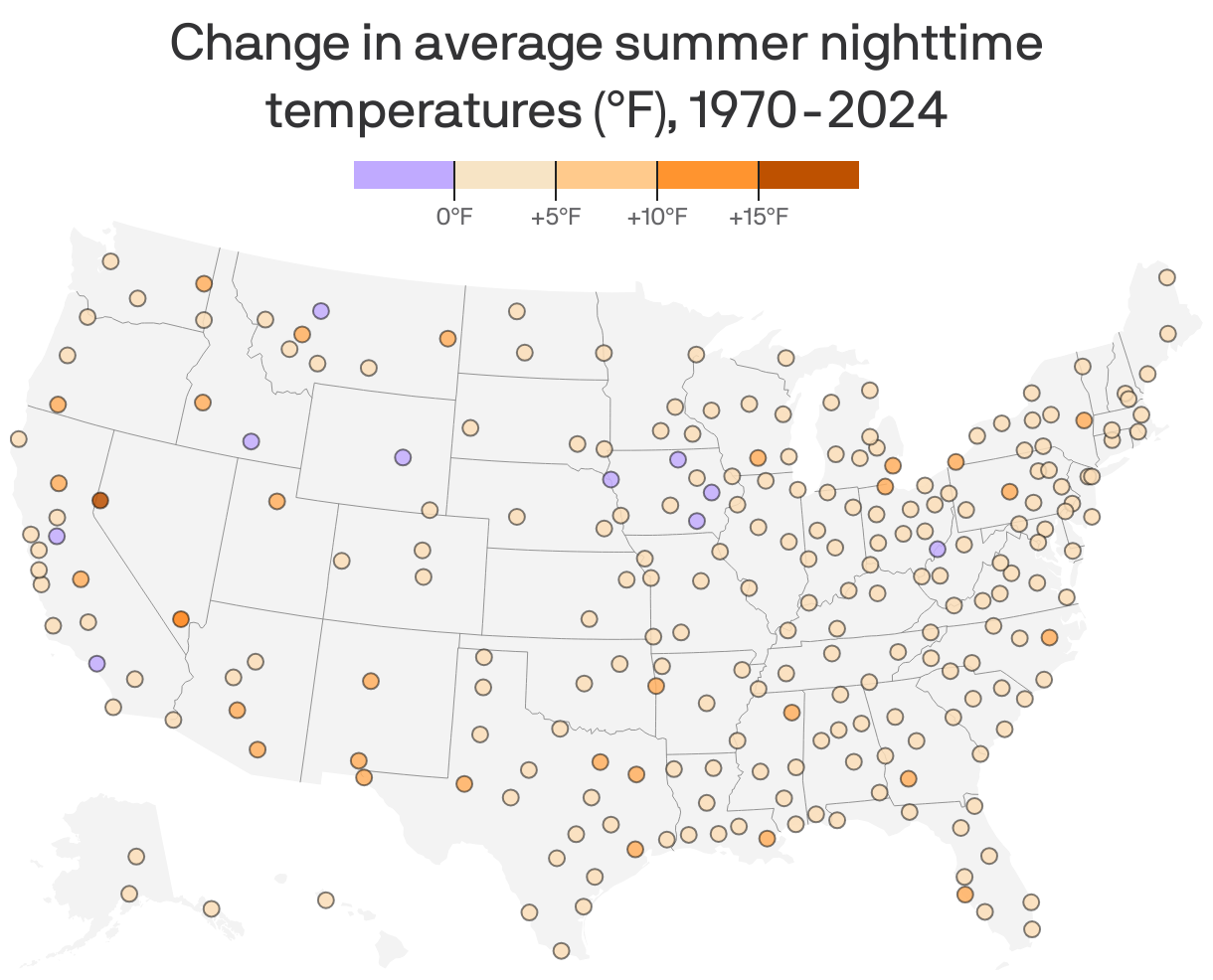
5. 🌡️ Summer evenings are getting warmer nationwide

Summer evenings are getting warmer across much of the U.S. — especially in Nevada and other parts of the Southwest — amid climate change, a new analysis shows.
Why it matters: Higher overnight temperatures can have health consequences for vulnerable groups, as well as increase demand for air conditioning.
- That, in turn, can strain electrical grids and increase energy demand, fueling a vicious cycle with more greenhouse gas emissions.
Driving the news: Average summer nighttime temperatures increased between 1970 and 2024 in 96% of 241 locations analyzed in a new report from Climate Central, a research and communications group.
- Among cities with an increase, temperatures rose by 3.1°F on average.
Zoom in: Reno, Nevada (+17.7°F), Las Vegas (+10°F), El Paso, Texas (+8.9°F) and Salt Lake City (+8.2°F) saw the biggest increases.
6. 🔋 Number of the day: 125,000 acres
That's how much acreage Chevron has obtained in Texas and Arkansas as it follows Exxon into the lithium market.
- "This opportunity builds on many of Chevron's strengths including subsurface resource development and value chain integration," Chevron New Energies President Jeff Gustavson said in yesterday's announcement.
- Go deeper via Mining.com
📧 Did a friend, colleague or an AI chatbot send you this newsletter? Welcome, please sign up.
🙏 Thanks to Chris Speckhard and Chuck McCutcheon for edits to today's edition, along with the brilliant Axios Visuals team.
Sign up for Axios Generate