
Axios Generate

October 21, 2022
💃🏽🕺🏽Oh yes. Friday. Today's newsletter has a Smart Brevity count of 1,206 words, 5 minutes.
📬 Did a friend send you this newsletter? Welcome, please sign up.
🎶 This weekend marks 50 years since the legendary Al Green released the album "I'm Still in Love With You," which provides today's intro tune...
1 big thing: Drought to solidify control amid La Niña
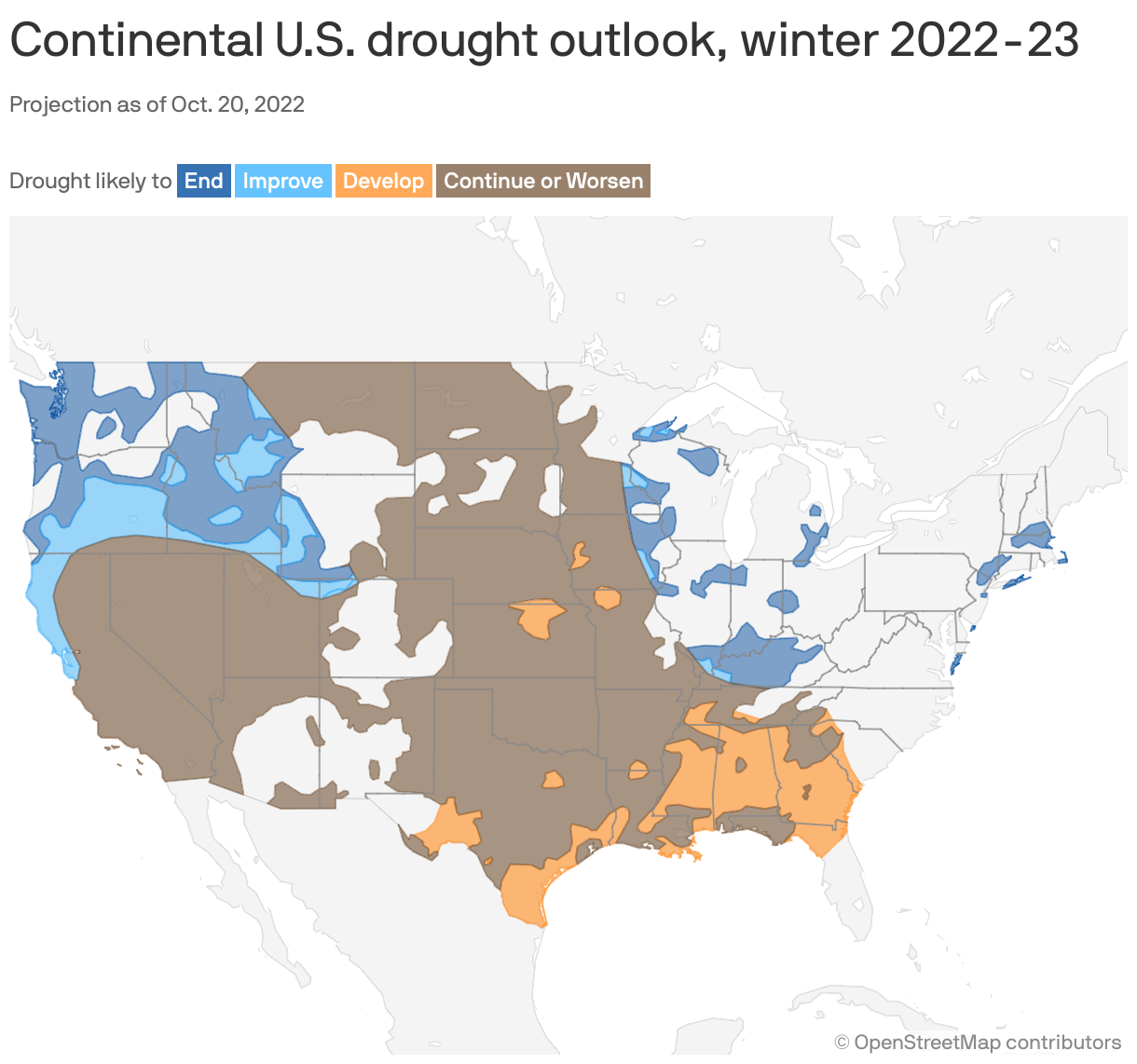
The third straight La Niña winter in the U.S. is likely to cause drought to expand and deepen from California to the Plains, branching out across the Southeast, NOAA said Thursday, Andrew writes.
How it works: Currently, water levels along certain stretches of the Mississippi River are so low that centuries-old shipwrecks are being revealed, and modern-day barge traffic is imperiled.
- Farmers in multiple states are facing the prospect of a challenging winter wheat season.
- And if, after a dry winter, spring rains falter in Texas, there would be a growing possibility of summer water supply constraints, experts warn.
The big picture: The new seasonal drought outlook through January depicts a weather pattern that is heavily influenced by a rare, three-winter "triple dip" La Niña in the tropical Pacific Ocean.
- La Niña conditions feature cooler-than-average ocean temperatures in the equatorial tropical Pacific. They can influence weather patterns worldwide.
- About 82% of the country was facing at least abnormally dry conditions as of Tuesday, the largest drought footprint in the Lower 48 states since the Drought Monitor was unveiled in 2000.
- Texas is entering the cool season with about 68% of its reservoir storage capacity, which compares to an average of 80% at this time of year, Texas state climatologist John Nielsen-Gammon told Axios via email.
Yes, but: Some areas got good news Thursday, with wetter conditions likely throughout winter in the Pacific Northwest.
What they're saying: “If we don't get replenishment this winter, and especially this spring after La Niña wanes away, water supply issues could become much worse than they were last summer in Texas,” Nielsen-Gammon said.
Between the lines: Climate change exacerbates weather whiplash, as regions oscillate between drought and flood.
- During dry periods like Texas is seeing, higher temperatures tend to make the droughts more severe than they otherwise would have been.
- Rainfall is coming in shorter torrents, which boosts surface water runoff without replenishing soil moisture, Nielsen-Gammon said.
2. Weather whiplash messes with Texas

Illustration: Shoshana Gordon/Axios
Texas illustrates the La Niña and climate change-related swings between drought and deluges, Andrew writes.
Driving the news: For example, the Dallas metro area saw most of its summer rainfall come in just three weeks between Aug. 10 and Sept. 5, said Victor Murphy, a meteorologist at the National Weather Service.
- During this period, Dallas experienced a 1,000-year rainstorm with about 15 inches of rain falling across the metro area on August 21-22.
- Some 3.01 inches of rain fell at Dallas Fort Worth International Airport in just one hour, setting an all-time record.
Context: Such extreme precipitation events are consistent with climate studies showing these are becoming more common and severe as temperatures increase.
- Since that three-week stretch ended, Murphy said, it has “turned bone dry.”
- This is the first calendar year with two separate 40-plus day stretches without measurable rainfall at DFW, Murphy said.
Threat level: Going into the cool season, Murphy said, Texas’ water resources are only about 13% better than they were at this point during the extreme drought in 2011 when supply worries reared their head during a La Niña summer.
- More people have moved to Texas, increasing water demand since then, Murphy noted.
- “I shudder to think where we would be right now without that three-week deluge,” he said.
3. 🏃🏽♀️Catch up fast on policy: oil and HFCs
The Interior Department said it will auction oil-and-gas drilling leases in the Gulf of Mexico on March 29, 2023, Ben writes.
Why it matters: The sale stems directly from the new climate law. To secure Sen. Joe Manchin's needed vote, it forces the Biden team's hand on selling more drilling rights. Go deeper.
The intrigue: Speaking of oil, National Security Council spokesman John Kirby said there's no timetable for the U.S. reevaluation of the relationship with Saudi Arabia in the wake of the OPEC+ production cut.
- U.S. officials opposed the move and called it a gift to Russia by propping up prices, but diplomatic fallout remains hazy. "We’re not going to rush this. I don’t have a timeline for you," Kirby told reporters.
- One interesting tidbit: The White House is not discouraging U.S. companies from attending next week's "Future Investment Initiative" confab in Saudi Arabia, dubbed "Davos on the desert."
Elsewhere on our policy radar...
🌍 EPA issued draft rules to govern the next phase of the congressionally mandated phase-down of hydrofluorocarbons.
Why it matters: HFCs are extremely powerful planet-warming gases. The U.S. is cutting use under a bipartisan 2020 law and to comply with an amendment to the 1987 Montreal Protocol.
4. Report: SEC plans to scale back climate rule
Photo illustration: Sarah Grillo/Axios. Photo: Chip Somodevilla/Getty Images
The SEC may significantly weaken planned rules on corporate emissions disclosures, the outlet Semafor reports, Ben writes.
Driving the news: The change would scuttle mandates that public companies reveal "Scope 3" emissions, it reports.
- That refers to emissions from use of companies' products in the economy or, for financial institutions, from their portfolio companies.
- The SEC, which issued draft rules in March, declined comment.
Why it matters: These emissions can dwarf what comes from companies' direct operations and the energy that powers them.
For instance, oil companies' Scope 3 emissions — such as gas burned in cars — are by far the biggest share of their total greenhouse gases.
The intrigue: Some big industries have been fighting the inclusion of Scope 3, or trying to scale back the requirements, calling the cost and complexity a major burden.
- More broadly, many companies, trade groups and environmentalists are intensely lobbying to shape the first-time mandates.
- The rule, which is behind schedule for completion, will also face litigation.
- Plaintiffs will likely claim it runs afoul of June's Supreme Court ruling that limits executive power without clear congressional instruction.
5. How AI could help translate extreme weather alerts

Illustration: Gabriella Turrisi/Axios
A startup that provides AI-powered translation is working with the National Weather Service to improve language translations of extreme weather alerts across the U.S., Axios' Ayurella Horn-Muller reports.
The big picture: Gaps in language access to emergency alerts during extreme weather events have led to missed evacuations, injuries and loss of life for non-English speakers. The NWS hopes machine learning could mitigate that.
How it works: Incorporating a mix of software and human translators, AI-translation service Lilt learns from linguists in real time using a neural network, or a computer system modeled loosely on the brain — which gets smarter with each use.
- The software gets used by human forecasters at the NWS forecasting office, with the AI engine suggesting translation for the translators to work with, while actively storing their input.
What they're saying: Phil Stiefel, solutions lead at Lilt, told Axios there is a longstanding need for better translation at the NWS.
- "If there's a translation error in a translated weather report, and somebody takes the wrong action based on that missed translation, then somebody could get hurt or even killed because of that," Stiefel says.
Of note: A 2021 research article in the American Meteorological Society looked at issues in English-to-Spanish translation of weather alerts that didn't account for dialects, which led to "inconsistent risk messaging," in Spanish-language alerts.
6. 🚗 Number of the day: $1.2 trillion
That's the tally from Reuters' updated analysis of how much automakers will spend through 2030 to develop and produce electric vehicles, batteries and raw materials.
Why it matters: It captures the recent surge in companies' investments and spending plans — the story calls it "is more than twice the most recent calculation published just a year ago."
🙏Thanks to Mickey Meece and David Nather for edits to today's newsletter. Have a great weekend and we'll see you Monday!
Sign up for Axios Generate

Untangle the energy industry’s biggest news stories


