Axios Generate

March 15, 2022

☕ Good morning. Today's Smart Brevity count is 1,180 words, 4.5 minutes.
🗓️ Join Axios virtually at our 1st What’s Next Summit on April 5. Register for sessions on trends that will revolutionize our future.
🚨 Follow Axios' live updates on the war in Ukraine.
1 big thing: Raskin's climate views imperil Fed nomination
Photo Illustration: Shoshana Gordon/Axios Photos: Bill Clark/AFP, Brooks Kraft/Getty Images
The likely collapse of Sarah Bloom Raskin's bid to be the Federal Reserve's top banking cop shows how deeply oil industry allies in Congress are dug in against weaving climate change into financial oversight, Andrew writes.
Catch up fast: Sen. Joe Manchin (D-W.Va) yesterday announced opposition to her nomination as vice chair of the Federal Reserve, effectively dooming her chances amid unified GOP opposition.
Why it matters: The stiff headwinds facing this nomination demonstrate how much resistance there is among the fossil fuel industry and their allies in Congress to integrating climate change risk analysis into the work of the country's top financial regulatory institution.
- It's not the analysis that worries opponents of her nomination, but where such studies might lead.
The big picture: Progressives and climate activists championed Raskin's nomination because they were eager to see someone with extensive knowledge of the ways in which climate change, through extreme weather and climate events, related geopolitical upheaval and other effects, poses economic risks.
- Not having her in the powerful role of vice chair of supervision means big banks will have less (but not zero) reason to worry about continuing to finance fossil fuel projects and plan for climate-related financial shocks.
The intrigue: The unprovoked Russian invasion of Ukraine impeded the Raskin nomination as well as gas prices skyrocketed, underscoring the importance of relying more on domestically produced energy.
- Manchin has been arguing for increasing U.S. oil and gas drilling in response to the war.
- In Raskin, he saw an impediment to that vision.
- So too did many oil and gas companies and their trade groups, which lined up in opposition to her nomination, while environmental groups supported her.
Zoom in: In announcing his opposition to Raskin's nomination, Manchin pointed to her climate views, stating: "Her previous public statements have failed to satisfactorily address my concerns about the critical importance of financing an all-of-the-above energy policy to meet our nation’s critical energy needs."
- Her writings as an academic show that not only did she think the Fed should ensure that banks get prepared for the consequences of climate change, but that she also thought banks and their regulators should play a positive role in a clean energy transition, shifting funding away from fossil fuels and toward clean energy.
- She offered assurances that it's not the Fed's job to pick energy winners and losers during her January testimony before the Senate Banking Committee, though ranking member Pat Toomey (R-Pa.) did not buy her comments, dismissing them as a "confirmation conversion."
Between the lines: Assuming Raskin is forced to bow out, then Banking Committee Republicans' tactic of boycotting attempts to vote on Biden's recent Fed nominees will have paid off.
2. Crude falls as traders weigh COVID's bite

Illustration: Aïda Amer/Axios
Crude oil prices have tumbled to their lowest levels since Russia began its invasion of Ukraine, with the U.S. benchmark WTI well under $100 per barrel again, Ben writes.
What they're saying: Via MarketWatch, Swissquote Bank analyst said in a note: “The downside correction in oil prices is sure a relief when it comes to the inflation expectations, but the new lockdown measures [in China] will continue worsening the supply chain crisis and add on the inflation worries."
"Expectations of positive developments in the Russia-Ukraine ceasefire talks bolstered hopes to ease tightness in the global crude market," said Fujitomi Securities analyst Toshitaka Tazawa, via Reuters.
Why it matters: The price shock from Russia's war has all kinds of spillover into the wider economy and gasoline prices in particular. There are political ramifications too as the midterm elections draw closer.
By the numbers: WTI is trading in the $95 per barrel range this morning after surging to $130 earlier this month, a 14-year high. The global benchmark Brent crude, which almost hit $140, is hovering around $100.
3. Charted: Russia's fossil export destinations
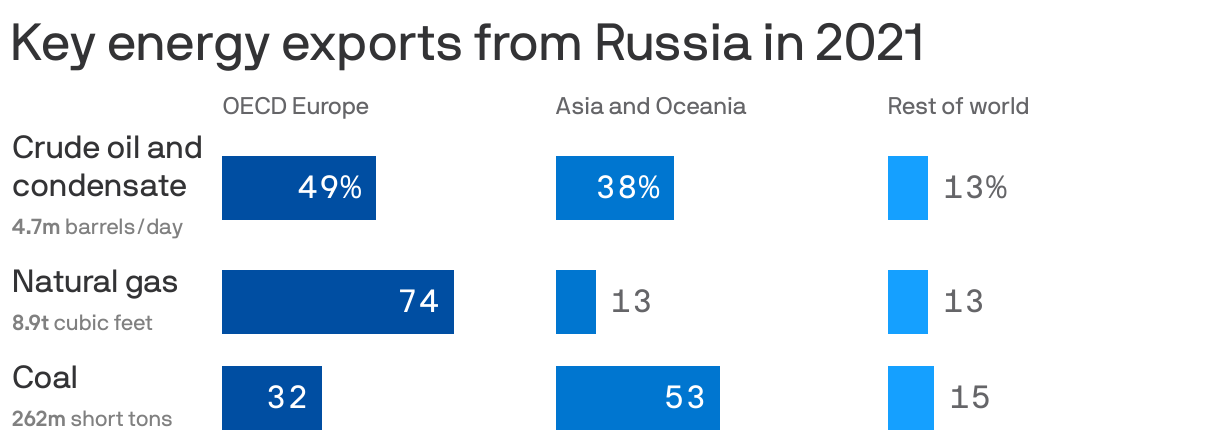
The Energy Information Administration is out with a helpful primer on the Europe-Russia energy interdependence, Ben writes.
Why it matters: The chart above captures how this relationship creates vulnerabilities for Europe and huge revenues for Vladimir Putin's regime.
What we're watching: Whether European Union officials can make good on their emerging plans to end the bloc's reliance on Russian fossil fuels this decade.
4. Energy loan office gets an upgrade

Illustration: Eniola Odetunde/Axios
The Energy Department's Loan Programs Office (LPO) has seen its portfolio upgraded two levels from "high-risk" single-B to "investment-grade" following an internal risk rating review, an office spokesman confirmed to Axios' Alan Neuhauser.
Why it matters: The LPO provides billions of dollars in loans and loan guarantees for projects that might struggle to find backing elsewhere.
- The office had been largely dormant in closing new loans for more than 10 years, but Energy Secretary Jennifer Granholm has made LPO — and its $43 billion in loan authority — central to her efforts to decarbonize the nation's energy infrastructure.
- The rejuvenated LPO now has 77 applications in the pipeline requesting $71 billion of loan proceeds, director Jigar Shah says.
Catch up fast: LPO new loan activity all but ceased after a $500 million loan guarantee to the solar manufacturer (wait for it) Solyndra went sideways in 2011, unleashing fierce partisan backlash against the Obama administration. The Trump administration showed no interest in LPO.
- However, LPO turned a profit on the $30 billion it had loaned, with a default rate of less than 3%. It today earns about $500 million a year in interest income, Shah says.
- To industry observers and political watchers, despite the breathless coverage of Solyndra, the program offers a relatively low-risk, low-cost way for the government to support domestic energy innovation.
Thought bubble: After 10+ years, your Axios Pro Climate Deals team believes we've reached the statute of limitations on mentioning "Solyndra" in every LPO story.
5. A venture bet on climate-smart irrigation tech

Illustration: Aïda Amer/Axios
Tel Aviv-based SupPlant, an ag-tech startup that makes smart sensors for crops, raised $27 million in Series A funding, the company told Axios' Megan Hernbroth.
Why it matters: Agricultural firms often find themselves on the front lines of climate crises from unusual freeze events to scorching temperatures.
Managing crop irrigation with predictive software could insulate the $1t industry from potential future shocks.
What's happening: Red Dot Capital led the round with participation from Menomadin Foundation, Smart-Agro Fund, Mivtah Shamir, Deshpande Foundation, PBFS and Maor Investments.
- SupPlant has raised $46 million in private funding to date. The valuation for its most recent round was undisclosed.
The big picture: SupPlant claims to improve crop yields during major weather events using its data on plant stressors and irrigation recommendations, CEO Ori Ben Ner told Axios.
Megan Hernbroth will co-author the Axios Pro Climate deals newsletter. Join the waitlist now.
6. Catch up fast: Courts, Tesla, shale
Climate: "The Australian government has won an appeal against a ruling that it has a duty of care to protect children from harm caused by climate change." (BBC)
Electric cars: "Tesla has hiked the prices of its electric vehicles in the U.S. and China after CEO Elon Musk warned of inflation pressure on the business." (CNBC)
Shale: "Oil output in the Permian in Texas and New Mexico, the biggest U.S. shale oil basin, is due to rise 70,000 barrels per day (bpd) to a record 5.208 million bpd in April, the U.S. Energy Information Administration (EIA) said." (Reuters)
Editor's note. The fourth item has been corrected to reflect that the portfolio upgrade announced by director Jigar Shah at CERAWeek and confirmed by the LPO was an internal risk rating upgrade. The portfolio was not updated by the credit agencies.
Thanks so much for reading. Hope you have a good day, and see you back here tomorrow.