Axios Generate

April 01, 2022

🍺 Hello Friday. Hello readers. Hello April. (Going for a "Goodnight Moon" vibe here.) Anyway, today's Smart Brevity count is 1,076 words, 4 minutes.
🚨Situational awareness: "Russian gas was still flowing to Europe on Friday despite a deadline set by President Vladimir Putin to cut it off unless customers start paying in roubles." (Reuters)
🔍 Follow Axios' live updates on the war.
1 big thing: Biden seeks a crosswalk between oil and clean energy
Illustration: Annelise Capossela/Axios
Two White House initiatives unveiled Thursday show how President Biden is struggling to navigate an oil supply crunch without letting his clean energy goals blow even further off-course, Ben writes.
Catch up fast: Biden announced the release of up to 180 million barrels of oil from the Strategic Petroleum Reserve and urged U.S. producers to speed up tepid production growth, too.
- But he's also invoking executive security powers under the Defense Production Act to try to speed U.S. production of key minerals used in electric car batteries and clean power projects.
Why it matters: The Russian war has forced a president who wants to hasten the transition away from fossil fuels toward embracing more oil production and natural gas exports.
It's an effort to lower U.S. gasoline prices, which are a political vulnerability for Democrats, and help Europe curb reliance on Russian gas supplies.
What they're saying: Biden and his aides say there's no tension between the goals of nearer-term domestic supply to curb pump prices and tackling climate change with clean energy.
In White House remarks, Biden said he's looking "not only to ease the pain that families are feeling right now, but to end this era of dependence and uncertainty, and to lay a new foundation for true and lasting American energy independence."
Yes, but: It's not so simple, for all kinds of reasons.
- Oil industry officials say the White House is sending mixed signals about oil's domestic future that deter investment. Bloomberg has a good look at this dynamic.
- And a reminder that investor pressure for returns over growth, as well as supply chain constraints, are a check on the pace of output increases, too.
- When it comes to clean energy, Biden's big domestic spending plan remains stuck on Capitol Hill. Environmentalists also fear that more support for oil and LNG will lock in fossil fuel development.
What we're watching, part 1: In the near term, the price of crude oil and gasoline.
- The announcement of releasing about a million SPR barrels per day over six months — and word it was coming — helped push crude oil prices downward.
- But one big question is how much crude from emergency stockpiles other countries may release. The IEA has convened an emergency meeting today that could provide some answers.
What we're watching, part 2: That's whether Biden's use of the Cold War-era DPA will be enough to significantly boost domestic output and processing of materials like lithium and cobalt.
"The DPA directive seems likely to benefit the few in-service facilities, and mines further along the development pipeline, but it may do little to expedite new facilities," the research firm ClearView Energy Partners said in a note.
Go deeper: As gas prices soar, Biden's climate ambitions sputter (New York Times)
2. EVs' critical mineral thirst
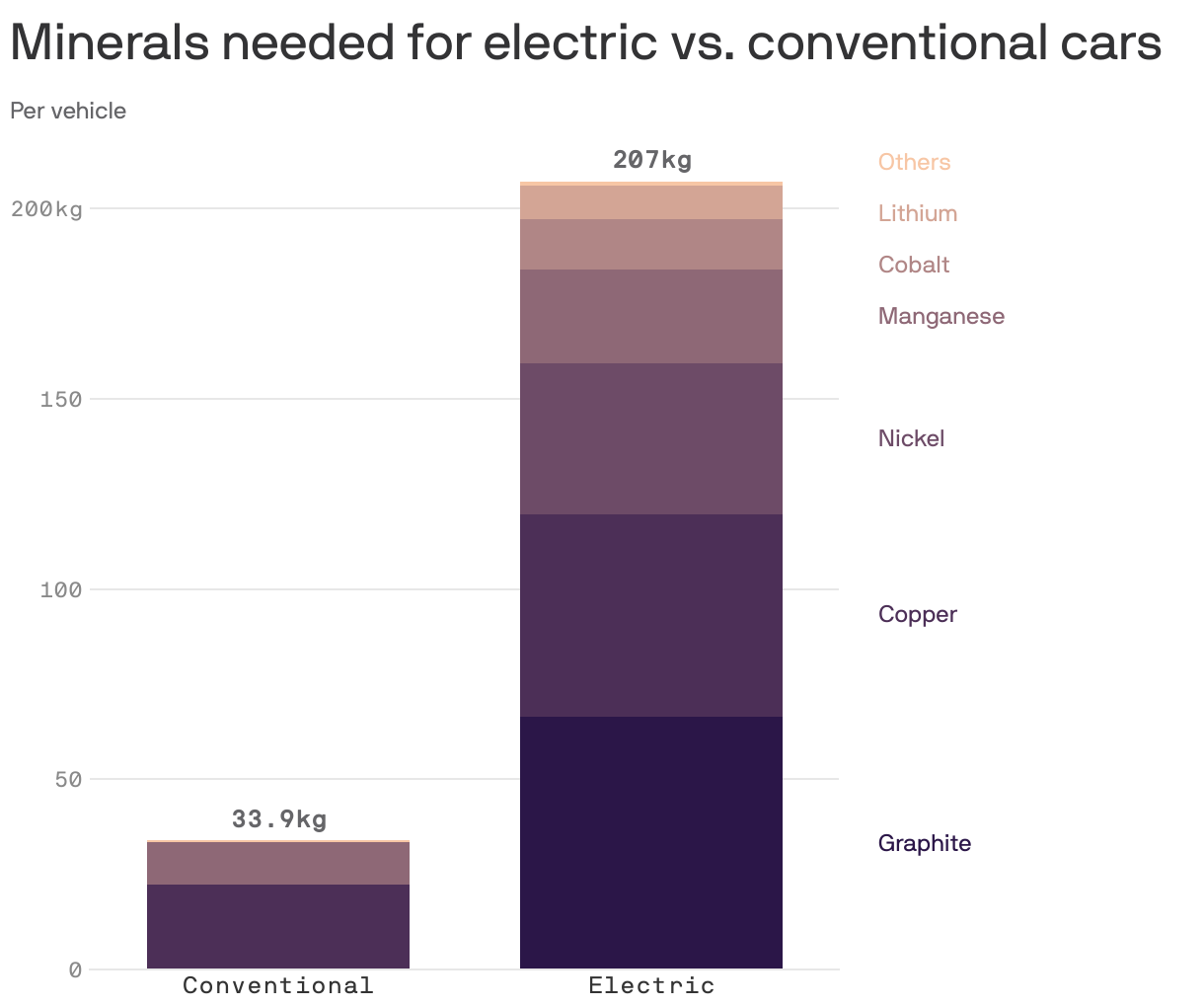
This chart shows why a huge expansion of electric car manufacturing and sales — a major White House goal — will require a lot more supply of critical minerals, Ben writes.
Why it matters: The White House said Biden's use of the Defense Production Act to spur more domestic development of critical minerals will curb reliance on China and other nations for materials that will "power our clean energy future."
3. A new push to make net zero less messy

Illustration: Aïda Amer/Axios
The United Nations hopes to bring some order to the Wild West of net-zero emissions pledges, Ben writes.
Why it matters: Carbon-neutral and net-zero emissions targets are becoming the coin of the realm among corporations, as well as local, state and regional governments.
But lack of common definitions, metrics and more means it's difficult to make apples-to-apples comparisons, track progress, and catch greenwashing.
Driving the news: Enter the new "High-Level Expert Group on the Net-Zero Emissions Commitments of non-State Entities" that Secretary-General António Guterres announced Thursday.
Catherine McKenna, Canada's former climate minister, leads the new group.
Zoom in: Goals include criteria for assessing pledges, verification and accounting of progress, and a "roadmap to translate standards and criteria into international and national level regulations."
The bottom line: McKenna, in a statement, said the "recent avalanche" of pledges will be vital to keeping the Paris Agreement goals alive, "but only if all pledges have transparent plans, robust near-term action, and are implemented in full."
Go deeper: UN chief names panel to probe companies' climate efforts (Associated Press)
4. Climate tech comes to YC's Demo Day

Illustration: Gabriella Turrisi/Axios
Y Combinator's Demo Day this week featured 31 startups focused explicitly on addressing climate change in some way, Axios' Megan Hernbroth reports.
Why it matters: Y Combinator is one of the most respected startup accelerators in Silicon Valley, having produced companies like Airbnb and Coinbase, and this year's climate cohort was its biggest and best-funded to date.
By the numbers: YC funded all 31 startups to the tune of $500,000 each, an increase from previous cohorts that received $125,000 for completing the program.
- It's the most climate-specific investments YC has made in a single cohort, a YC representative confirmed to Axios. It has funded 91 climate startups to date.
Zoom in: The companies funded covered a range of increasingly popular areas within climate technology.
The bottom line: Silicon Valley sees climate tech as a growing investment opportunity after years of avoiding the market due to previously unsuccessful bets. Go deeper
Megan Hernbroth co-authors the Axios Pro Climate deals newsletter. Sign up now.
5. Manchin's energy terms spook progressives

Photo illustration: Sarah Grillo/Axios. Photo: Alex Wong/Getty Images
Capitol Hill progressives don’t like what they hear when they listen to Sen. Joe Manchin’s (D-W.Va.) talk about a potential climate and deficit-reduction bill, Axios' Hans Nichols reports.
Why it matters: The holdout senator is hinting at supporting some climate provisions as part of a slimmed-down Build Back Better legislation.
- But House and Senate progressives worry any final bill will be heavier on energy independence favored by oil-and-gas companies — and lighter on the carbon reduction they seek.
- In a 50-50 Senate — and a Democratic majority with just half a dozen votes to spare in the House — progressive opposition to a smaller reconciliation package could kill any potential deal.
What they're saying: Rep. Alexandria Ocasio-Cortez (D-N.Y.) said Manchin’s proposal sounds like a “fossil-fuel bill.”
“When he says he wants to act on climate, I think it's quite understandable that people would meet that with a great deal of disbelief,” she told Axios.
The other side: Earlier in the week, Manchin signaled parameters for any potential climate and energy bill.
"I will not vote to put the United States of America in a position … to basically end up like Europe," the senator told a West Virginia radio show, according to the Free Beacon.