Axios Generate

December 20, 2024


🍾 Welcome to 2024's last newsletter! We're going out with a quick 1,275 words, 5 minutes. Thanks for reading, and we'll return Jan. 2.
🚨 Situational awareness: Donald Trump is threatening new tariffs on the EU unless it tackles its "tremendous deficit" to the U.S. with "large scale" oil and gas purchases.
- State of play: U.S. energy exports to Europe have already grown since Russia invaded Ukraine. But EU officials quickly signaled they're open to more, CNBC reports on Trump's overnight post.
📻 And happy birthday to Chris Robinson of the Black Crowes, who have today's intro tune...
1 big thing: From the Hague to Helena, climate court cases abound
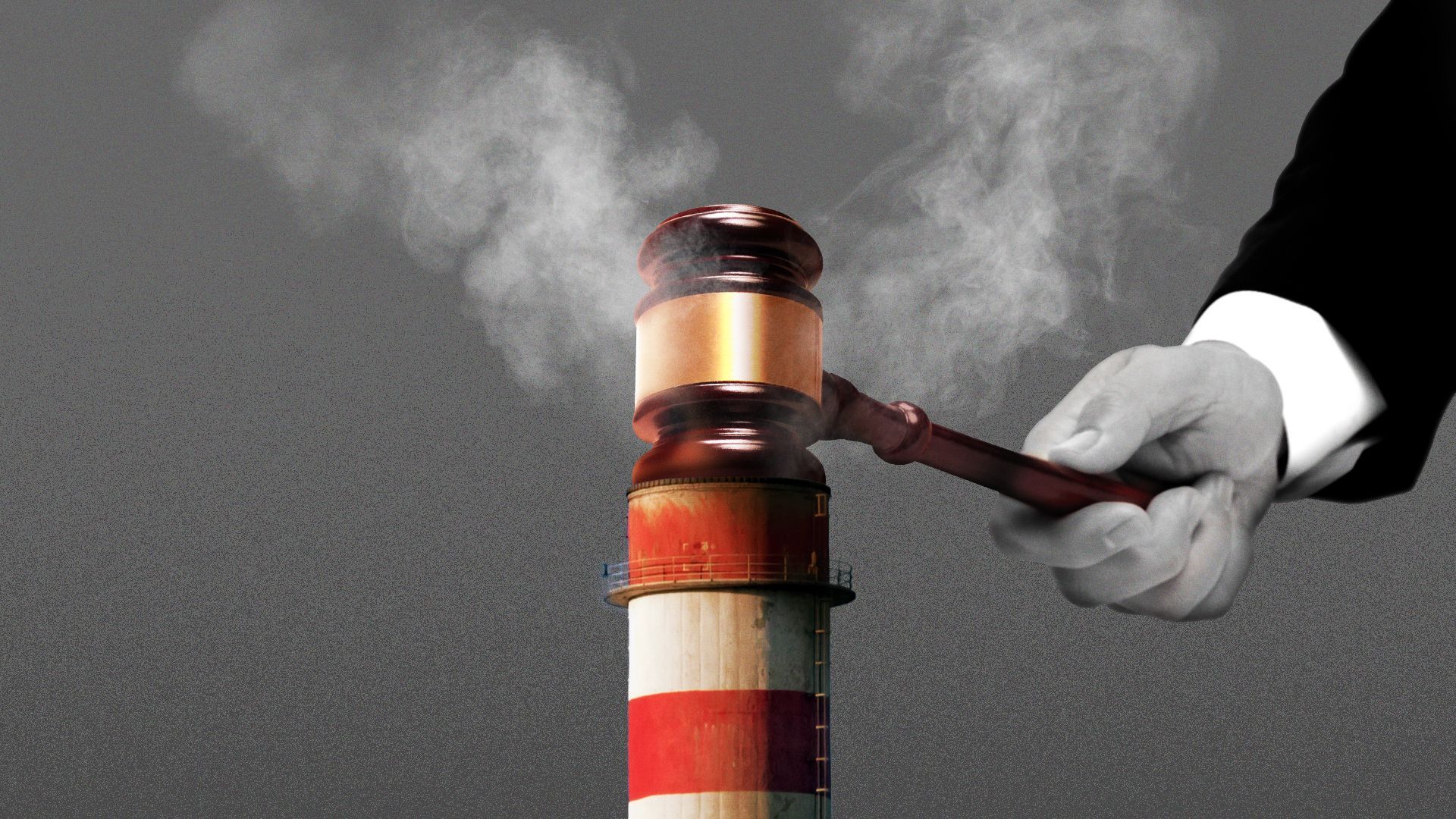
Court cases involving climate change are taking on increased importance with global efforts proceeding far slower than the climate is warming and national policy subject to whiplash.
Why it matters: Cases under deliberation at the Hague, newly decided in Montana and in process elsewhere show that courts are increasingly receptive to the duty of governments and corporations to limit emissions.
What they're saying: The surge in cases is a symptom of those entities' failures to act on climate, says Patrick Parenteau of the Vermont Law School.
- "The courts aren't going to save us, but when the political process is failing, that's where you turn to," he told Axios in an interview.
The big picture: In the U.S., cities, states and citizens have pursued legal action to force the government and fossil fuel industry to take responsibility for causing global warming and enact new emissions curbs or provide compensation for climate change-related damage.
- This month has brought two major developments that may mark a turning point in climate change-related legal battles.
- At the International Court of Justice at the Hague, the tiny island nation of Vanuatu brought a case seeking an advisory opinion on the obligations that countries have to combat global warming.
- A rare two weeks of public testimony has concluded, but not before fractures between industrialized and developing nations were laid bare.
Then, on Wednesday, a 6-1 majority on the Montana Supreme Court backed a lower court's decision that the state's fossil fuel policies and lack of action to curb global warming violated young people's constitutional right to a clean environment.
- The decision in Held v. Montana also directs state agencies to consider greenhouse gas emissions from proposed development projects.
State of play: The Montana decision is especially significant since several other states have similar constitutional provisions, potentially leading to a domino effect of state legal actions to force certain steps to be taken.
- Illinois, Pennsylvania, New York, Massachusetts and Rhode Island have similar constitutional provisions, and efforts are underway to enact language in other states, said Michael Gerrard, a climate change law scholar at Columbia University.
Zoom out: Gerrard said legal action on climate change can be effective in settings in which courts are independent and influential.
- He noted cases in the Netherlands that spurred governmental action and a Supreme Court ruling in Nepal that resulted in Parliament passing a climate law.
- "The courts are having an influence in some cases," he told Axios in an interview.
2. 👀 Exclusive: New cash for tackling climate risk to grid with AI

Sunairio, an AI-driven weather and climate modeling software firm aimed at boosting energy grid reliability, raised $6.2 million in a new funding round, Axios has learned.
Why it matters: The investment demonstrates the demand for software that uses AI to provide specific and actionable information for the energy industry.
Zoom in: The round was led by Buoyant Ventures along with Constellation Technology Ventures and MassMutual Ventures' Climate Tech Fund.
- It brings Sunairio's total external funding to $8.8 million.
- The company's software can help utilities and energy traders manage increasing grid volatility due to growing amounts of intermittent renewable energy sources, along with rising electricity demand from data centers and elsewhere, according to CEO Rob Cirincione.
- Sunairio is also geared toward helping the energy industry anticipate and minimize disruptions from more frequent and severe extreme weather events.
The intrigue: Sunairio developed a high-resolution, probability-based climate model system tailored for managing energy supply and demand.
- Its projections span from 15 days to 15 years. They aim to capture so-called "black swan" events that might not show up if projections were mainly based on historical data.
- According to Cirincione, Sunairio produces asset-level climate simulations down to the wind turbine level that can support commercial decision-making, unlike existing modeling tools from its private sector competitors and public weather and climate agencies.
- "What we need is high-resolution data that's going to predict or provide insights for weather right on top of a wind farm, or right where a solar panel is," Cirincione said.
The intrigue: The company's research into using generative AI for climate simulation earned a National Science Foundation grant earlier this year.
- Cirincione said current computer models from NOAA, climate risk management firms and even the promising AI models from big tech firms don't yet meet energy companies' needs.
3. 💡 One big idea: Microgrids for data centers

☀️ New analysis makes a financial and climate case for solar microgrids — paired with storage and generators — to meet hyperscalers' huge AI-driven power needs.
Why it matters: Tech companies need energy ASAP. And that appetite is bringing fears that data centers will hinder power sector decarbonization.
Driving the news: A joint report by experts from Stripe, Scale Microgrids and Paces says large microgrids should muscle into the conversation that's now largely about gas, utility-scale renewables, and nuclear.
What they found: Project timelines of two years or less are much faster than new nuclear. They also beat new co-located gas plants, it argues, citing 3-year lead times for turbines.
State of play: Meanwhile, there are long interconnection waits for utility-scale solar. It also describes barriers to other options on cost or logistics.
The bottom line: "While building off-grid solar microgrids of this magnitude would be a first, it's very possible to do with technology that exists today, and to scale it quickly."
4. 🔢 Biden's (potential) data center drive and the angst in tow
There are growing signs of an 11th-hour White House effort to fast-track data center build-outs — and plenty of worries emerging about it, too.
Catch up quick: National Economic Council head Lael Brainard yesterday offered the latest signs that some kind of plan is afoot in comments to Bloomberg and a Brookings Institution speech.
- "What we're working on is actions to retain that key AI power infrastructure here in America, to address land, power and permitting constraints," she told the news outlet.
Why it matters: The potential effort would allow "massive data centers" and power plants on federal lands, "responding to worries that the United States could fall behind other nations in the race to dominate artificial intelligence," WaPo reports, following up a Politico piece.
- Bloomberg's piece, citing an anonymous official, said it's focused on finding "a small number of federal sites" to speed construction near clean energy.
State of play: "This administration is continuing to work with all stakeholders to ensure the U.S. leads the world in AI and AI data centers are powered by clean energy without raising electricity costs for consumers," Robyn Patterson, a White House spokesperson, tells Axios.
What we're watching: Whether any of this actually happens as the clock winds down on Biden's term, and the pushback to the still-vague plans.
- Environmentalists and several Democratic senators are trying to head things off at the pass.
5. 💬 Quote of the day: LNG geopolitics edition
"Putin could have succeeded in shattering the Ukraine coalition if it hadn't been for U.S. LNG, because the economic costs for Europe would have been too high. The disruption would have been too high."— Energy analyst Dan Yergin in an interview with Axios
Yergin, the famous energy historian and vice chair of S&P Global, made the point as S&P rolled out a new study claiming major economic benefits from the industry.
State of play: The analysis — funded by the pro-export U.S. Chamber of Commerce — landed the same day as DOE's big LNG study with very different findings in climate and economics.
6. ⚛️ Number of the day: up to 24 gigawatts
That's the amount of power envisioned in the flurry of deals between tech and nuclear companies to build new reactors as data center needs soar, per ClearView Energy Research.
Why it matters: Tech giants "may be among a narrow field of players with the financial wherewithal and risk tolerance sufficient to pursue new advanced reactors," they note.
Yes, but: These deals are not binding or firm financial commitments, ClearView cautions.
📨 Did a friend, colleague or even a frenemy send you this newsletter? Welcome, please sign up.
🙏 Thanks to Chris Speckhard and Chuck McCutcheon for edits to today's edition, along with the brilliant Axios Visuals team.