
Axios Generate

November 07, 2023
👨🍳 We've got a diverse menu today, but keep the tables turning with a Smart Brevity count of just 1,045 words, 4 minutes.
🎶 A double dose of Lorde trivia! Today's her birthday, and exactly 10 years ago she ruled the Billboard Hot 100 with today's intro tune...
1 big thing: EVs have a mileage problem

Illustration: Sarah Grillo/Axios
Evidence is piling up that electric vehicles are driven much less than gas-powered models, which could sap the tech's power against climate change if the trend continues, Ben writes.
Driving the news: A new peer-reviewed paper analyzed odometer readings of used cars listed from 2016 to 2022.
- Fully electric cars average nearly 4,500 fewer miles annually than conventional models.
- Battery SUVs also saw a gap, although not as large.
The big picture: The data may signal comparatively fewer high-mileage drivers are making the switch, the authors say.
- And EV owners may be using them as a second car alongside a gasoline model, researchers writing in Joule suspect.
- "Range anxiety" due to "immature" charging infrastructure may be a factor.
Why it matters: "For maximum impact, we need the highest-mileage drivers behind the wheel of EVs rather than low-mileage drivers," co-author John Helveston, an engineering professor a George Washington University, said in a statement.
Catch up fast: Multiple studies using different methods have reached some version of this conclusion about EV miles.
- For instance, in 2021 we covered a study of California driving habits based on home electricity data.
Yes, but: Only a surveillance state could create a perfect window into drivers' habits, so every study has limitations.
- One here: this dataset only captures EVs that owners got rid of. That could tilt the data toward drivers who decided the tech was a "poor fit."
- And relying on used car data weights the analysis toward older models.
The bottom line: The big question is whether EV drivers today — and going forward — better mimic gas-powered car owners.
- "I would echo the caveat from the authors that these analyses tell us mostly about older EVs. It will be interesting in future work to examine driving patterns for newer EVs," UC Berkeley's Lucas Davis, who wrote a separate study, tells me via email.
Go deeper: Helveston explained the findings in a thread on X.
2. Shocker: Earth has warmest October on record
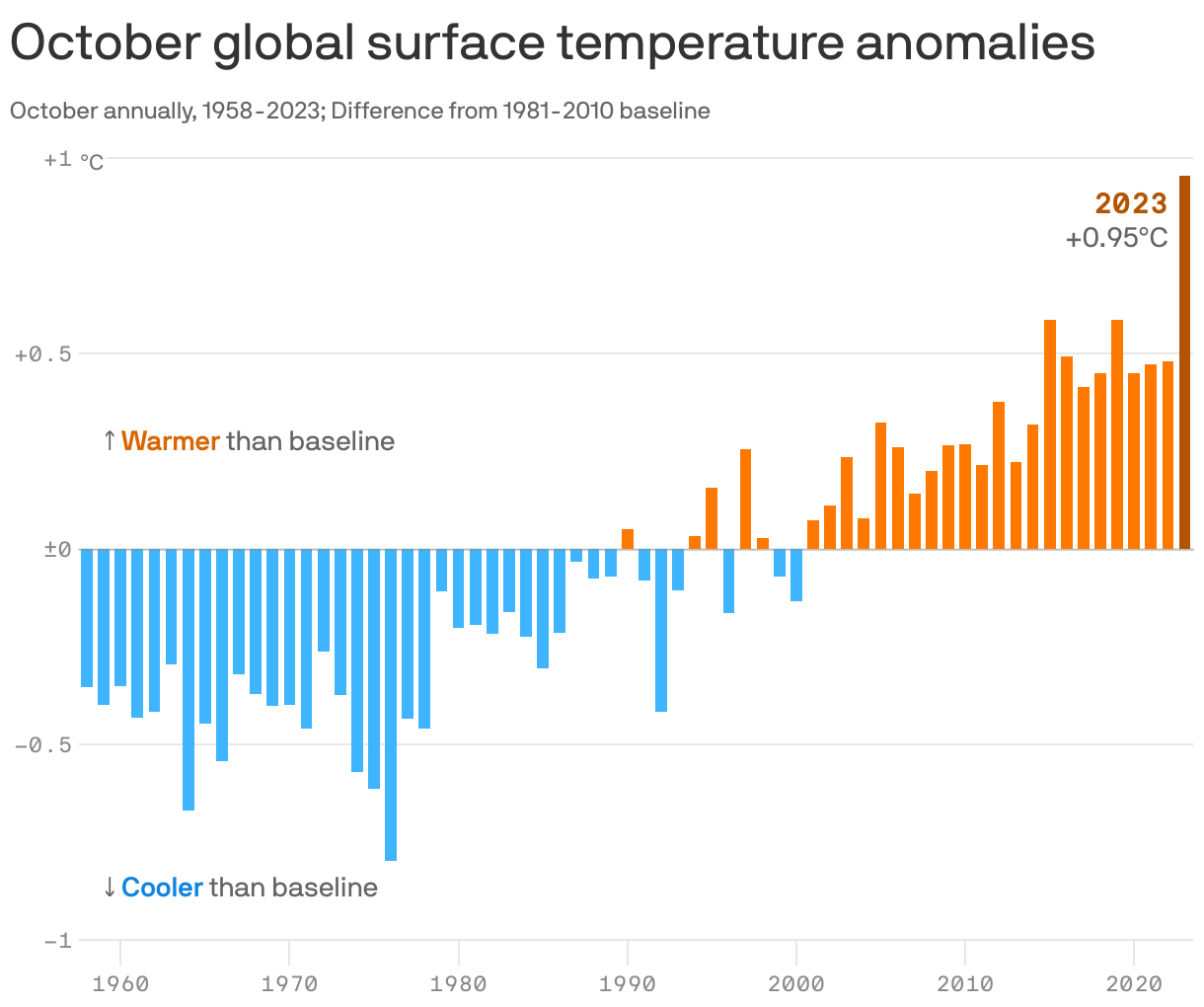
Last month may not have been as "gobsmackingly" hot as September, but the globe set a decisive record for its warmest October on record, Andrew writes.
Driving the news: The findings, from European and Japanese research center data, come from computer model re-analyses. That involves cobbling together data from buoys, surface weather stations, satellites and other sources in near-real-time.
Why it matters: Earth is well on its way to having its warmest year on record, peppered with deadly extreme weather events. Many of these would likely have been less severe if there were fewer excess greenhouse gases from human activities.
By the numbers: Based on data from the Japan Meteorological Agency, October had a monthly temperature departure of 0.95°C (1.71°F) from the 1981-2010 average.
- There is an ongoing strong El Niño event, but it cannot account for each of the shattered records this year.
What they're saying: "While not quite as bananas as September, it remains gobsmackingly warm," climate scientist Zeke Hausfather told Axios via email.
- "It was the second highest monthly temperature anomaly (e.g. departure from normal) that we've seen all year after September 2023," Hausfather said.
What's next: Expect other climate milestones to be announced throughout the month as international scientific institutions weigh in with their numbers, released in the run-up to the COP28 climate summit in Dubai, which starts Nov. 30.
3. Crude oil's 70s show and a big pipeline deal
Illustration: Annelise Capossela/Axios
📉 U.S. oil prices fell below $80 per barrel for the first time since August, Ben writes.
- Why it matters: Mixed economic signals, for the moment, carry more market weight than geopolitical risks from the Israel-Hamas war.
- State of play: WTI, the U.S. benchmark, is trading around $79 this morning.
💵 Kinder Morgan is buying NextEra Energy Partners' Texas gas pipeline network in a $1.8 billion deal.
- The big picture: It's part of power giant NextEra's focus on renewables. And Bloomberg notes that pipeline companies are "increasingly turning to acquisitions for growth" amid hurdles to building new infrastructure.
4. On my screen: AI and mining
Illustration: Eniola Odetunde/Axios
🧠 Cleaner power grids are also more complex — and artificial intelligence can help overcome those challenges to maximize carbon cuts, Ben writes.
- The big picture: A new IEA post explores how AI can help integrate large-scale and residential renewables, demand response, smart grids and other tech. It's already happening.
- State of play: Grids increasingly involve multidirectional flows. Another important area is matching demand with times of highest renewables output.
- The bottom line: There's a "vastly greater need for information exchange — and more powerful tools to plan and operate power systems as they keep evolving."
⛏️ Data wiz Hannah Ritchie's latest post nicely contextualizes the huge amount of mining needed to expand climate-friendly power, transport and industrial tech.
- Why it matters: It's still, on net, far less extraction than fossil fuels. And that's even with huge waste rock volumes created to obtain commodity-grade copper, nickel and more.
- Yes, but: Mining still needs to respect human rights and occur with environmental guardrails, she notes.
- The bottom line: "Fears that the energy transition will lead to a massive global expansion of mining is not backed by the data."
5. 🏃🏽♀️ Catch up fast on policy: Renewables and construction

Illustration: Sarah Grillo/Axios
☀️ Top Biden aides say the country's renewable power expansion is showing important progress despite headwinds hitting the sector, Ben writes.
- Driving the news: The Interior Department on Monday said it's "advancing" 15 projects on public lands in western states.
- State of play: That includes two California solar projects now online that total nearly 900 megawatts.
- Go deeper: The New York Times has more.
🏗️ The agency that oversees federal buildings is pouring $2 billion into 150 construction projects that use "low-embodied carbon" types of steel, concrete, glass and more.
- Why it matters: The General Services Administration effort is part of a wider White House push to use government procurement to boost the market for climate-friendly goods and energy. Reuters has more.
6. 🧮 Number of the day: $100 billion
The amount California's public employee retirement fund (CalPERS) plans to invest in climate solutions by 2030, Ben writes.
Why it matters: It would more than double the current climate-related investment from the nation's largest public pension fund.
- Fund managers say it will boost portfolio performance while fighting climate change.
What's next: They're eyeing higher exposure to areas like renewables, water management, carbon-trapping building material and far more.
The intrigue: "Government policies, like Inflation Reduction Act (IRA), positively impact the economics of mitigation solutions and create new opportunities," a strategy deck states.
Did someone forward you this newsletter? Welcome, and please sign up.
🙏 Thanks to Chris Speckhard and Javier David for edits to today's edition, along with the talented Axios Visuals team.
Sign up for Axios Generate

Untangle the energy industry’s biggest news stories