Axios Generate

January 19, 2024
🕺 Made it! Friday. Today's newsletter has a Smart Brevity count of 1,260 words, 5 minutes.
🎶 Happy birthday to the late, great Janis Joplin, who has today's intro tune...
1 big thing: Biden team looks to jolt EV charging
Illustration: Natalie Peeples/Axios
The White House is scrambling to ensure U.S. EV adoption doesn't lose its charge amid signs — albeit limited — of slowing momentum, Ben writes.
Why it matters: The charging focus gives Biden officials a way to promote EVs even though a fairly limited number of models — for now — are eligible for $7,500 purchase subsidies.
- They're also emphasizing charging-related jobs as polls show worrying political signs for President Biden on the economy.
Driving the news: The Treasury Department this morning announced plans for regulations governing household and business tax breaks up to 30% for installing charging equipment.
- The wonky but important part: Its definition of census tracts eligible for credits under the 2022 climate law is broad, covering two-thirds of the U.S. population, officials said.
State of play: It's among several charging initiatives that have been unveiled in recent days.
- On Thursday, the Transportation Department announced nearly $150 million in grants to repair and replace nearly 4,000 existing charging ports across 20 states.
- Last week brought $623 million in DOT grants for cities and rural regions nationwide to install public charging.
The big picture: Polling shows that charging access gives drivers pause about going electric.
- For instance, a new Deloitte survey shows 40%-42% of U.S. respondents call it their greatest concern about EVs.
Catch up fast: The latest moves are part of a much wider charging push, much of it enabled by the 2021 infrastructure law that devotes billions of dollars to building a national network.
- However, the first of these taxpayer-funded chargers have only begun opening recently.
The intrigue: The White House is rebutting perceptions that the U.S. EV transition is losing steam.
- They're emphasizing a wide angle, noting that sales have more than quadrupled under Biden.
- However, while U.S. sales are still rising, the growth rate appears to be easing a bit, and Detroit automakers GM and Ford have been tempering expectations.
- The latest sign of these tempered expectations arrived just this morning when, via Bloomberg, Ford said it's scaling back production of its F-150 Lighting electric pickup.
2. Our shrinking carbon budget

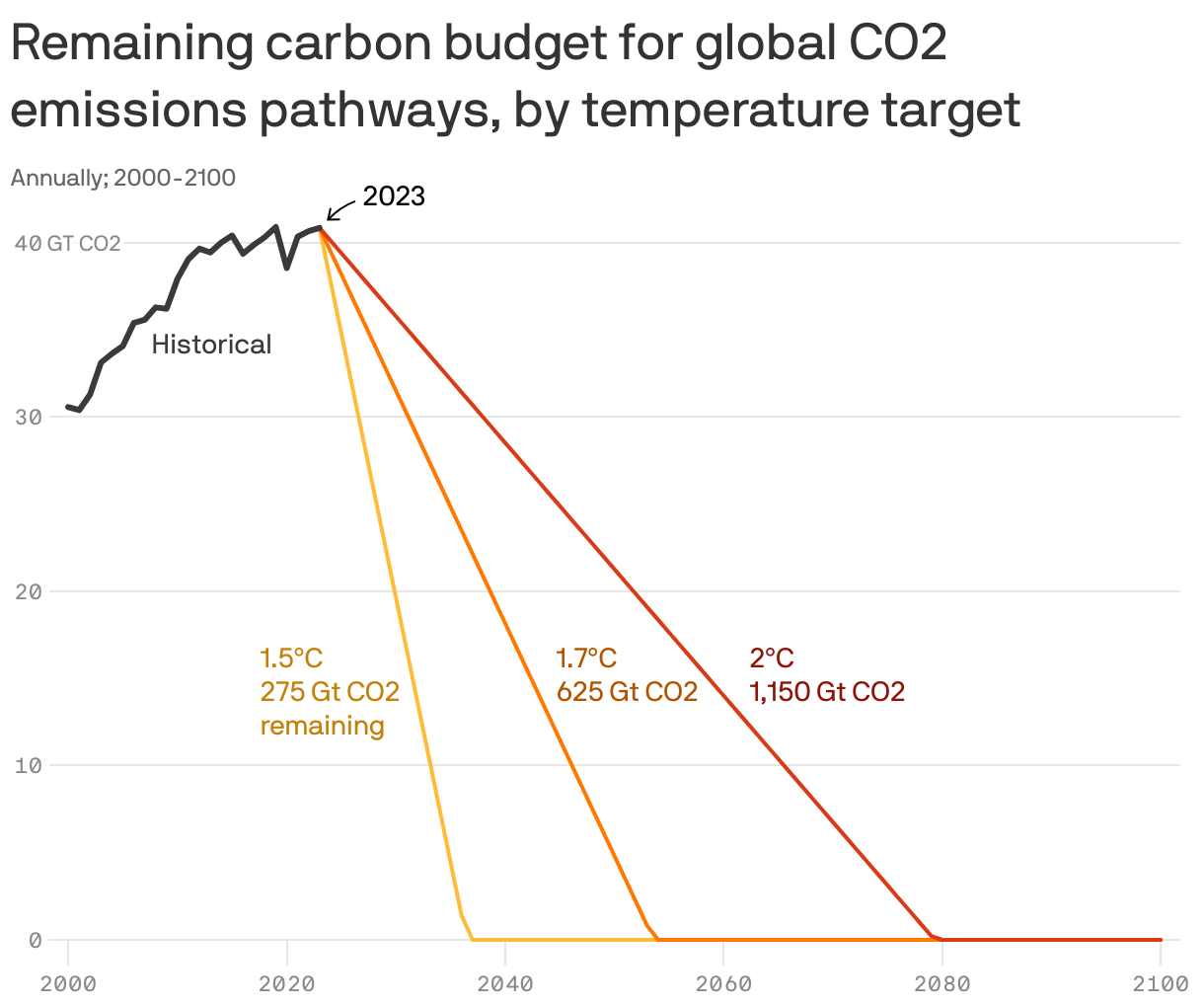
Each year that passes without rapid and sustained cuts in greenhouse gas emissions makes it dramatically harder to limit warming to the Paris Agreement's 1.5°C or 2°C targets, Andrew writes.
Zoom in: Adhering to Paris' 1.5-degree target, which is a ceiling of warming that climate studies show may be needed to avert potentially catastrophic warming effects, would necessitate an extraordinarily steep emissions drop.
- The longer we wait for emissions to plunge, the steeper and more unrealistic that curve becomes.
- A less steep, but still challenging pathway would yield Paris' 2°C target, but even that slope in emissions is nowhere close to where emissions are headed now — speeding the world towards more than 3°C (5.4°F) of warming above preindustrial levels.
The intrigue: In fact, the numbers in that chart's carbon budget, while reflective of 2023 greenhouse gas emissions, might be even smaller in reality.
- We may have even less carbon to "spend" before we skate past the Paris goals.
- A study published in October found that the world had just six years left at 2022 emissions rates to have a 50% chance of limiting warming to 1.5°C.
- That only increases to about two decades at the same initial emissions rate for a 66% chance of hitting the 2°C target.
Our thought bubble: Climate action is happening faster than ever, from technological developments to public policies. But it's still not happening anywhere near fast enough.
3. On my screen: geopolitics

Illustration: Shoshana Gordon/Axios
🗺️ A Foreign Affairs piece warns of geopolitical tensions that could slow energy transition — and argues this topic gets short shrift in climate diplomacy circles, Ben writes.
The big picture: "[M]uch of the real work needed to advance the energy transition falls outside the realm of the UN climate negotiating mechanism," write Columbia's Jason Bordoff and Harvard's Meghan O'Sullivan.
Why it matters: They argue the geopolitical landscape will dictate the pace of energy transition just as much as climate finance and tech advancements.
Threat level: One worry is that nations looking to curb reliance on Chinese tech "risk going too far toward protectionism in the name of energy security and resilience."
What we're watching: Another risk is 2024 electoral success of far-right parties that don't support acting on climate — and the authors see this already underway in Argentina and elsewhere. This demands policies that address "feelings of powerlessness related to discontent over lost jobs, high inflation" and more.
4. On my screen, part 2: social science

Illustration: Eniola Odetunde/Axios
📝 A Nature essay on challenges to implementing the U.S. climate and infrastructure laws shows that soft sciences can help bring firm results, Ben writes.
Threat level: Social science research suggests "under-appreciated resistance" to boosting transmission and supply infrastructure; persuading consumers to use tax incentives, and "changing political processes required to enact policies at municipal, state and federal levels," it states.
Yes, but: Social science findings can also help lower these barriers, the authors say. For instance, there are policy frames that can help reduce political polarization around climate tech.
The intrigue: It includes a cool table that describes behavioral "plasticity" challenges to adoption of specific technologies, and hypotheses about levels of political polarization around them.
The bottom line: Passage of huge energy and climate bills just begins the heavy lifting.
5. Capitol Hill's next climate fight is over CO2 pipelines
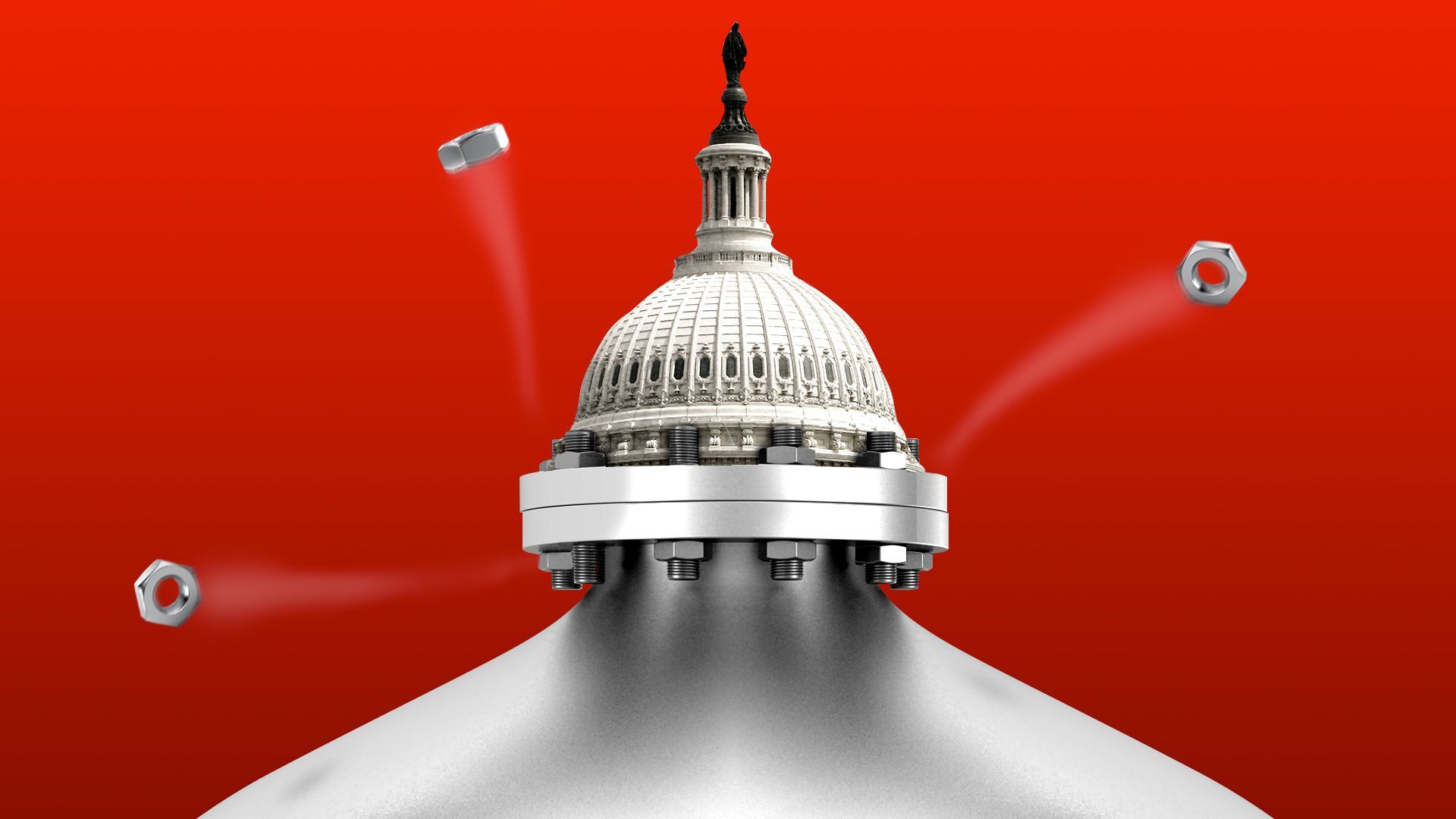
Illustration: Aïda Amer/Axios
Carbon dioxide pipelines are a new frontier shaping congressional debates about energy transition, Axios Pro's Jael Holzman and Nick Sobczyk report.
Why it matters: New infrastructure and climate laws in recent years offer billions of dollars to help build pipeline networks to move captured CO2.
- But the potential boom is fracturing the left and creating tricky political problems in traditionally Republican areas.
- "There's massive ignorance within the Democratic Party about this," Rep. Jared Huffman (D-Calif.) told Nick.
State of play: Concerns about these pipelines have been coloring work on reauthorizing the Pipeline and Hazardous Materials Safety Administration.
The House Transportation and Infrastructure Committee's bipartisan reauthorization bill would clarify PHMSA's authority over CO2 pipes and move toward new safety standards.
Between the lines: Look for CO2 pipelines to also get wrapped up in broader Hill conversations about permitting and "clean" energy infrastructure.
- Climate hawks and the energy industry expect to massively expand the CO2 pipeline network, juiced by expanded tax credits for carbon capture in the Inflation Reduction Act and billions for demonstration projects in the 2021 bipartisan infrastructure law.
Unlock the whole story — and vital scoops and analysis every week — by talking to our sales team about Axios Pro: Energy Policy.
6. 🏃🏽♀️ Catch up fast: FEMA, oil, EVs
🌀 Via the NYT, the Federal Emergency Management Agency is overhauling disaster assistance programs by "expanding aid for survivors of hurricanes, wildfires and other catastrophes and making it easier to access."
🛢️ Bloomberg reports that "oil deliveries from Saudi Arabia and Iraq totaling almost 9 million barrels are delayed as tankers switch routes to travel the longer way around Africa, rather than transiting the Red Sea."
💵 The WSJ reports that the nascent market for "clean" energy tax credits under the 2022 climate law is "surging faster than expected, with deals totaling as much as $9 billion already done and tens of billions more expected this year."
- State of play: The law not only expanded tax breaks for energy projects but creates direct-pay and transferability that enable more parties to monetize and use the subsidies.
7. 💬 Quote of the day: AI and markets edition
"We believe the very large power demand growth from [generative AI] is not well understood, and not priced into a number of stocks that will benefit from this growth particularly within the sectors that provide the components and infrastructure to data centers."— Morgan Stanley analysts in a wide-ranging look at themes to watch in 2024
📬 Did a friend send you this newsletter? Welcome, please sign up.
🙏 Thanks to Chris Speckhard and Chuck McCutcheon for edits to today's edition, along with the talented Axios Visuals team.