
Axios Generate

February 15, 2024
🔭 If you squint just right, the weekend is edging into the picture. This edition has a Smart Brevity count of 1,234 words, 4.5 minutes.
🎶 Our editor extraordinaire Javier David saw the legendary Stevie Nicks play last night, so she's got today's intro tune...
1 big thing: Amazon rainforest nears tipping points
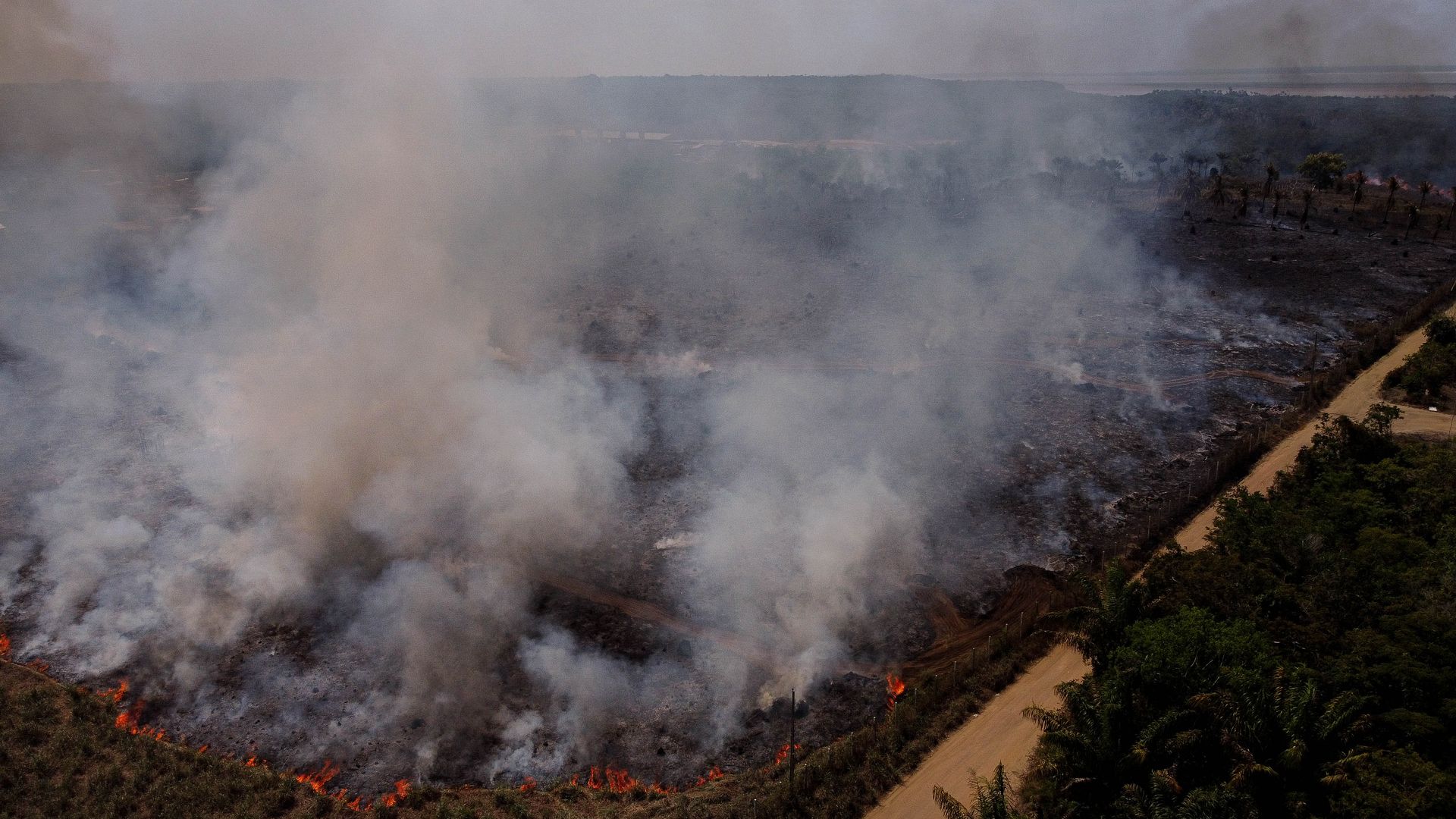
A mixed area of fields and Amazon rainforest burns in 2023. Photo: Gustavo Basso/NurPhoto via Getty Images
As much as half of the Amazon rainforest may cross tipping points as soon as 2050, beyond which those areas would no longer support such an abundance of life and buffer Earth from climate change, a new study shows, Andrew writes.
Why it matters: The Amazon is home to more than 10% of Earth's biodiversity and holds up to 20 years' worth of global carbon dioxide emissions.
Threat level: It is also extremely fragile in the face of climate change, which along with deforestation has largely driven its decline.
- If large parts of the rainforest were to deteriorate and abruptly transition into a different type of ecosystem, it would affect the entire planet's carbon balance sheet.
Yes, but: A catastrophic collapse of the entire forest is unlikely during this century, the study published yesterday in the journal Nature says.
- Though the study finds it's plausible that up to half of the Amazon forest will cross tipping points by 2050, it says that is not inevitable.
- Greenhouse gas emissions cuts and curbs in deforestation, among other measures, would reduce the likelihood and severity of large-scale shifts, the study finds.
Zoom in: An international team of scientists examined possible points at which portions of the Amazon would transition permanently into a totally different type of ecosystem.
- The researchers find that by 2050, between 10% and 47% of Amazonian forests may undergo sudden ecosystem transitions that could worsen regional climate change, with global consequences.
What they did: The study combines multiple lines of evidence to look at five major drivers of water stress on the Amazon, and the critical thresholds of these factors that could trigger tipping points.
What they're saying: In the southern Amazon, the dry season has grown 4 to 5 weeks longer since 1979, study coauthor Carlos Nobre told Axios via email.
- He pointed to a combination of global warming-related droughts, such as the one this year, and deforestation for lengthening the dry season.
- "We need urgently nature-based solutions. Zero deforestation, degradation and fires," he said.
- "All of that can help avoid the tipping point, but only if we globally succeed in not letting the global warming exceed 1.5°C."
2. Key energy body under scrutiny as it turns 50

Illustration: Shoshana Gordon/Axios
The International Energy Agency — which turns 50 this year — has new plans and new problems as it navigates middle age, Ben writes.
Why it matters: The multilateral group formed after the 1973 oil embargo coordinates supply security and, in recent years, has greatly increased focus on climate change.
State of play: This week's ministerial meeting and birthday party brought announcements including ...
- Opening talks with India on becoming a full member and plans for the Paris-based IEA to open a Singapore office — nods toward Asia's importance in energy demand and transition.
- New work to "develop a framework with actionable tools" for helping nations secure critical minerals.
The intrigue: The climate group Oil Change International yesterday urged IEA to ensure future transition finance analyses will have "strong recommendations to immediately halt finance flowing to fossil fuels."
- On the other side, a blunt new WSJ op-ed by oil analyst Bob McNally accuses IEA of straying from clear-eyed analysis in favor of politicized climate wish-casting.
- IEA sees global oil and gas use peaking this decade. But critics say that even its most cautious modeling, in recent years, began putting too much faith in aspirational national policies.
- This isn't just dorm room chatter. Its work is constantly cited by policymakers, academics and journalists.
- McNally and some others see IEA's work creating an unrealistically low sense of how much supply investment is needed.
Yes, but: IEA boss Fatih Birol, on "Bloomberg Talks" this week, noted that it's not alone in seeing an oil demand peak this decade.
- "After we said it, several ... oil and gas companies in Europe repeated the same thing," he said.
3. 🏃🏽♀️ Catch up fast: Oil and ESG
🛢️ Speaking of IEA, its latest monthly oil market analysis underscores a post-COVID turning point, Ben writes.
- The big picture: "The expansive post-pandemic growth phase in global oil demand has largely run its course," the agency notes.
- Zoom in: IEA reiterated its view that consumption growth will be nearly cut in half this year to 1.2 million barrels per day. Momentum loss was already apparent in late 2023, with Q4 gains slowing a lot.
- State of play: The agency sees supply growth outpacing demand this year. But don't get too comfy — geopolitical risks and low inventories could still bring volatility. Reuters has more.
💵 Via the Financial Times, "JPMorgan's $2.5tn asset management arm has left Climate Action 100+, an investor group that prods companies into action on global warming, saying its division now has the capacity to do corporate climate engagement on its own."
4. Great Lakes ice cover sets mid-February record
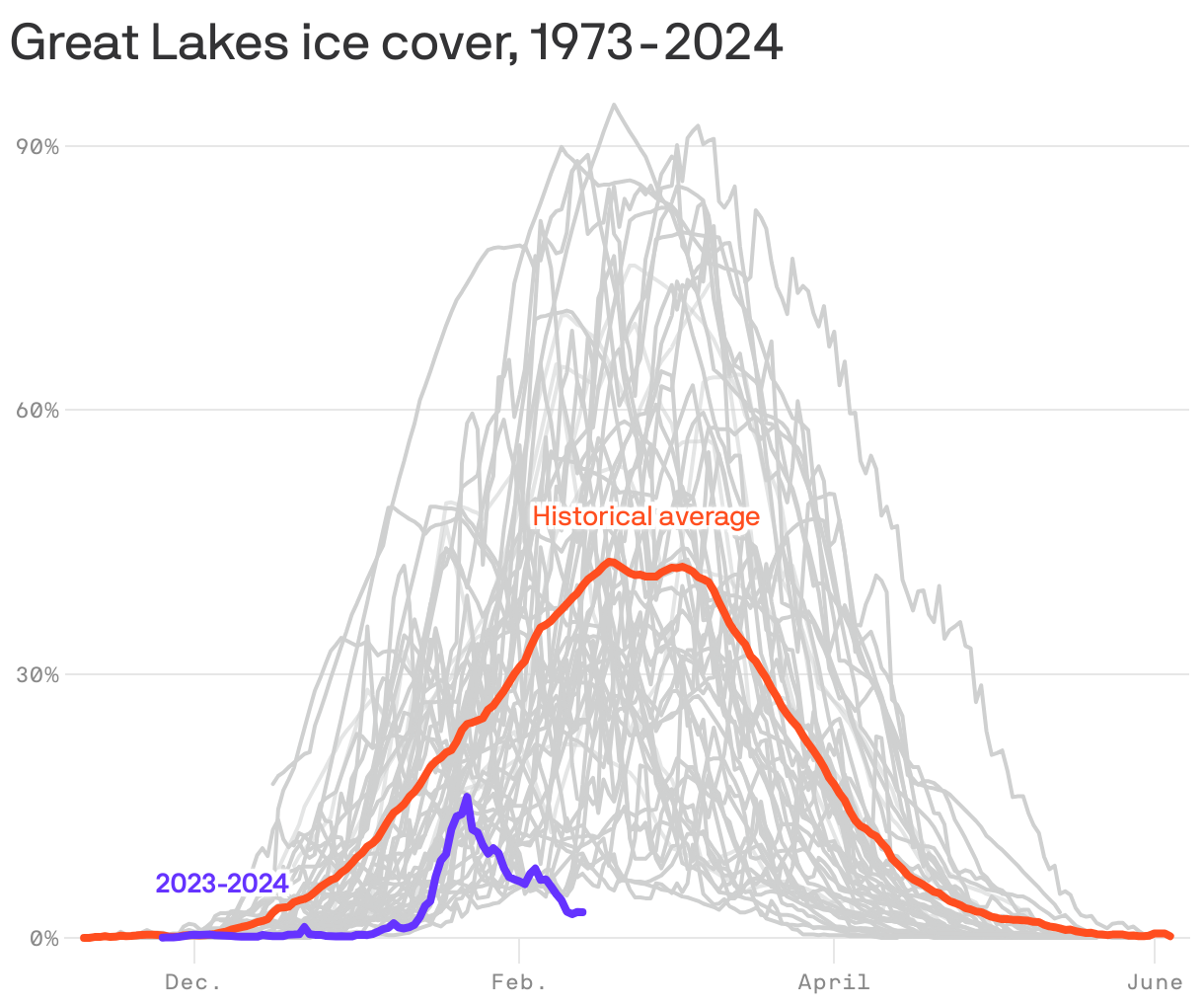
Great Lakes ice cover is record low for mid-February after starting out the same way early in the season, Andrew writes.
The big picture: The absence of ice this winter coincides with record-warm temperatures and a "lost winter" residents of the Great Lakes states and Midwest have experienced.
- According to NOAA, Lakes Erie and Ontario have lake ice that is tied with historic lows, while Lakes Superior, Michigan and Huron (typically some of the coldest), are at record-low levels of ice.
- The below-average snow and ice and unusually mild conditions are likely tied to climate change and a more transient El Niño climate pattern.
Of note: Portions of the Great Lakes states are on their way to having their warmest winter seasons on record (meteorological winter ends at the end of February).
5. Google and greens launch powerful methane tracker

Illustration: Rae Cook/Axios
A new initiative merges satellite tracking with AI and other powerful computing to create an Eye of Sauron-style tool for tracking methane, Ben writes.
Why it matters: Methane is a powerful planet-warming gas, and oil and gas infrastructure is among the largest sources.
What's new: The Environmental Defense Fund next month will launch MethaneSAT, which will orbit Earth 15 times per day from 350 miles above.
- Google is providing Cloud computing and applying AI to the satellite imagery.
- The combined mapping and analyses create "unprecedented" power to pinpoint emissions — and give useful info to companies, researchers and the public, they said.
- MIT Technology Review has more.
The big picture: "We're effectively putting on a really high-quality set of glasses, allowing us to look at the Earth and these emissions with a sharpness that we've never had before," EDF chief scientist Steven Hamburg told reporters.
What we're watching: How it might aid corporate and regulatory efforts.
- And over 155 nations back a voluntary pledge to cut methane emissions by 30% by 2030 (relative to 2020).
6. 🏎️ Automakers pressed to "race" for green steel

Illustration: Natalie Peeples/Axios
Climate NGOs are linking arms to push automakers toward adoption of steel produced with low-carbon methods, Ben writes.
Why it matters: Steel furnaces are mostly coal-powered today. The industry produces 8%-ish of global CO2 emissions.
What's new: Enter the "Race to Green Steel."
- It's a partnership between RMI, Calstart, Industrious Labs, International Council on Clean Transportation, and the Climate Group.
What's next: They hope to deepen automakers' work with existing initiatives to boost procurement and set targets.
- That spans efforts within those groups and outside, like the U.S.-launched "First Movers Coalition," which aims to create a "demand pull" for clean tech from massive industries.
The big picture: The new coalition says automakers could cut 30%-50% of vehicles' "embodied emissions" with just very small price increases.
The bottom line: Clean steel is rare and more expensive today, but there's fresh energy behind helping big buyers change the equation.
📬 Did a friend send you this newsletter? Welcome, please sign up.
🙏 Thanks to Chris Speckhard and Chuck McCutcheon for edits to today's edition, along with the brilliant Axios Visuals team.
Sign up for Axios Generate

Untangle the energy industry’s biggest news stories


