
Axios Generate

March 13, 2024
🐪 Halfway there. Today's edition gets you over the hump with a Smart Brevity count of 940 words, 3.5 minutes.
🎶 Exactly 20 years ago, Usher and guests were atop the Billboard Hot 100 with today's all-timer of an intro tune...
1 big thing: Methane's "worrying trends"


Fresh data shows the persistence of fossil fuel methane emissions — but with it offers hope of potential changes, Ben writes.
Why it matters: It's a powerful planet-warming gas, and the energy industry is the second-largest source of human-caused methane (after agriculture).
- Meeting Paris targets requires steep cuts.
Driving the news: Energy-related emissions inched up in 2023 and remain around 2019's record levels, the International Energy Agency said this morning.
- There is a small silver lining. While fossil fuel use has expanded, methane intensity — that is, amount per unit of production — has dropped a bit.
The big picture: Roughly 70% of methane from fossil fuel production comes from the top 10 emitting nations, IEA finds.
- The U.S. is the largest source from oil and gas operations, while China is tops from coal.
Friction point: The agency sees both "signs of progress and some worrying trends."
- There's no shortage of pledges, including new ones at last year's UN climate summit, and emissions are falling in some areas.
- If all national and corporate targets are fully met, methane from fossil fuels would drop 50% by 2030.
Yes, but: At least for now, the landscape of national and corporate pledges is strewn with mirages.
- "[I]n most cases, these pledges are not yet backed up by detailed plans, policies and regulations," IEA finds.
The intrigue: Steep cuts are quite feasible — in theory.
- IEA estimates two-thirds of methane from fossil fuels can be avoided with known and existing tech, "often at low — or even negative — cost."
The bottom line: Despite signs of progress, the heavy lifting remains.
2. Why effective research about Africa requires more Africans

Illustration: Shoshana Gordon/Axios
Research into Africa's energy transition is surging, but scientific course corrections would make this work more useful, a new analysis concludes.
Why it matters: Providing energy for development, and better living standards, while limiting carbon dioxide is a big 21st century challenge, Ben writes.
The big picture: The study in Energy Policy explored 156 peer-reviewed papers with transition modeling. Among the findings:
- Nearly two-thirds of the papers are written exclusively by authors outside of Africa.
- Research on energy and emissions pathways is often siloed from studies on development.
- Transition modeling for Africa gives relatively little attention to nuclear, carbon capture, hydrogen and geothermal.
Friction point: These trends leave knowledge gaps.
- Papers written with African scholars focus more often on individual nations — a needed thing because policies are rarely continental.
- "[S]ome important country-specific characteristics and challenges related to implementing energy transition policies are less likely to be addressed in studies with no Africa-based researchers," they note.
What's next: More support for local researchers from African governments and international donors would help, it states.
- Another recommendation: "The dual challenge of economic development and climate change calls for more multidisciplinary collaborative research to address the two issues within the same framework."
3. New in tech finance: Protein and DAC

Illustration: Aïda Amer/Axios
🥩 The Bezos Earth Fund is providing an initial $60 million to create "Bezos Centers for Sustainable Protein," part of a wider $1 billion program on climate-friendly food systems, Ben writes.
- Why it matters: The meat industry is a huge source of greenhouse gas emissions. But alternative proteins — the plant-based and nascent lab-grown variety — remain a small market compared with traditional sources.
- What's next: "The Centers will target major technological barriers to reducing cost, increasing quality, and boosting nutritional benefit of alternative proteins by advancing science and technology," the announcement states.
🎣 Direct air capture startup CarbonCapture just landed $80 million in Series A finance.
- Why it matters: Deep pockets are increasingly interested in the nascent space. Amazon and Saudi Aramco are among the Series A investors, and Prime Movers Lab led the round.
- Go deeper: Talk to our sales team about Axios Pro: Climate Deals for more on this — and a steady diet of must-read daily scoops and analysis.
4. One policy thing: Freight emissions push
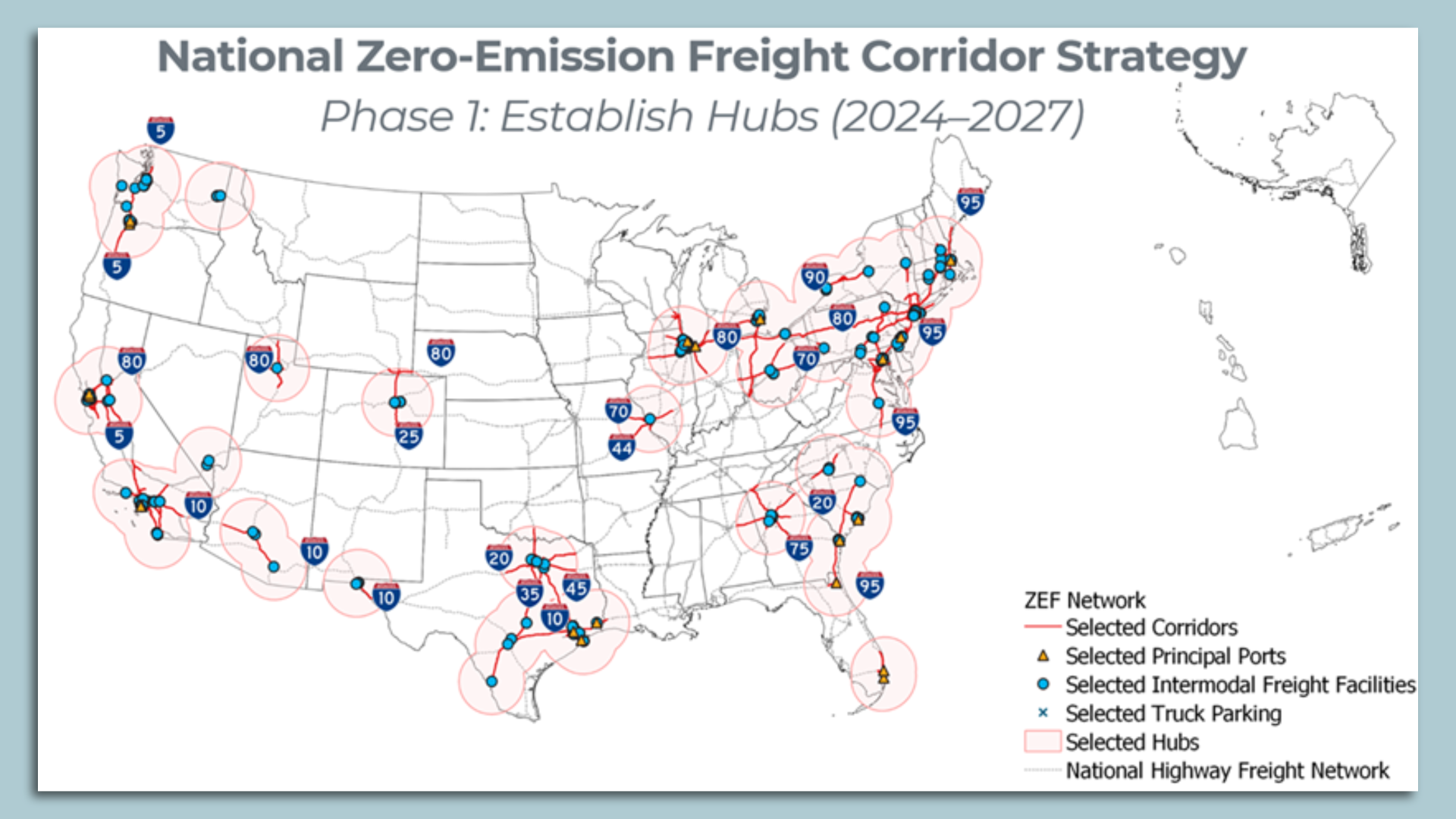
Image courtesy of the Joint Office of Energy and Transportation
Biden officials have unveiled a detailed road map to help spur buildout of charging and hydrogen refueling infrastructure for big trucks, Ben writes.
Why it matters: Diesel-powered freight movement is a big source of CO2 and dangerous air pollutants like fine particulate matter.
- Yet lack of infrastructure to support electric and hydrogen models is a barrier to deployment.
The big picture: Enter the new "National Zero-Emission Freight Corridor Strategy."
- It's designed to help guide public dollars and catalyze private investment, but it also aims to "focus utility and regulatory energy planning" at local and regional levels and "align" industry activity.
- Officials see a tool for breathing life into the administration's goal of zero-emissions models reaching 30% of medium- and heavy-duty truck sales in 2030, and 100% by 2040.
Threat level: These trucks spew roughly a fourth of all greenhouse gases from U.S. transportation, the announcement states. And transportation is the largest overall emissions source.
Catch up fast: Recent years have given officials new money and policy tools, such as billions in the bipartisan infrastructure law for refueling infrastructure.
The bottom line: The strategy is an attempt to get lots of voices singing in harmony.
5. 🧮 Number of the day: $469 billion
That's the amount of "surplus" factory investment for clean tech manufacturing — largely batteries and solar equipment — slated to come online over the next three years.
Why it matters: The tally, via the research firm BloombergNEF, is part of a report warning that Chinese output is a double-edged sword, Ben writes.
- It's driving down the price of energy transition but also threatens domestic industrial policy goals in the U.S. despite climate law subsidies.
Threat level: "Global price pressures, and especially cheaper and cheaper imports, will result in many U.S. factories facing a pretty rude awakening ... and it will probably lead to a lot of factory cancellations," BNEF analyst Pol Lezcano tells Bloomberg.
📬 Did a friend send you this newsletter? Welcome, please sign up.
🙏 Thanks to Chris Speckhard and Javier E. David for edits to today's edition, along with the brilliant Axios Visuals team.


