Axios Generate

September 05, 2024


🥞 Welcome back! We're serving up 1,233 words, 4.5 minutes.
⚡ Situational awareness: The Agriculture Department today announced $7.3 billion for rural electric cooperatives to build "clean" energy projects.
- Officials called it the biggest investment in rural electricity since the New Deal. Project selections...Reuters coverage
📻 This week in 1990, the late George Michael released "Listen Without Prejudice Vol. 1," which provides today's stellar intro tune...
1 big thing: Heat wave envelops Southwest, West
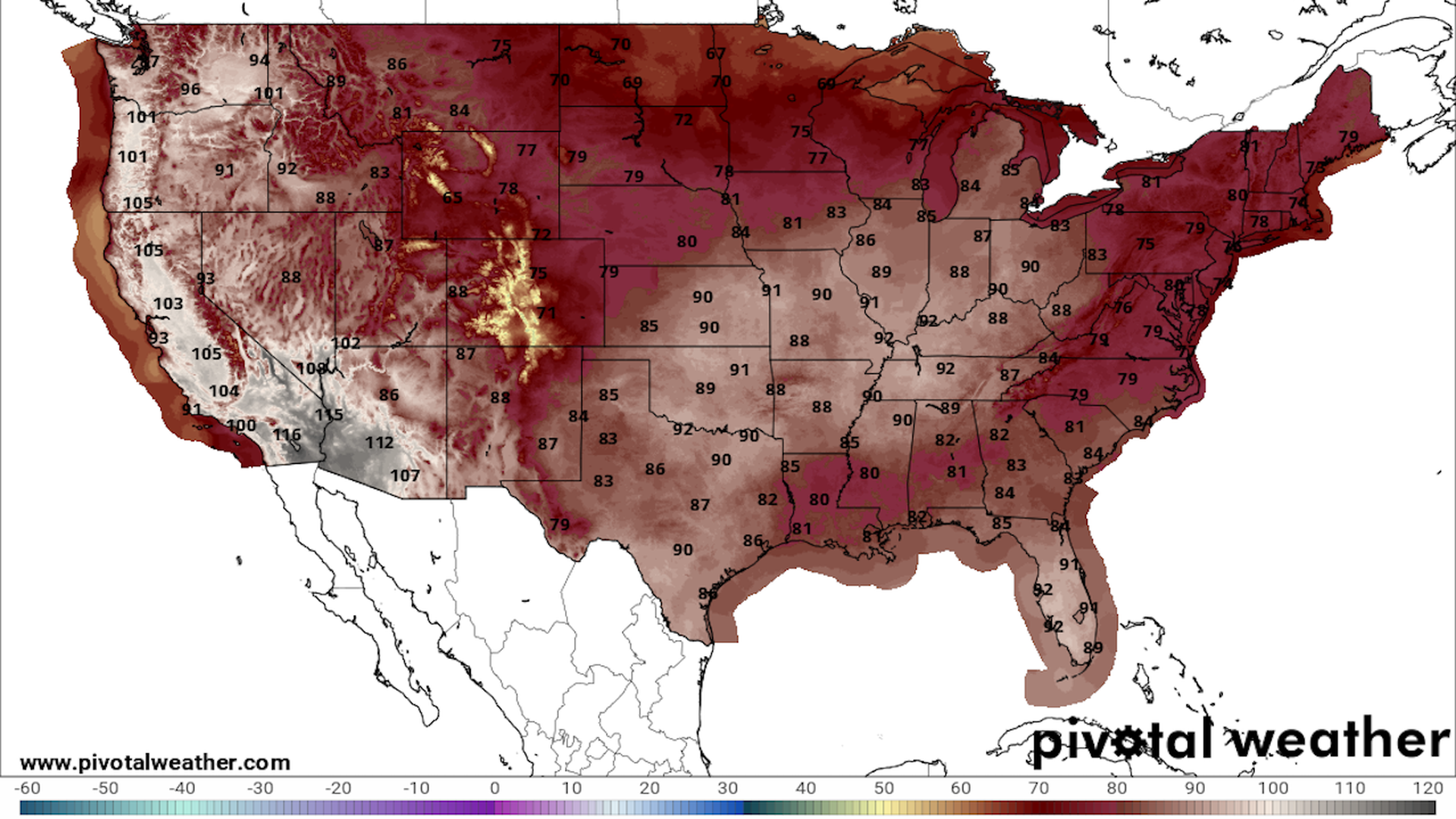
An early September heat wave is breaking temperature records from Arizona, westward into metro San Diego and LA, and up the coast to Portland and Seattle.
Threat level: The climate change-worsened extreme heat event is bringing temperatures of 15°F to 20°F above average in the Pacific Northwest and is set to roast the Southwest for an extended period.
- Extreme heat watches, warnings and advisories are in effect for 66 million people as of this morning, stretching from Phoenix to Seattle.
- The National Weather Service is warning of "major" to "extreme" levels of heat risk in Phoenix, Las Vegas, Sacramento, and other parts of the West. This indicates a heightened risk of heat-related illness to the general population.
Stunning stat: Phoenix has now gone a record-setting 101 days straight with highs of 100°F or above; the next 10 days are forecast to stay above that threshold. This crushes the previous record of 76 straight days, set in 1993.
- It also is forecast to break the city's record of 55 days in a year with 110-degree or above high temperatures today.
Between the lines: Heat contributed to 645 deaths in metro Phoenix last year, which is likely an undercount given how such deaths are counted and classified.
- The Maricopa County Office of the Medical Examiner has already confirmed 177 heat-related deaths this year and is investigating another 436, per reporting from Axios Phoenix.
- The heat wave is also affecting the LA and San Diego metro areas, which were not hard hit by previous events during the summer.
Zoom in: This heat wave comes on the heels of the hottest summer on record for tens of millions of people, with Las Vegas, Phoenix and Sacramento among dozens of cities and towns setting seasonal records.
- The hot, dry summer leaves the region primed to burn. Multiple large wildfires are in progress in California, Idaho, Oregon and other states, and more are likely to come.
- These fires follow the Park Fire this season, which stands as California's fourth-largest wildfire on record.
Context: Climate change is causing extreme heat events to be more frequent, longer-lasting and intense, studies show.
- According to Climate Central's Climate Shift Index, human-caused global warming is causing the forecast high temperature in Phoenix today to be at least five times as likely as it would have been in the preindustrial era.
What's next: While the most intense period of this upcoming heat wave is likely to wane by early next week, longer-range outlooks show the likelihood for more heat events in the Southwest through September, though less intense than the current event.
2. NOAA bolsters its AI forecasting capabilities

The NOAA is adding to its high-performance computing resources in a bid to bolster its uses of AI and machine learning for weather and climate.
Why it matters: The agency's $100 million investment comes as it faces rapid advances in forecasting techniques and new entrants build accurate weather models trained on historical data.
- These competitors include big tech companies like Nvidia and Google, as well as private forecasting startups like tomorrow.io and WindBorne, plus NOAA's peer agencies abroad.
- The money comes from the 2021 infrastructure package and 2022 climate laws.
Zoom in: According to the atmosphere and oceans agency, the money will be used to install a new high-performance computer from General Dynamic Information Technology.
- The new machine, called Rhea, after the Greek goddess and mother of gods, will be located at a modular data center in West Virginia.
- It would both benefit the agency's physics-based models and provide better training data for its AI/machine learning efforts, the agency told Axios.
By the numbers: Rhea would add about 8 petaflops of computing speed and capacity to NOAA's existing capacity of 35 petaflops.
- One petaflop is one quadrillion operations per second.
- Another machine is also in the pipeline for that facility, which NOAA says would bring its total research and development computing power to 48 petaflops.
The bottom line: This move is a step towards a more AI-centric NOAA since the modular data center approach could accommodate additional machines.
3. 🚨 Breaking: New offshore wind approval
/2024/09/05/1725540216266.gif?w=3840)
The Interior Department just green-lit a big wind project off Maryland's coast.
Why it matters: U.S. Wind — a subsidiary of Italy's Renexia — plans over 2 gigawatts of capacity, enough to power over 700,000 homes, Interior said.
🖼️ The big picture: It's the 10th offshore project Biden officials have approved, totaling over 15 GW. Officials call today's move evidence of a jumpstarted industry. The White House target is 30GW operating by 2030.
Reality check: The young U.S. sector has hit choppy waters thanks to interest rates, supply costs, and most recently equipment failures. Several projects have been scrapped or delayed.
🔭 What we're watching: How many projects actually get built — and how fast.
- BloombergNEF sees just over 13GW installed by 2030, while Rystad Energy analysts similarly project 14GW (and less if Donald Trump wins the November election).
4. 🏃 Catch up quick on tech finance: Data centers and hydrogen

🏦 Bank of America is providing $205 million in exchange for tax credits to finance CO2 capture from a North Dakota ethanol plant, the WSJ reports.
- Why it matters: It's the "first deal of its kind" under the 2022 climate law's expanded, newly flexible incentives, they report.
🖥️ Private equity giant Blackstone is buying the Asia Pacific region data center firm AirTrunk in a deal valued at $16.1 billion.
- What we're watching: What's powering all this computing to serve AI and other applications. As my colleague Katie Fehrenbacher points out, many facilities in the Asia Pacific region will plug into gas and coal-heavy grids.
- The intrigue: AirTrunk CEO Robin Khuda, in the announcement, said the deal will "support the energy transition in Asia Pacific." I'll follow up if I learn more.
💵 Adnoc, the UAE's national oil company, is buying a 35% equity stake in Exxon's planned — but uncertain — Baytown hydrogen project in Texas.
- Why it matters: The multibillion-dollar investment is a new front in Adnoc's diversification, and it underscores the stakes of the Treasury Department's pending decision on hydrogen tax credits in the 2022 climate law.
- State of play: Exxon has said the huge project's viability depends on Treasury making hydrogen production using natural gas, alongside carbon capture, eligible.
5. New Harris climate aide brings wonk and activist experience

The Kamala Harris campaign has tapped Camila Thorndike, most recently with the pro-electrification group Rewiring America, as "climate engagement director."
Why it matters: Harris' staffing moves offer clues about priorities — especially in the absence of detailed policy platform.
- The campaign also faces the challenge of exciting green-minded voters as she moderates her more aggressive 2019 positions.
State of play: Thorndike will be "primary liaison" with "climate voters," a Harris spokesperson said. Politico first reported the hire.
Catch up quick: Her career melds activism and wonkery. She held several roles at Rewiring America, most recently senior director of public engagement, and earlier policy positions.
- Before that she was an energy and environmental aide to Sen. Bernie Sanders and also has worked with the youth-focused Sunrise Movement, which wants rapid moves away from fossil fuels.
👀 What we're watching: How Harris addresses climate and energy in next week's first debate with Donald Trump.
6. 💬 Quote of the day
"It is clear that the transition to electrification will not be linear, and customers and markets are moving at different speeds of adoption."— Volvo CEO Jim Rowan
The auto giant is backing off plans for all sales to be fully electric by 2030. Instead Volvo now hopes 90% of sales to come from EVs and plug-in hybrids by then, it said yesterday.
📨 Did a friend, colleague or even a frenemy send you this newsletter? Welcome, please sign up.
🙏 Thanks to Chris Speckhard and George Moriarty for edits to today's edition, along with the brilliant Axios Visuals team.