Axios Generate

February 14, 2023
👋 Hi readers! Today's newsletter has a Smart Brevity count of 1,093 words, 4 minutes.
🎧 Jael Holzman of the new Axios Pro: Energy Policy newsletter (sign up!) unpacks the energy fallout from U.S.-China tensions on the Axios Today podcast.
🎶 Elvis Costello and The Attractions dropped the album "Get Happy!!" this week in 1980 and it provides today's intro tune...
1 big thing: The red-hot politics of green manufacturing

Illustration: Aïda Amer/Axios
This week brings the latest multi-billion dollar investment in U.S. battery manufacturing — but with a geopolitical twist, Ben writes.
🏃🏽♀️Catch up fast: Ford will pour $3.5 billion into a Marshall, Mich. plant that will have 2,500 employees when initial production starts in 2026.
The intrigue: Ford is licensing tech and using services from Chinese battery giant CATL, though the project is wholly owned by Ford.
- The agreement arrives as revelations of Chinese surveillance balloons have worsened already high U.S.-China tensions.
- The Information's Steve LeVine reported that "in a display of the thorny politics," President Biden declined an invite to join Michigan Gov. Gretchen Whitmer and Ford officials at the rollout.
- The White House didn't respond to a request for comment on that report.
What they're saying: GOP House Majority Leader Steve Scalise said the White House's "leftist green agenda" makes the U.S. more reliant on China.
- "This from Ford shows certain companies are fine with that," he said via Twitter.
- Virginia GOP Gov. Glenn Youngkin recently pulled his state from consideration for the Ford-CATL venture, calling it a "Trojan horse" for the Chinese regime.
The other side: Ford officials emphasized it's a U.S.-owned project.
- CATL will "help us get up to speed so we can build these batteries ourselves — batteries made here in Michigan and built for America," executive chairman Bill Ford said at the announcement.
- Via The Detroit News, Ford's Lisa Drake noted automakers including Tesla already use imported CATL batteries, but in this project, Ford has "control over the manufacturing, control over the production, control over the workforce."
🖼️ The big picture: The deal is the latest notch on the growing U.S. "battery belt" as automakers race to produce equipment for their electrification plans.
- Ford expects the plant to qualify for major tech manufacturing incentives in the new climate law.
🔭 Zoom in: The plant will produce lithium iron phosphate (LFP) batteries, giving Ford another battery chemistry alongside the nickel cobalt manganese (NCM) batteries that now power Ford's EV lineup.
- The automaker noted nickel and cobalt are in high demand with limited supply, making them more costly.
- The batteries have different attributes that appeal to different customer needs, Ford said.
- NCM's greater power and energy density enable more range, while LFP batteries charge faster and help cut vehicle costs.
2. Methane measuring initiative launches

Illustration: Aïda Amer/Axios
New open-source protocols for measuring and reporting methane emissions could point the way toward a future with cleaner energy infrastructure, Andrew writes.
Why it matters: New voluntary guidance of how to conduct methane emissions inventories comes from a partnership between the energy industry and watchdog groups, called Veritas.
Zoom in: The effort includes a group of major oil and gas players, such as Chevron, ExxonMobil and EQT Corp., along with environmental groups like the Clean Air Task Force (CATF) and RMI.
- The new standards cover multiple segments of the natural gas supply chain, from production to delivery.
The big picture: Methane is a powerful greenhouse gas and in recent years, global emissions have been increasing. This is despite a pledge by more than 100 countries to cut them by 30% by 2030.
- Remote sensing has revealed methane super emitters in the U.S. and elsewhere, finding leaky well sites, pipelines and other infrastructure to be more pervasive than thought.
Between the lines: The new guidelines were not designed for the new EPA methane emissions draft rule or other specific regulations, though a GTI Energy spokesperson said the group is informing regulators of the methodology.
What they’re saying: "We need reliable measurements and strong verification programs to make sure that the emissions that companies day are coming from their equipment is actually the reality," Lesley Feldman, a research and analysis manager at CATF, told Axios.
3. Parsing Biden's oil horizon

Here are some rough answers to an important question for the future of U.S. energy and climate policy: What exactly does "beyond" mean?, Ben writes.
Catch up fast: President Biden went off script in the State of the Union when saying the U.S. will need oil for at least a decade and "beyond."
What we're watching: To paraphrase Prince, beyond is a mighty long time, so here's a look at some attempts to game out the future.
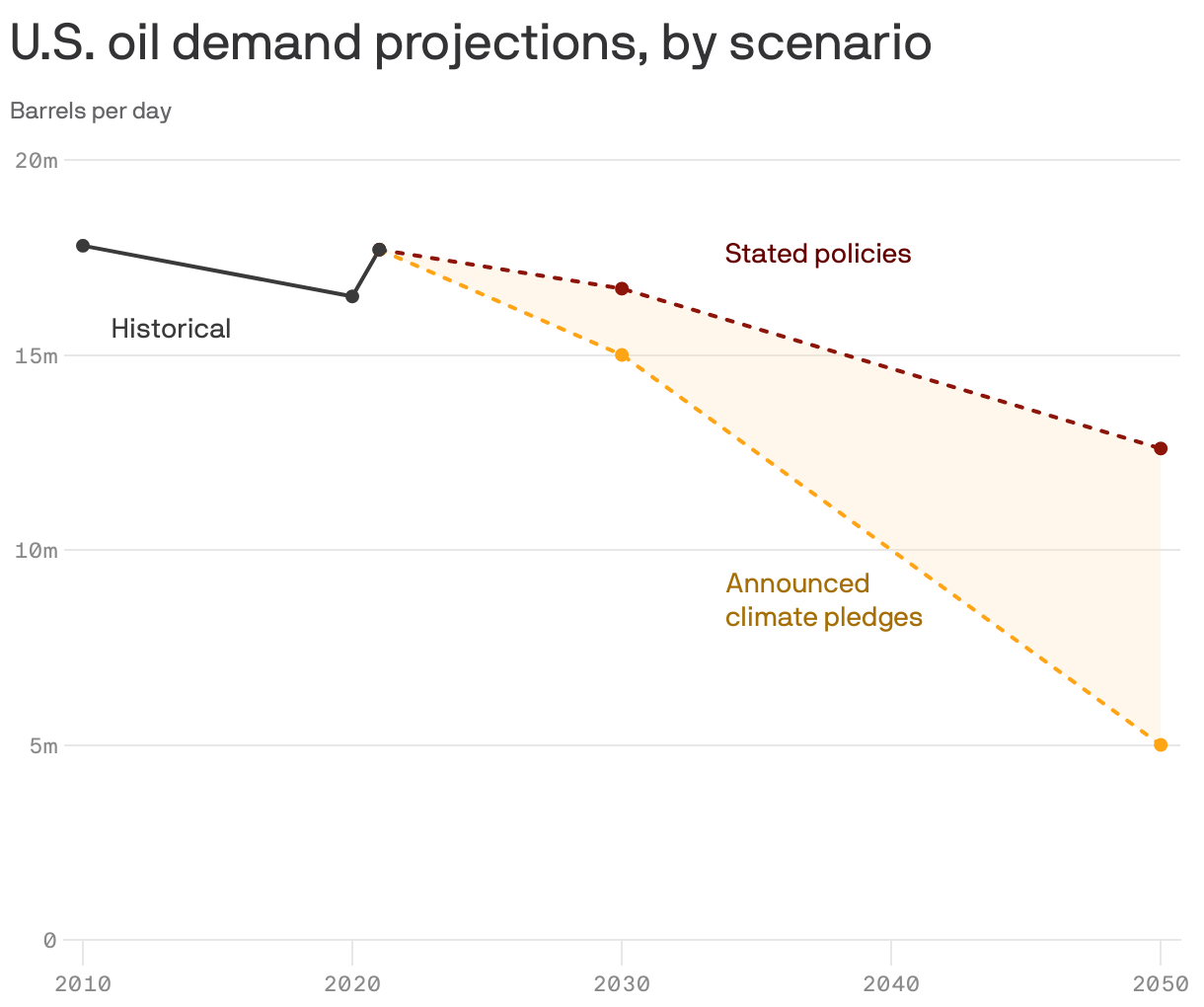
- Wood Mackenzie analyst Ed Crooks' new column notes their "base case" sees U.S. oil use plateauing in the mid-2020s; in 2050, it's just 35% below current levels.
- The International Energy Agency, meanwhile, has a similar view (see chart above). In their projection of existing policies, demand falls 29% from 2021 levels by 2050 to a still-robust 12.6 million barrels per day.
Yes, but: In the IEA scenario in which U.S. climate pledges are achieved, the decline is far steeper, falling to 5 million barrels per day — which is hardly nothing — at midcentury.
4. 🏃🏽♀️Catch up fast on policy: Arctic, Treasury, SPR
🧊 President Biden tapped Mike Sfraga as the first nominee for the new role of ambassador at large for Arctic affairs.
- The big picture: Sfraga, chair of the Arctic Research Commission, would be the top U.S. diplomat for the vast region during heightened tensions with Russia.
- Threat level: Rapid global warming is also making the region more accessible for commercial and military activities.
💰 The Treasury Department is moving closer to providing billions worth of climate law tax incentives for a wide range of low-carbon energy manufacturing projects, critical minerals processing, and more.
- Driving the news: The agency, per new guidance, will open the door to applications on May 31 for $4 billion worth of a wider $10 billion program.
- Zoom in: $1.6 billion of the initial funding will flow to communities with closed coal mines or retired coal-fired power plants. Treasury also launched a separate program that provides extra incentives for wind and solar power projects in low-income regions.
🛢️ The Energy Department plans to sell 26 million barrels from the Strategic Petroleum Reserve in the latest release under years-old congressional mandates.
- The intrigue: SPR releases and repurchases are governed by a mix of mandates and administration decisions that don't fit neatly together. Bloomberg has more.
5. 💬 Quoted
"There’s... a fair amount of buy-in on the left that procedures are good, that getting rid of them is risky, and that we’d be better off keeping the ones we have than experimenting with an administrative state that maybe has a little bit more leeway to operate without being tied down by all sorts of rigid procedural obligations."— University of Michigan law professor Nicholas Bagley on The Ezra Klein Show podcast
That's a snippet from Bagley's interview where he says liberals protect an administrative state that's ill-suited to tackling big things — like massive renewable energy expansion, Ben writes.
📬 Did a friend send you this newsletter? Welcome, please sign up.
🙏 Thanks to Nick Aspinwall and David Nather for edits to today's newsletter.
Sign up for Axios Generate

Untangle the energy industry’s biggest news stories