Axios Generate

March 17, 2022

🍩 Good morning. Today's Smart Brevity count is 1,314 words, 5 minutes.
🗓️ Join Axios virtually at our 1st What’s Next Summit on April 5. Register for sessions on trends that will revolutionize our future.
🚨 Follow Axios' live updates on the war in Ukraine.
1 big thing: Democrats look to limit gas price fallout
Illustration: Annelise Capossela/Axios
The White House and top Capitol Hill Democrats are scurrying to limit the political damage from high gasoline prices, Ben writes.
Driving the news: Senate Majority Leader Chuck Schumer vowed to haul Big Oil CEOs before Congress to explain the "bewildering incongruity" between pump costs and the recent crude oil price decline.
- It "smacks of price gouging," Schumer said on the Senate floor yesterday. That was not long after President Biden tweeted that gasoline prices should be lower, based on the oil price.
- "Oil and gas companies shouldn’t pad their profits at the expense of hardworking Americans," Biden said.
The latest: House Energy and Commerce Chairman Frank Pallone, late in the afternoon, invited CEOs of oil majors like Exxon and large independents to testify on April 6.
The announcement accuses the industry of exploiting the Ukraine crisis and market shocks to "keep prices artificially high and increase their own profits."
Yes, but: Several analysts and economists said the crude-pump price discrepancy simply reflects the time it takes oil price changes to filter through the refined product market.
For example, Jason Bordoff, an Obama-era White House energy and climate aide, tweeted this in response to Biden's comment:
- "There's a long economics literature explaining 'rockets & feathers' — why gasoline prices go up faster when oil price rises than they fall when oil price drops."
- Rapidan Energy Group President Bob McNally, an energy aide in the George W. Bush White House, made a similar point.
Why it matters: These and other recent allegations of oil companies taking advantage of consumers come as gasoline prices are at record levels (though not if you adjust for inflation).
- That's probably a political liability for Democrats heading into the midterm elections, even though presidents have very little near-term sway over gasoline prices.
- It's also spilling into climate policy debates. Republicans and industry groups are calling for the White House to back off efforts to curb federal leasing.
By the numbers: Crude oil prices have come down a lot over the last week or so. WTI, the U.S. benchmark, fell into the $94-per-barrel range earlier this week after going to about $130-per-barrel earlier in the month. (It's now regaining some ground to about $100 this morning.)
Gasoline prices have fallen less quickly. This morning, per AAA, the nationwide average is $4.29-per-gallon, compared to $4.32 a week ago.
What's next: This morning PunchBowl News reported that House Democratic leaders are in preliminary talks with rank-and-file members about ideas for lowering prices.
It's a "recognition that sky-high prices at the pump could be a massive political problem this fall," it notes. Members are batting around ideas including a gas tax holiday and direct consumer rebates, it reports.
2. Court revives key carbon metric

Illustration: Sarah Grillo/Axios
A federal appeals court yesterday lifted an injunction that had blocked the Biden administration from factoring in the costs of climate change when making government rule-making decisions, Andrew and Axios' Rebecca Falconer write.
Why it matters: The court's stay in a lawsuit brought by several Republican-led states means that, for now, federal officials can consider the economic costs of climate change, known as the social cost of carbon, when evaluating projects and rules.
- This could help the Biden administration reduce greenhouse gas emissions. It could also speed up the review of oil and gas drilling permits and lease sales, in addition to any environmental rules.
Context: The social cost of carbon is a dollar estimate of the damages caused by emitting one additional metric ton of greenhouse gases into the air.
- It provides policymakers with a way of incorporating future climate damage into present-day decision-making.
- The Biden administration is studying what an updated cost should be, but in the meantime had implemented the metric applied during the Obama administration, which was $51 per metric ton.
Yes, but: The GOP-led states argue in their lawsuit that President Biden didn't have the authority to make such changes without public input — something the three-judge panel on the 5th U.S. Circuit Court of Appeals rejected yesterday.
What's next: The Biden administration is appealing the District Court’s decision that led to the earlier injunction.
3. Disclosure guidelines are so hot right now

Illustration: Shoshana Gordon/Axios
The Taskforce on Nature-related Financial Disclosures (TNFD) released its first draft of a working risk assessment and disclosure framework for financial institutions, Axios' Megan Hernbroth reports.
Why it matters: ESG is nearly universal among institutional LPs, according to a survey from Adams Street Partners. But without specific guidelines, most ESG promises are, well, promises.
State of play: The framework comes roughly a week before the SEC is expected to vote on additional climate-related risk disclosures for businesses operating in the U.S.
- As the name implies, the task force's framework focuses more narrowly on nature-related risks like fallowing fields or extreme weather kneecapping logistics networks.
- Several investors have told Axios they don't expect the SEC disclosures will negatively impact industry-wide deal-making, but it could hold executives' feet to the fire depending if it really gets into the weeds on topics like Scope 3 emissions.
Zoom in: The framework has industry- and geography-specific recommendations and analysis for companies and financial institutions as they build their own risk assessments and disclosures.
It also includes a dictionary to ensure disparate industries are talking about nature-related risks in the same way.
What's next: The working document will be finalized near the end of Q3 2023, the organization told Axios on a press call.
Megan Hernbroth will co-author the Axios Pro Climate deals newsletter. Join the waitlist now.
4. The Energy Department's delicate LNG position
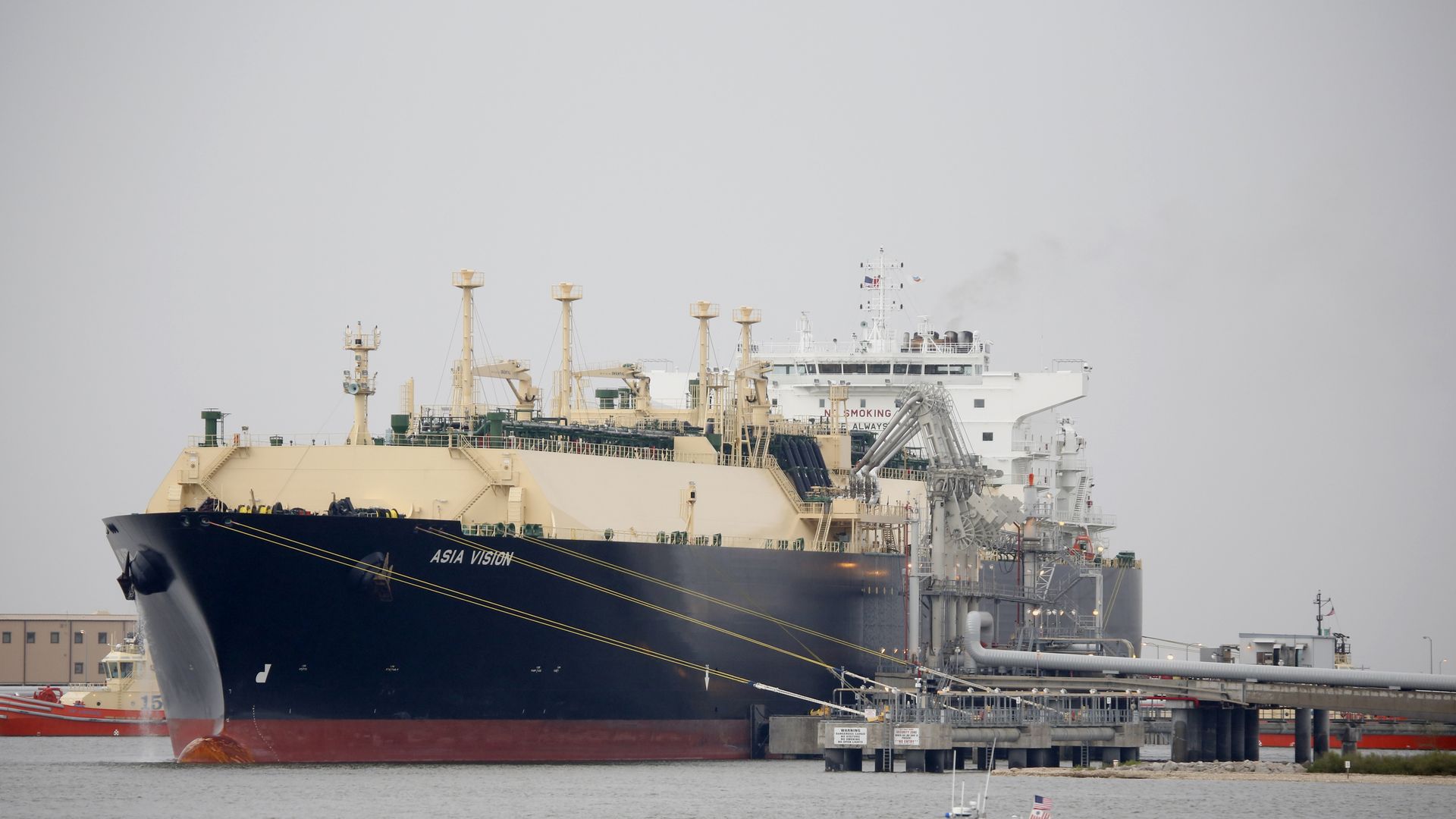
The Asia Vision LNG carrier ship docked at a terminal in Sabine Pass, Texas, on Feb. 22, 2016. Photo: Eric Kayne via Getty Images
The Energy Department's approval of wider LNG exports destinations from two Cheniere Energy facilities provided a window into the Biden administration's rather complicated relationship with the fuel, Ben writes.
Driving the news: The department yesterday issued two long-term authorizations from Cheniere terminals in Louisiana and Texas to any countries that don't have free-trade deals with the U.S., including all of Europe, DOE said.
- The announcement — which drew cheers from industry groups — noted the U.S. has already been increasing exports to Europe and said LNG is important to global energy security.
- It also said that with exports rising, DOE is "particularly focused on driving down methane emissions in the oil and gas sector both domestically and abroad."
My thought bubble: Communications about topics DOE is really jazzed about look...different. They have quotes from Energy Secretary Granholm and others, and social media promotion that didn't occur with yesterday's announcement.
- LNG is a tricky topic for the Biden administration as some environmentalists press officials to curtail fossil fuel exports.
- But they always faced an uphill battle, and now Europe's push to end reliance on Russian gas is creating even more momentum for LNG.
Of note: The U.S. has recently become the world's top LNG exporter.
5. One useful thing: an upstream pollution roadmap
Reprinted with permission from "Managing upstream oil and gas emissions: A public health oriented approach" in the Journal of Environmental Management
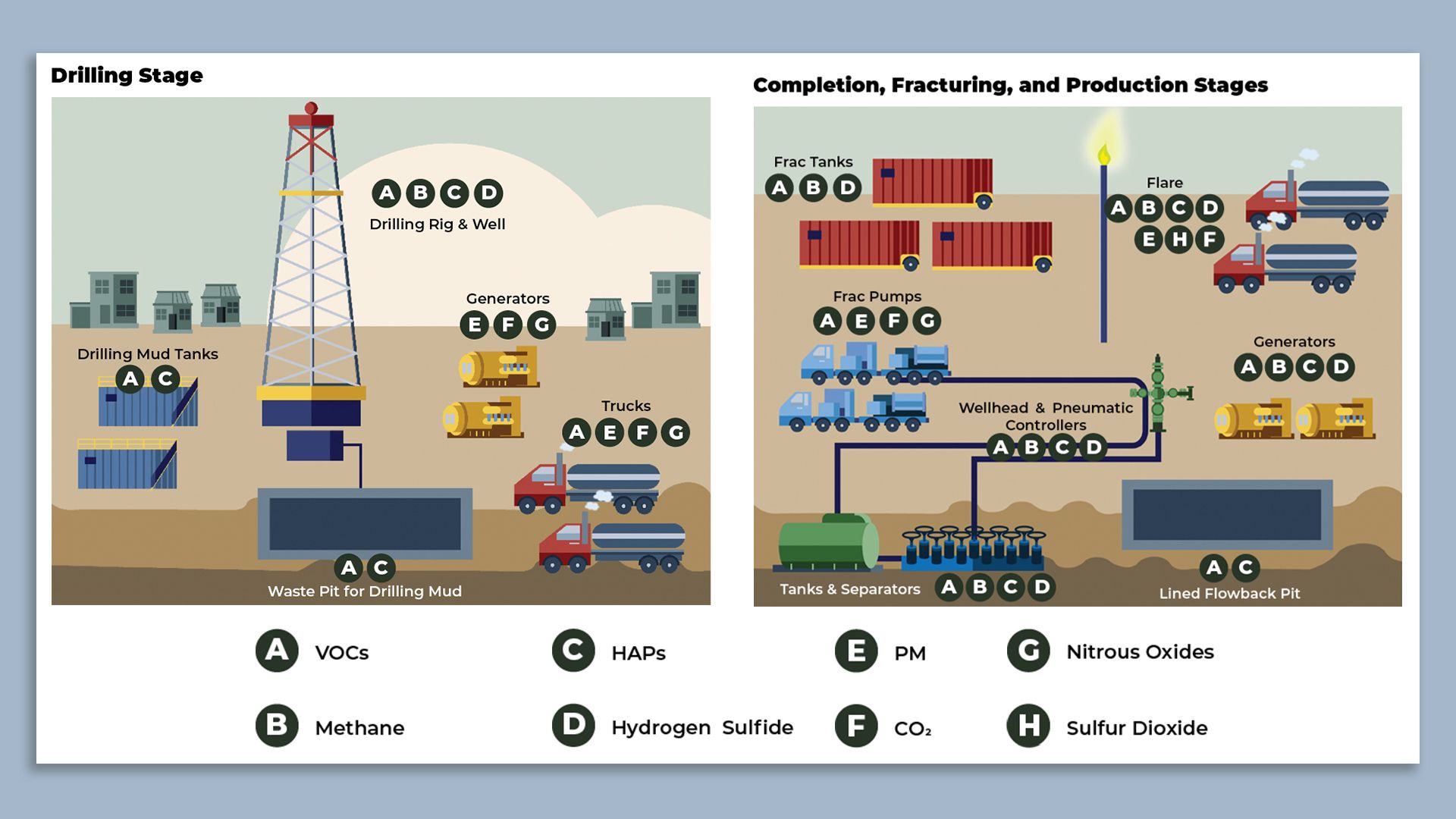
A new paper includes a helpful look at the types of pollution occurring at different phases of oil-and-gas exploration and production, Ben writes.
Driving the news: The study in the Journal of Environmental Management includes the chart above. By the way, in the graphic above VOCs are volatile organic compounds, while HAPs are hazardous air pollutants and PM is fine particulate matter.
Why it matters: While overall pollution sources are known, the study warns that "knowledge gaps" in on-the-ground emissions location and monitoring impede public health protection.
It offers ideas for integrating monitoring technologies that together provide a better picture, weaving together satellite imaging, on-the-ground readings, use of drones and more.
6. Catch up fast: Occidental, Swiss Re, Texas
Shareholder advocacy: "U.S. regulators will force Occidental Petroleum to hold a shareholder vote on tighter emissions targets, rejecting a petition by a company that has touted its climate goals as among the most ambitious in the oil and gas sector." (Financial Times)
Insurance: "Swiss Re has announced a new climate policy that includes commitments to shift away from the most carbon-intensive oil and gas production." (Reinsurance News)
Fossil finance: "Texas is seeking information from BlackRock Inc., JPMorgan Chase & Co., Invesco Ltd. and 16 other firms on whether they discriminate against the fossil-fuel industry." (Bloomberg)
Editor's note. The fourth item in Tuesday's newsletter has been corrected to reflect that the portfolio upgrade announced by director Jigar Shah at CERAWeek and confirmed by the LPO was an internal risk rating upgrade. The portfolio was not updated by the credit agencies.