
Axios Generate

February 11, 2025

⚡️ Our hugest apologies for our delay in getting you this newsletter. The vendor that sends Axios newsletters had a technical lapse. Thank you for reading and trusting Axios! Here's a short spin around the beat with 1,042 words, 4 minutes.
🚨Situational awareness: The SEC is backing off Biden-era rules that would have forced public companies to disclose climate risks to their business.
- The commission's acting GOP head signaled the SEC will also stop defending the rule in court. Full statement.
🎵 This week in 2003, Massive Attack released the album "100th Window," which provides today's haunting intro tune...
1 big thing: About that 1.5°C Paris Agreement target...
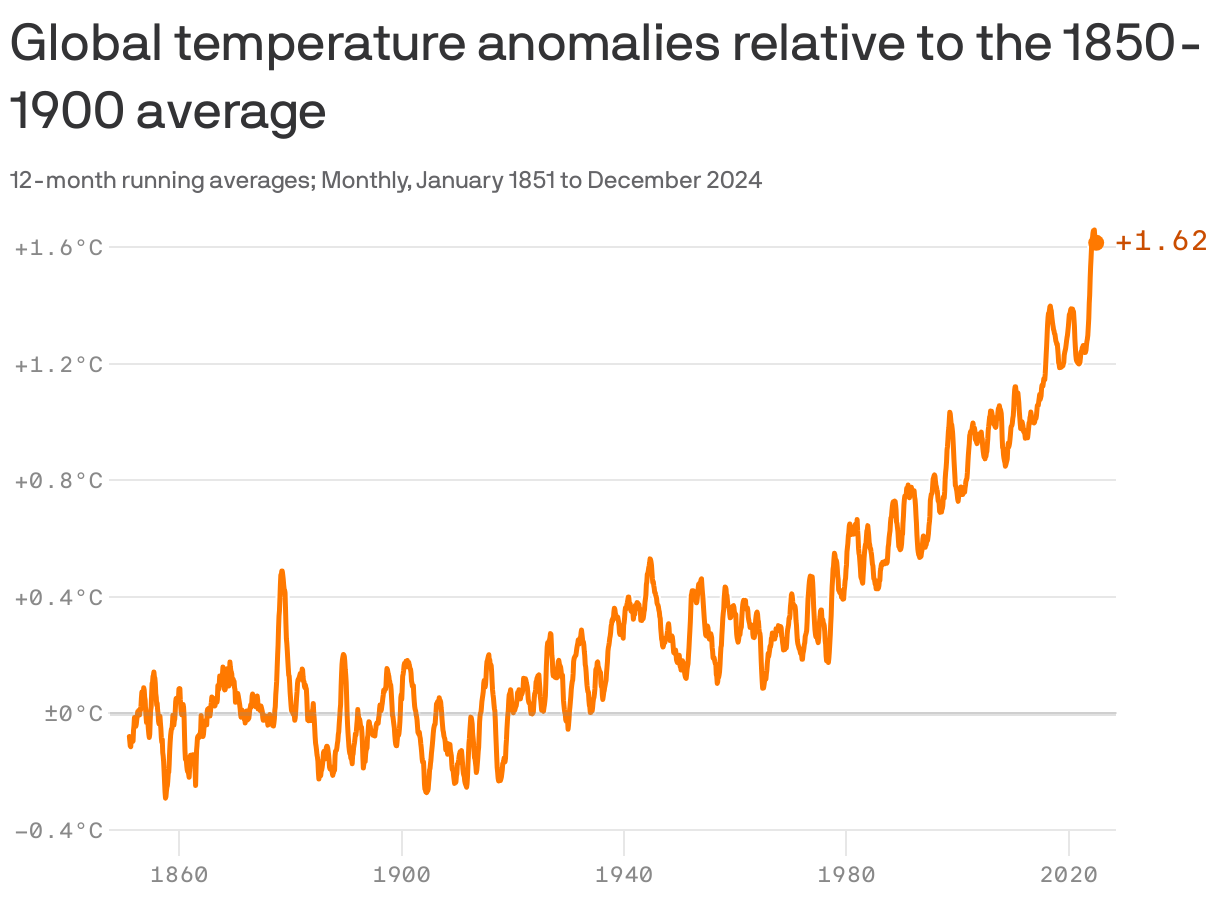
Two new studies show the world is nearing — or may have already eclipsed — the Paris Agreement's 1.5°C aspirational target, relative to the pre-industrial era.
Why it matters: The 1.5°C long-term goal, while largely symbolic, marks a point at which the ramifications of warming further are likely to become far more significant for humans and ecosystems.
- Studies have shown, for example, that the likelihood of triggering tipping points in the climate system — such as the dramatic slowdown of a vital current in the Atlantic Ocean — climb more steeply after 1.5°C of warming.
Driving the news: In the first study, out yesterday in the journal Nature Climate Change, Alex Cannon of Environment and Climate Change Canada finds about an 80% chance that the world has already breached the 1.5-degree target when it comes to the long-term warming level.
- The Paris Agreement defines the target as a two-decade-long period, not a single year.
- But the study shows that the first 12-month period exceeding 1.5 degrees above pre-industrial levels — generally defined as average temperatures between 1850 and 1900 — likely would occur within the period breaching the target.
- The study examines recent climate observations and modeling projections to determine long-term warming under different levels of greenhouse gas emissions.
What they're saying: "While it's an interesting study, I think it is premature to conclude we have already passed 1.5C given the differences in estimates of warming since pre-industrial across different temperature records," said climate scientist Zeke Hausfather.
- Hausfather, who wasn't involved in the new research, noted that the Cannon study relies on one of the hottest global temperature datasets.
Yes, but: The second study, published yesterday in the same journal, found that near-Herculean efforts to achieve emissions cuts would be needed now to avoid exceeding the 1.5-degree goal.
- Without such cuts, 2024 would lie within the first 20-year period with an average warming of 1.5°C, the study found.
Zoom out: Small island nations, worried about sea level rise and extreme weather events, advocated for the aspirational 1.5-degree goal in the Paris Agreement's text.
Reality check: Whether the 1.5-degree target has been breached is a distraction from the proper focus: rapidly bringing down emissions of planet-warming pollutants such as carbon dioxide, experts told Axios.
- "Crossing 1.4C is a failure. Crossing 1.6 is a failure. And every increment thereafter, considering what we knew 30yrs ago about the dangers of continued fossil fuel emissions," said Kim Cobb, director of the Institute at Brown for Environment and Society, said.
- "But peak fossil fuel emissions are in reach, this year or next, and that is a tangible win we can secure for the history books, if we keep our eyes on the prize," said Cobb, who wasn't part of the new research.
2. 🔀 BP vows "fundamental reset" as profits fall

The tension is quickly building ahead of BP's strategy update coming later this month.
Why it matters: The struggling firm is a living — and in BP's case, difficult — experiment in Big Oil's efforts to juggle its core business with energy transition.
🗞️ Driving the news: BP this morning reported a $1.17 billion Q4 profit that missed analyst estimates, with quarterly and full-year earnings down sharply.
- CEO Murray Auchincloss, in a statement, said 2024 brought progress in reshaping its portfolio and cutting costs.
- A Feb. 26 update will "fundamentally reset" BP's strategy, he said.
What we're watching: Whether BP will significantly pare back low-carbon plans, even as it maintains its long-term net-zero target.
- The earnings come amid reports that the activist firm Elliott Investment Management has built up a big stake in BP and will push for major changes.
💬 What they're saying: Jefferies analysts say Elliott could seek the "refocus of BP's strategy on traditional oil & gas activities where BP has a strong growth portfolio."
- The various goals could also include "lower exposure to low carbon activities by either divesting assets, exiting projects or spinning off businesses," they write.
The bottom line: Expectations are now high that BP will do more than tinkering around the edges.
3. 🏃Catch up quick: Nuclear-powered AI, DOE, LNG
⚛️ French officials announced a $10.3 billion plan with the AI cloud firm Fluidstack to build "one of the world's largest decarbonized AI supercomputers."
- Why it matters: It would be fueled by nuclear power, they said. And it's among a suite of energy-related plans unveiled at this week's international AI summit in Paris. Reuters has more.
🔬 House Democrats allege there's "broad potential for conflicts-of-interest between DOGE, Tesla, and DOE" as Elon Musk's DOGE aides put the department under the microscope.
- Friction point: A new letter to Energy Secretary Chris Wright notes DOE's clean-tech work in recent years "directly intersect[s] with Tesla's corporate interests." It cites, among other things, proprietary info in loan agreements with other automakers.
- State of play: DOE did not respond to a request for comment on the letter, authored by members of the House's energy and science committees.
🤝 Via Bloomberg, Indian energy companies are holding talks to buy more LNG from U.S. suppliers ahead of PM Narendra Modi's trip to visit President Trump this week.
4. 💻 On my screen: Clarity on fossil fuel subsidies
Energy analyst Hannah Ritchie has a nice explainer on something readers may have noticed: estimates of global fossil fuel subsidy costs are all over the map.
Why it matters: Subsidies can make it harder to fight climate change, but some provide low-income people a needed economic buffer.
The big picture: Her piece via Our World in Data breaks down why the IMF's oft-cited $7 trillion annual tally is so high.
- It goes way beyond explicit payments to try to capture societal costs from pollution, climate change, congestion and more.
The bottom line: "[T]o see what interventions would help, we need to understand the differences between implicit and explicit subsidies," she writes.
"Bundling them together as a single 'subsidy' figure makes it hard to get a clear picture of what's needed."
5. 🧮 AI number of the day: Up to 1.2 gigawatts
That's the expected power generation from gas that Energy Transfer will supply CloudBurst Data Centers for a planned campus outside San Marcos, Texas.
Why it matters: The pipeline giant will provide the gas to directly fuel AI infrastructure, rather than connecting to grids.
- It's the latest sign of "behind the meter" development to meet growing data center needs.
- It's Energy Transfer's first commercial gas deal to directly supply data centers, the companies said.
📧 Did a friend, colleague or an AI chatbot send you this newsletter? Welcome, please sign up.
🙏 Thanks to Chris Speckhard and Chuck McCutcheon for edits to today's edition, along with the brilliant Axios Visuals team.
Sign up for Axios Generate