Axios Generate

March 01, 2024

🍺 Made it! We've got a newsy edition today that still spans just 1,053 words, 4 minutes.
🎸 Happy birthday to The Who's Roger Daltrey. He sings brilliantly on this week's final intro tune...
1 big thing: An uneven energy transition as emissions hit fresh record

Illustration: Sarah Grillo/Axios
Newly-released data shows a bifurcated world when it comes to energy transition and carbon emissions, Ben writes.
Why it matters: Climate-friendly technology is moving much more slowly in developing economies — often the same places emissions and energy demand are rising fast.
What's new: The International Energy Agency just dropped reports on global carbon dioxide and "clean" energy trends in 2023.
- Energy-related emissions inched up to a new record, but growth slowed to 1.1% last year. That's still the wrong direction when Paris Agreement targets envision steep cuts.
- Emissions in advanced economies (OECD nations and a few others) fell 4.5%, "a record decline outside of a recessionary period."
- But CO2 in China rose significantly, and India, Indonesia and other markets also saw increases.
How it works: Rising deployment of wind, solar, electric vehicles, nuclear and other climate-friendly tech is holding down the pace of emissions growth.
- "Since 2019, clean energy growth has outpaced growth in fossil fuels by a ratio of two-to-one," IEA finds.
- But that uptake is highly uneven, with the vast majority occurring in advanced economies and China, "with the rest of the world continuing to lag well behind."
Stunning stats: "In 2023, China and advanced economies accounted for 90% of capacity additions for wind and solar PV, and more than 95% of global sales of electric cars," the agency's report states.
The big picture: IEA's goal isn't to "tsk-tsk" economies where people are striving for better living standards, but is instead highlighting capital gaps.
- "We need far greater efforts to enable emerging and developing economies to ramp up clean energy investment," IEA boss Fatih Birol said in a statement.
The bottom line: Global climate goals envision both faster cuts in rich nations and far more progress in emerging economies.
2. EPA tries the Goldilocks route on power plants

Illustration: Natalie Peeples/Axios
Biden officials face a complicated political landscape as they spare existing gas-fired power plants — at least for now — from looming electricity carbon emissions rules, Ben writes.
Why it matters: Power generation is the nation's second-largest source of CO2, but neither Obama-era regulations, nor a more modest Trump-era rule, survived court challenges.
What's new: The EPA on Thursday said final rules this spring will impose standards on today's coal-fired power plants, and gas plants built in the future.
- But in a pivot from draft rules floated last May, existing gas plants — the largest U.S. power source — will instead be covered in a later regulation addressing both CO2 and air pollutants.
"This stronger, more durable approach will achieve greater emissions reductions than the current proposal," EPA head Michael Regan said.
The intrigue: The shift carries risks for Biden's agenda.
- Pollution rules take a long time to write, so standards for current gas plants probably won't be done pre-election and could stretch into next year (or even beyond).
- They could be abandoned by a second Trump administration, if he's reelected.
- And depending on D.C.'s power balance, it could be vulnerable under the Congressional Review Act — a tool for killing rules issued late in presidential terms.
Between the lines: The politics are tricky, too.
- The pivot drew cheers from some activists, who cited plans to address localized air pollution, but criticism from some quarters.
- Liberal Sen. Sheldon Whitehouse (D-R.I.) called it "inexplicable," yet the NYT reports some swing state Democrats disliked the earlier plan.
What's next: We'll be watching for signs it moves the political needle in either direction — and watching the clock.
3. 💵 Tech number of the day: $244 million
That's how much next-wave geothermal startup Fervo Energy just raised, Ben writes.
Why it matters: It's vote of confidence that geothermal — still a niche source compared to its potential — has mojo.
- And shale producer Devon Energy leading the round shows how geothermal is ripe for applying drilling tech to zero-carbon energy.
4. 🏃🏽♀️ Catch up quick: FERC, offshore wind, EVs

Illustration: Annelise Capossela/Axios
⚡ Via Reuters, "President Joe Biden on Thursday nominated two Democrats and one Republican to the Federal Energy Regulatory Commission (FERC), an independent panel that rules on energy transmission and liquefied natural gas projects."
🤝 Bloomberg reports: "New York state agreed to buy electricity from offshore wind farms being planned in the Atlantic Ocean, marking progress for the struggling industry after inflation forced some projects to be canceled."
- State of play: E&E News' Ben Storrow has a quick yet informative look at the contracts and what they mean for the proposed projects.
😬 TechCrunch reports: "Electric vehicle startup Fisker is planning to lay off 15% of its workforce and says it likely does not have enough cash on hand to survive the next 12 months."
5. GREET-ings and SAF-utations

Illustration: Sarah Grillo/Axios
The White House is delaying release of a key model — called GREET — for companies to qualify for the 2022 climate law's sustainable aviation fuel (SAF) tax credit, Axios Pro's Jael Holzman first reported.
Why it matters: It's wonky but important! From aviation to agriculture, many companies are eagerly awaiting this model, which measures jet fuel's lifecycle carbon emissions.
State of play: Officials won't meet their March 1 deadline for releasing an updated version of GREET, per a White House official familiar with the situation.
- GREET is a tool previously used for federal ethanol mandates.
- The updated version is supposed to incorporate climate activists' concerns that more SAF would mean much more land use, which can have deleterious climate impacts.
- Expect the update in "weeks, not months," said the official.
Catch up quick: Agriculture stakeholders and their Capitol Hill allies pushed President Biden to let companies use GREET to measure their emissions to qualify for the credit.
- That's opposed to an international standard laid out in statute, which companies called onerous.
What's next: The official said the administration has incorporated fresh data and science on indirect land use, and even with that integration, "we believe that much of the SAF on the market is well positioned to qualify for the credit."
Talk to our sales team about Axios Pro: Energy Policy.
6. Charted: The U.S. LNG surge to Europe
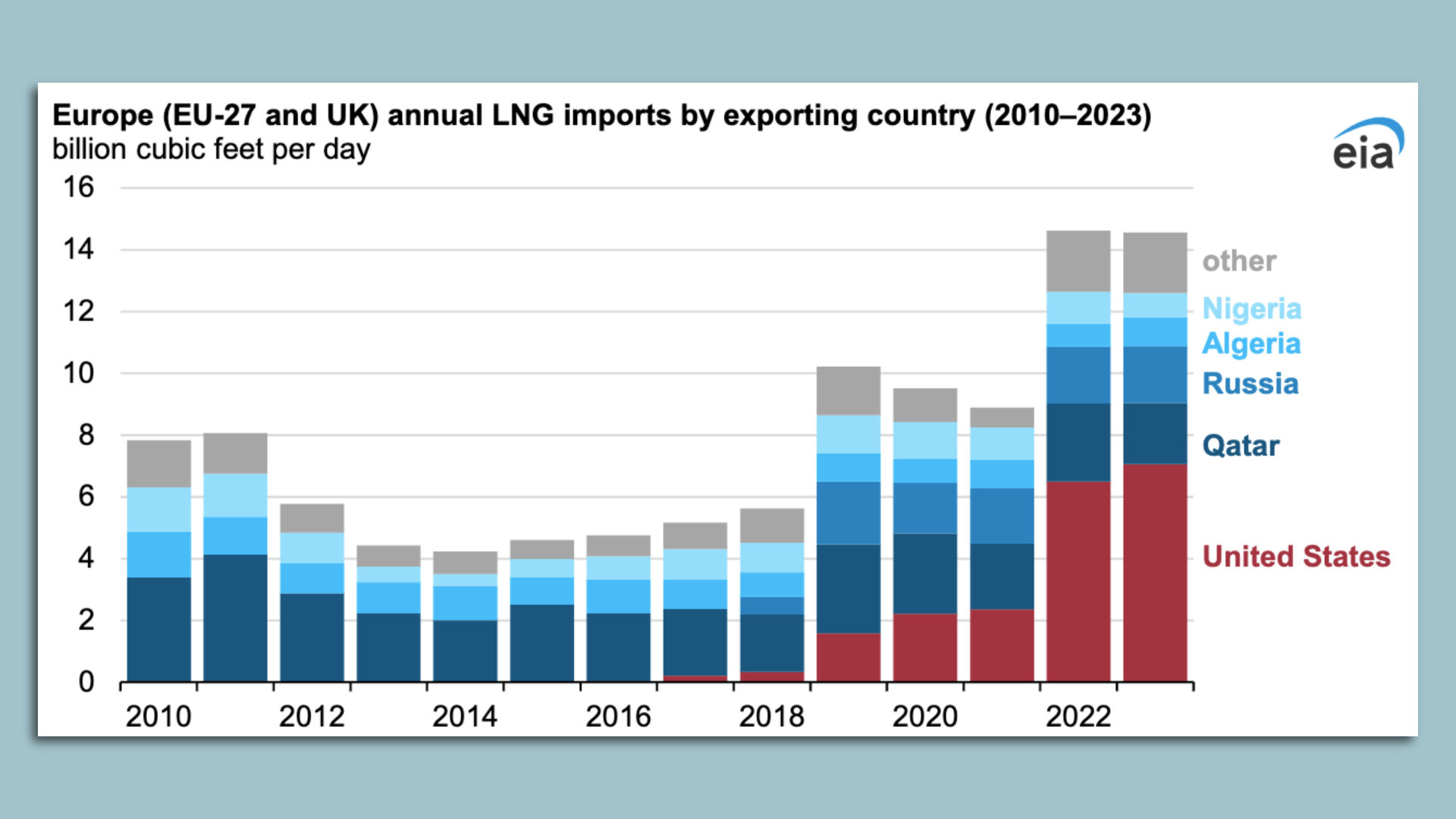
Image courtesy of the Energy Information Administration
This chart ☝️shows the U.S. supplied nearly half of Europe's LNG imports in 2022 and 2023, Ben writes.
Why it matters: It's a major effect of Russia's invasion of Ukraine, as the surge in U.S. cargoes helped offset loss of Russian pipelined supplies.
Friction point: The relationship with Europe is one reason the White House faces criticism over its recent pause on new LNG export licenses.
- But Biden officials note U.S. exports to global markets will keep rising for years due to projects already under construction.
📬 Did a friend send you this newsletter? Welcome, please sign up.
🙏 Thanks to Chris Speckhard and Javier E. David for edits to today's edition, along with the brilliant Axios Visuals team.