Axios Future of Mobility
July 08, 2026

👋 Hi again! I'm just back from another long EV road trip to New England, which is the focus of this week's newsletter.
- Spoiler alert: EV fast-charging is a lot better, but not perfect.
📌 Join Axios Live in Washington, D.C., on Thursday, July 16, at 7:30am ET for a conversation on the future of housing and homeownership in America. RSVP here.
1,649 words, a 6-minute read.
1 big thing: EV road trip offers glimmers of hope
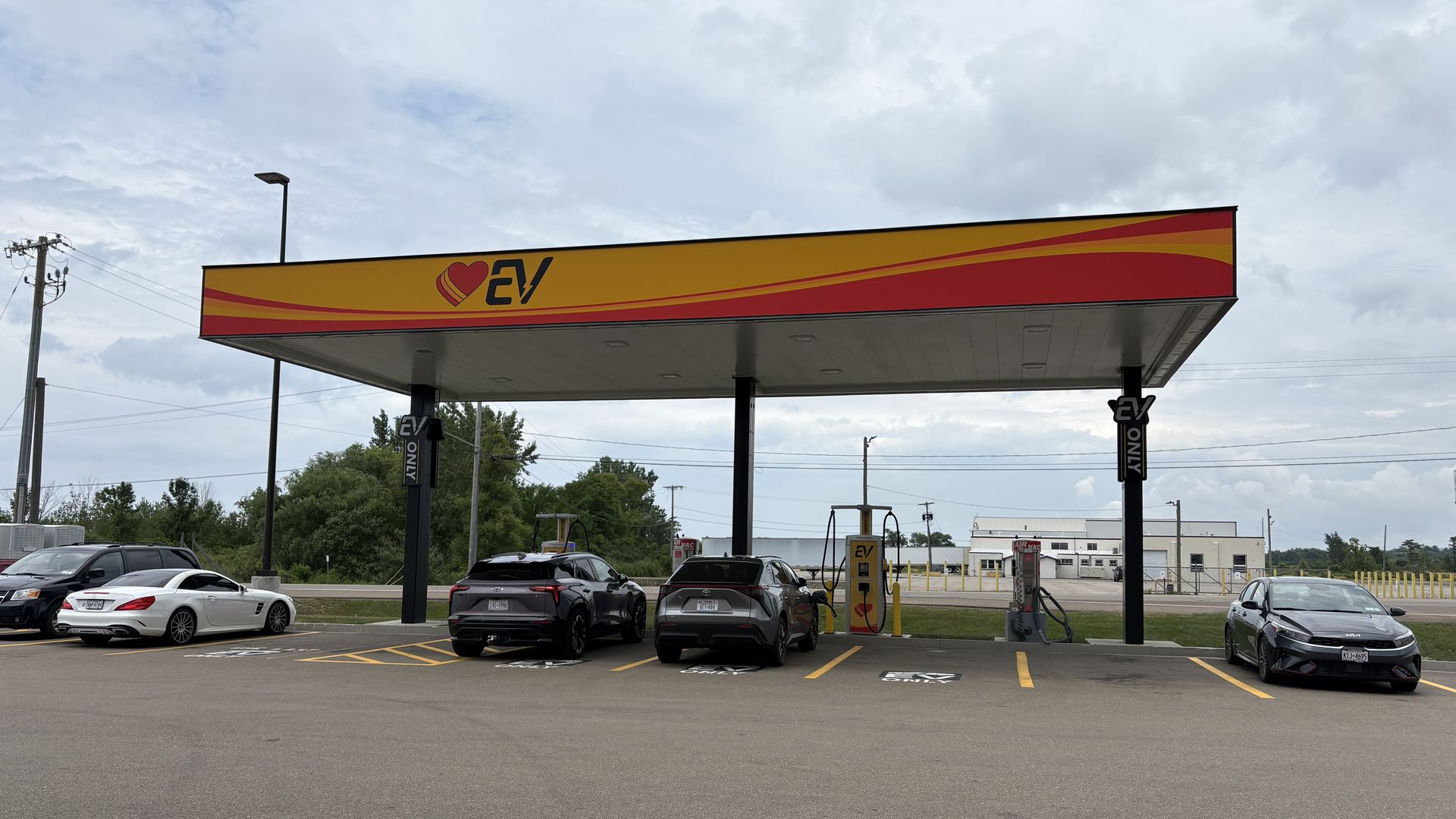
My 1,900-mile road trip last week in an electric vehicle proved it's easily doable, but the charging experience is still not as seamless and convenient as pumping gas.
Why it matters: Driving an EV is delightful. Charging an EV is what gives people anxiety. Until that problem is solved, EV sales in the U.S. will remain lackluster.
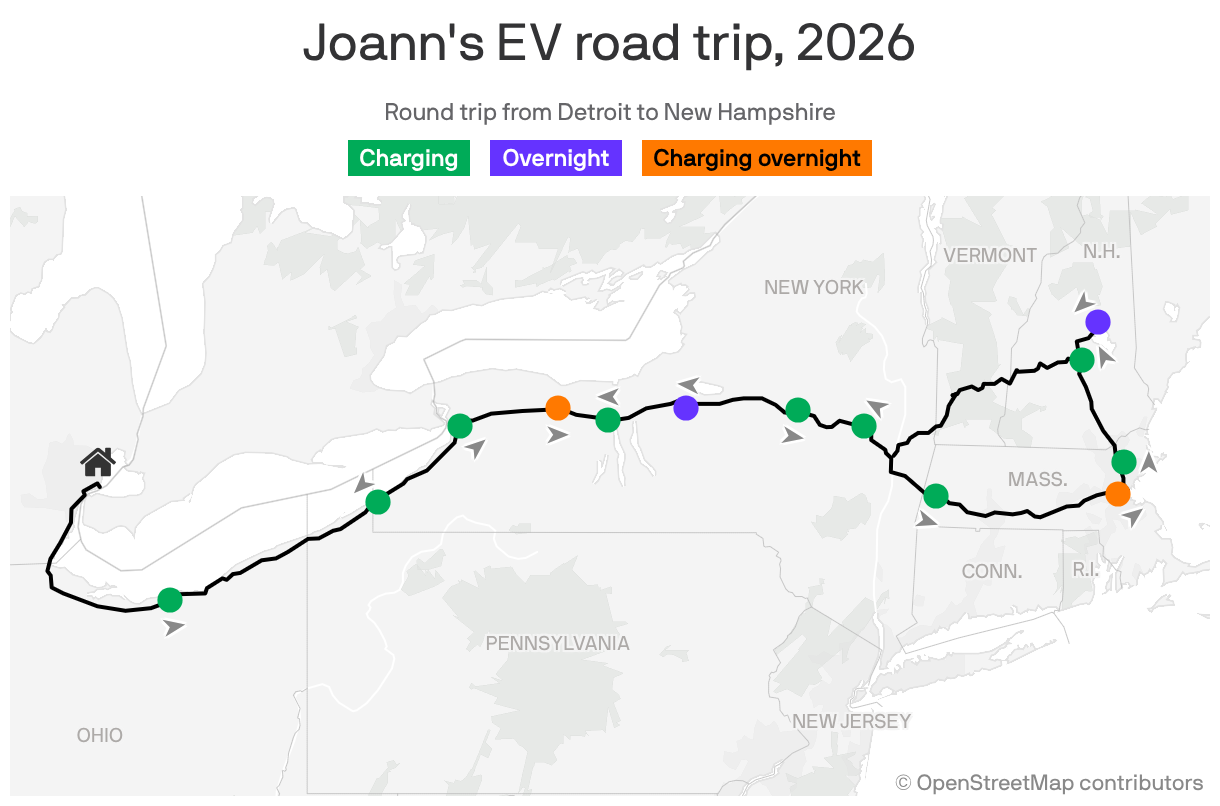
Driving the news: My husband and I drove from Michigan to New Hampshire and back in a Toyota bZ on loan from the automaker's media test fleet.
- I wanted to see for myself how the world's largest automaker had upped its EV game after disappointing customers with its first model in 2022, the bZ4X. (It's way better, with a bigger battery and longer driving range.)
- And I was eager to try out Ionna, the fast-growing charging network owned by eight major automakers. (More on that below 👇.)
The big picture: This was our fourth long road trip in an EV, and they keep getting easier.
- There are a lot more fast chargers available now compared to my first Michigan-to-Florida trek in 2023, and reliability has improved.
- And getting access to Tesla's Supercharger network has been a game-changer for non-Tesla owners. (Tesla drivers, of course, have enjoyed easy charging from the start.)
⚡️ Catch up quick: We recharged 12 times over the 1,900-mile journey, usually for about 25-30 minutes — long enough to use the bathroom and grab a snack or coffee.
- I figure the stops added about two hours of driving time to the journey, compared to bathroom breaks and refueling stops in a gas car.
- 🤦 (It would have been less if we didn't have to double back in Massachusetts when I realized I had set my purse down next to a charger and forgot it!)
My husband Bill's take as we cruised the New York State Thruway: "I've concluded that charging is not that inconvenient. Yeah, you'd like to be on the road faster, but this gives you a chance to check your email or texts and to stretch your legs. It really doesn't take that long."
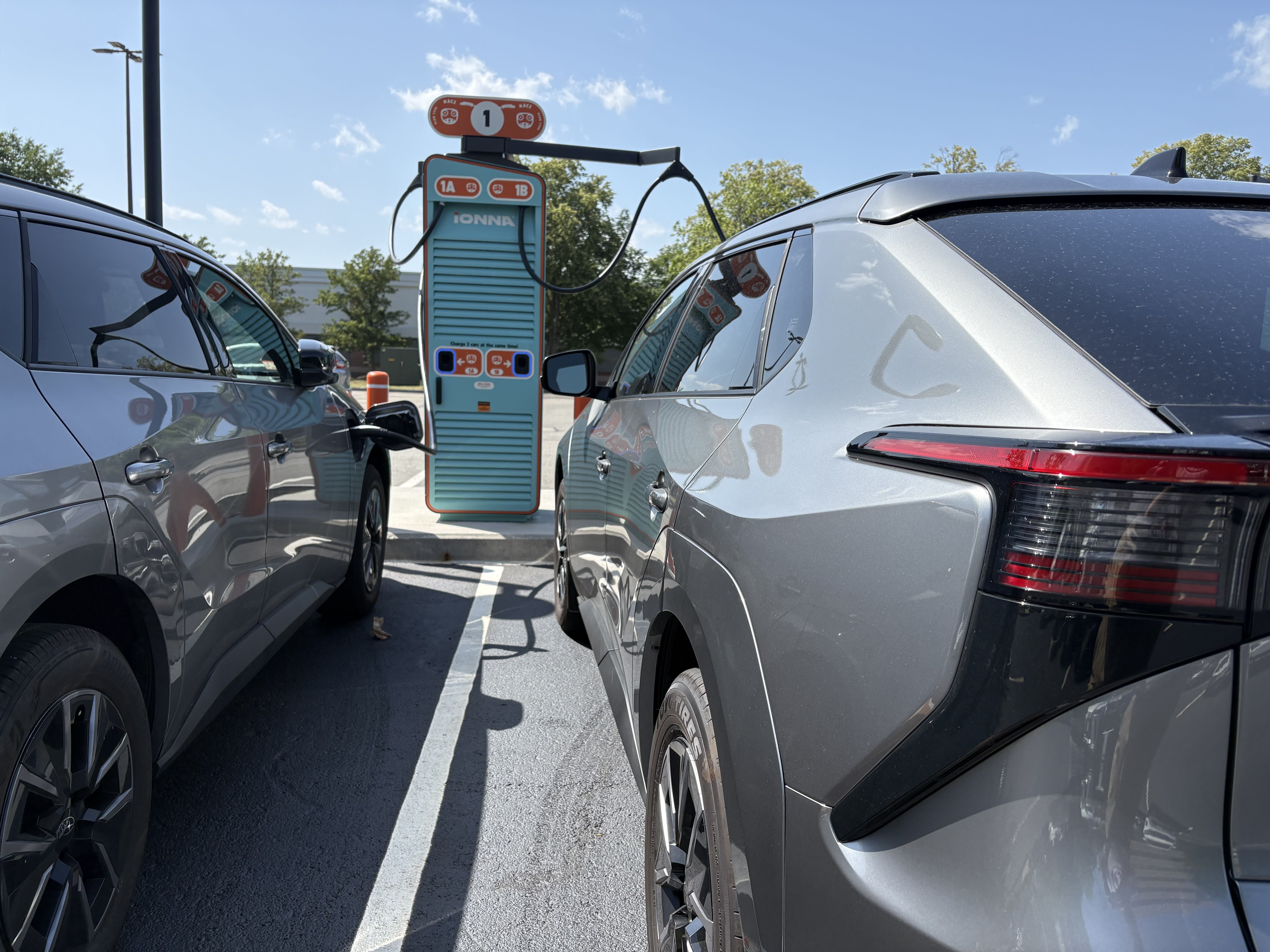
Follow the money: Public charging is more expensive than charging at home — usually around 60 cents per kWh, compared to 20 cents per kWh for residential power in Michigan. (Some states are higher.)
- Of course, gas is expensive, too — the national average is just below $4 a gallon.
🥵 The intrigue: An unexpected factor, however, was the heat wave that spread from the Midwest to the East Coast over the July 4th holiday.
- Running the car's air conditioner cut anywhere from 20 to 40 miles off our estimated driving range.
- The bZ FWD Plus has an EPA-estimated driving range of 314 miles, but our tester averaged about 276 miles.
- By comparison, a 2026 Toyota RAV4 gas-electric hybrid gets 40 miles per gallon on the highway. Under ideal conditions, it could go 580 miles between fill-ups.
What we found: While some charging sessions were pretty seamless, there's still too much friction in the process.
Case in point: Most non-Teslas need a NACS adapter to plug in at a Tesla Supercharger, for example, and the cables are too short for many other EV brands, depending on where the charging receptacle is located.
- We didn't want to be jerks by parking the Toyota sideways across multiple spaces, so we learned to look for plugs situated perpendicular to the bank of Superchargers.
- The bZ already has a built-in NACS port, but we needed a CCS1 adapter to charge at other networks, like Electrify America.
- At some stations, you can push a button and the right adapter is automatically deployed.
Another annoyance: You have to download multiple apps and set up payment accounts for many separate charging networks.
- You can always swipe a credit card, but we found it sometimes takes a few tries, and you can't always get a receipt.
What we're watching: Some automakers are trying to streamline public charging by integrating more networks into their vehicle app.
- That way, you only have to use one app and set up one payment method, no matter which network you're using.
- In Toyota's case, it has easy plug-and-charge arrangements with two of the six charging networks we used on our trip — Tesla and Ionna (the charging network owned by eight automakers).
- Plug in and then swipe on the Toyota app to begin charging. The receipt goes directly to your Toyota wallet.
💭 My thought bubble: If every charging session could be as smooth and seamless as that, more people would be lining up to buy EVs.
The bottom line: EV charging is improving, but it's still got miles to go until it's truly convenient.
2. 🚘 What I drove
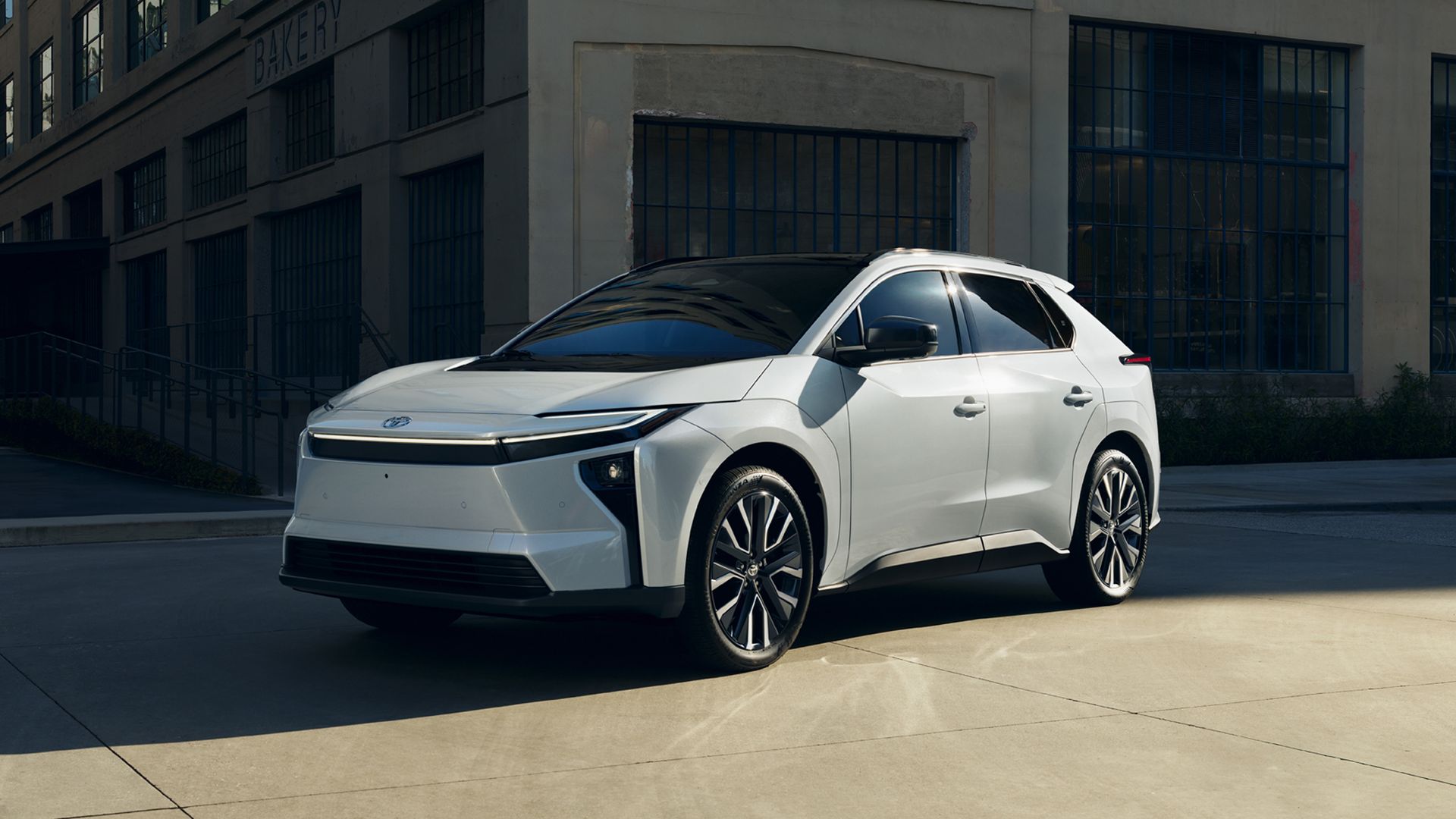
2026 Toyota bZ
- MSRP: $34,900 to $45,300, depending on trim level. As tested: $40,633 for XLE FWD Plus, including a few cosmetic options plus delivery.
- Under the hood: Single or dual-motor system fed by 57.7-kw base battery (235 miles driving range) or 74.7-kw battery (up to 314 miles).
- Manufacturing site: Aichi, Japan.
What's new: The bZ, one of four new Toyota EVs hitting the market this year, is a big improvement over its predecessor, the bZ4X.
- It gets a 25% bump in driving range, for instance, along with a built-in NACS port to recharge at Tesla Superchargers.
- The interior has also been updated with a new center console, slimmer instrument panel and a standard 14-inch multimedia screen.
What I loved: It's fun to drive and delivered instant power when we wanted to pass a slowpoke driver on a two-lane road in Vermont.
- Using NACS chargers at Tesla, Ionna and ChargePoint stations was a breeze.
What I didn't love: The interior materials felt cheap, especially the dust-collecting fabric on top of the dashboard.
- Toyota's smartphone app was fairly easy to use once I got the hang of it, but it doesn't have a built-in route planner to predict charging stops.
- Instead, it pairs with Apple Maps' route planner. (If you've got an Android smartphone, you'll have to wait.)
What drove me crazy: My phone kept getting disconnected from Bluetooth, so I couldn't mirror the route on the car's touchscreen using Apple CarPlay.
- Connectivity was a problem in some areas — especially in the Green Mountains and parts of upstate New York — which meant the car and the Toyota app were sometimes out of sync on their range estimates.
- Clearly, there are some software compatibility issues that need improvement.
What to watch: Toyota is rolling out a new infotainment system that includes a built-in route planner, which is essential for any EV.
I test-drive vehicles in my role as a juror for the North American Car and Truck of the Year awards. Opinions are my own.
3. Ionna charges ahead
EV sales momentum may have slowed in the U.S., but for charging company Ionna, it's full speed ahead.
The big picture: Ionna is on track to open 30,000 high-speed charging bays across the U.S. by 2030, a network its founding automakers see as a key to EV adoption.
- "The faster we can get to market, the faster we feel we can unlock vehicle sales for [automakers]," Ionna CEO Seth Cutler says.
Catch up quick: Ionna was founded in 2023 by BMW, General Motors, Honda, Hyundai, Kia, Mercedes-Benz, Stellantis and Toyota. In 2025, Rivian began partnering with Ionna, too.
- Ionna's goal is to raise the game for EV charging with convenient, affordable fast chargers and amenities like windshield cleaners, trash bins, restrooms and food.
- Its 400-kW chargers are the fastest available today in the U.S., and provide access to both NACS and CCS plugs.
State of play: Since February 2024, Ionna has opened 120 "Rechargery" locations in 31 states, with 60 more locations under construction.
- It's also partnering with convenience stores and gas stations like Sheetz, Wawa and Circle K.
💭 My thought bubble: I expected more when I charged at an Ionna in Reading, Massachusetts: a convenience store and a protective canopy, perhaps? Cutler tells me such features will be added to many locations; the primary focus has been getting chargers in the ground.
- But charging couldn't have been easier, given its integration with Toyota's app.
🏷️ By the numbers: Ionna's charging fees are significantly less than other networks — 39 cents per kWh vs. 64 cents per kWh at Electrify America, for example — and that's before discounts offered by individual carmakers.
Follow the money: Clearly, carmakers are subsidizing the costs, but let's face it — they have a strong interest in removing barriers to EV ownership.
4. Drive-thru
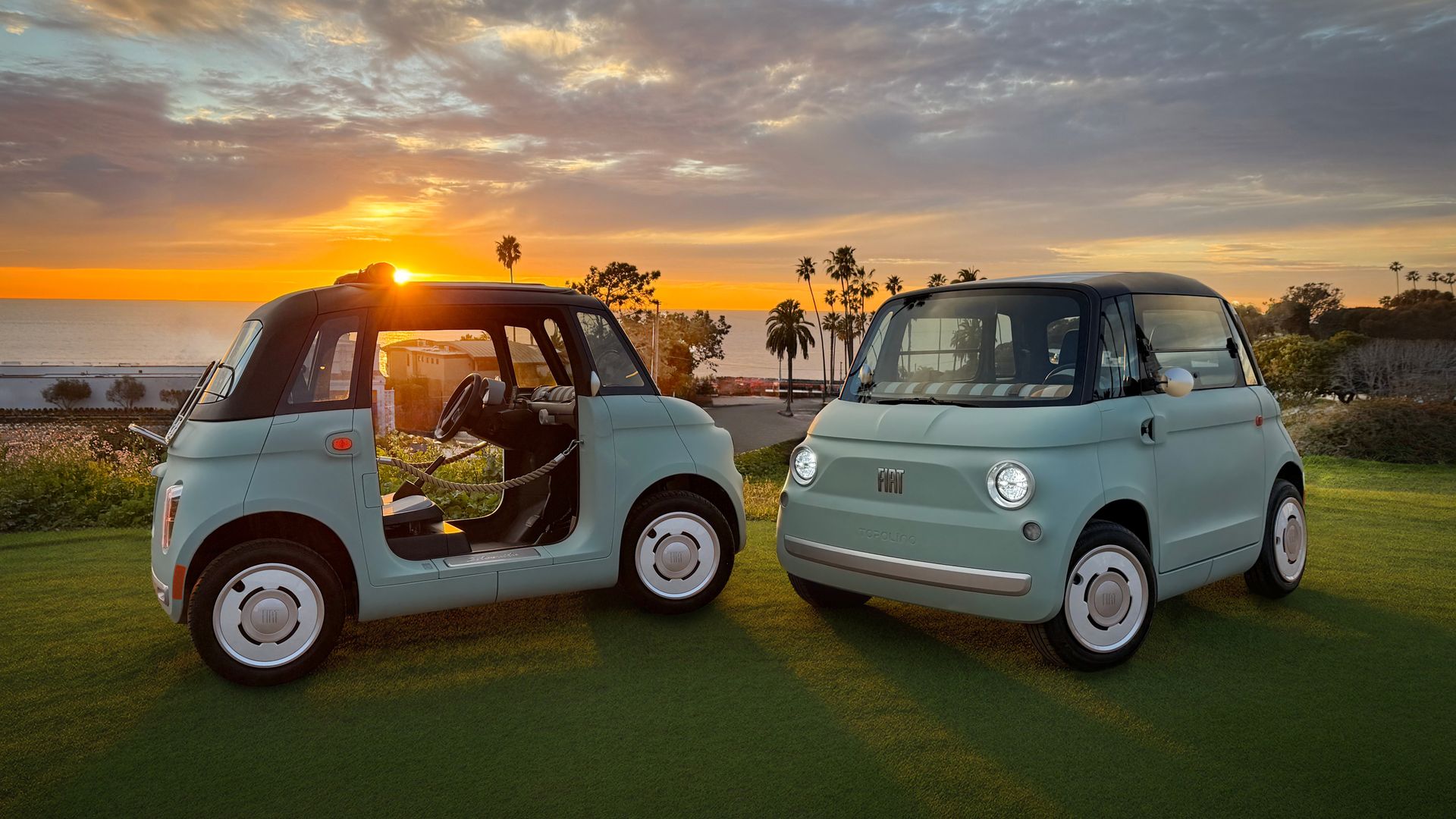
🚗 The tiny Fiat Topolino EV has arrived in the United States, with a starting price just under $15,000.
- It has a top speed of 19 mph, but a conversion kit coming later this year can boost the top speed to 25 mph to make it street legal (on public roads with a speed limit under 35 mph) (Car & Driver)
- 💭 My thought bubble: Si, per favore! 🇮🇹
🛻 Toyota confirmed a $3.6 billion expansion of its San Antonio manufacturing site, creating 2,000 new jobs, and said it will shift production of Tacoma pickups from a plant in Mexico to the U.S., sidestepping uncertainty over North American trade policy. (Axios)
🚖 Tesla is ramping production of its driverless Cybercab, even though it still hasn't perfected an unsupervised autonomy system that's safe enough to deploy. (Electrek)
🚁 Manna, an Irish drone delivery company, is launching U.S. operations in Tulsa, Oklahoma, with plans to create more than 1,000 jobs there over the next three years and set up a U.S. manufacturing base.
Thanks to editors Pete Gannon and Bill Kole. If you're a fan of this newsletter, please ask your friends to sign up, too.
Sign up for Axios Future of Mobility