Axios Future of Health Care

June 07, 2024

Happy Friday! I'm heading out of town for a week, but I'd love to come back to an inbox full of feedback on how you've liked this series of deep dives into the biggest health care trends.
- If you hate them, good news — we're almost done!
- If you've liked them, please tell me why, and it'll help me shape future coverage. And don't worry, I may be off next week but the newsletter isn't.
Today's word count is 1,727, or a 6.5-minute read.
1 big thing: The workforce crisis is already here
Demoralized doctors and nurses are leaving the field, hospitals are sounding the alarm about workforce shortages and employees are increasingly unionizing and even going on strike in high-profile disputes with their employers.
Why it matters: Dire forecasts of health care worker shortages often look to a decade or more from now, but the pandemic — and its ongoing fallout — has already ushered in a volatile era of dissatisfied workers and understaffed health care facilities.
- Some workers and experts say understaffing is, in some cases, the result of intentional cost cutting. Regardless, patients' access to care and the quality of that care are at risk.
- "There are 83 million Americans today who don't have access to primary care," said Jesse Ehrenfeld, president of the American Medical Association. "The problem is here. It's acute in rural parts of the country, it's acute in underserved communities."
The big picture: Complaints about understaffing, administrative burdens and inadequate wages aren't new, but they are getting much louder — and more health workers are leaving their jobs or cutting back their hours.
- "Like so many other things in the world, the pandemic just made this stuff super obvious. For a lot of physicians, the treadmill got harder," said Joanne Spetz, director of UCSF's Philip R. Lee Institute for Health Policy Studies.
- And the pandemic itself triggered a spike in burnout and poor mental health among the workers who bore the brunt of its impact.
- "The pandemic led a lot of people to say, honestly, for lack of a better way to say it, 'Oh hell no,'" Spetz said.
All of this is accelerating two major trends: There aren't enough health care workers, at least in some sectors or parts of the country, and too many of the ones who are left are miserable.
By the numbers: Nearly half of physicians say they're burned out, and 20% say they're depressed, according to Medscape's annual survey.
- In another survey by Doximity, a social networking site for doctors, 4 in 5 physicians said they're overworked, and 3 in 5 said they're considering retiring early, looking for another job or changing careers.
- Nursing home and elderly care employment took a particularly steep dive during the first couple of years of the pandemic, and unlike hospital, outpatient or physician office employment, remains far below pre-pandemic levels.
- And overall, employment across the sector remains below pre-pandemic trends, per KFF.
The intrigue: Some of the top reasons nurses give for leaving their employer — other than planned retirement — are burnout, emotional exhaustion and insufficient staffing, which the authors of a recent JAMA Network Open study called "systemic features of their employer."
- That presents a glaring issue: Nurses leaving the workforce over staffing concerns inherently leads to worse staffing issues if they're not replaced.
- "It's just huge risk for death spiral," Spetz said.
What we're watching: Some of this is coming to a head over the Biden administration's new requirement that nursing homes maintain minimum staffing ratios.
- The administration and its allies — including AARP- and SEIU-affiliated nursing home workers — claim that the rule ensures safe conditions in nursing homes and will improve patient care.
- Opponents, which include the long-term care industry, say that staffing shortages and costs make the regulation impossible to comply with, and they are pushing for Congress to block it.
But the idea of staffing ratios isn't new. California has mandated nurse-to-patient ratios in hospitals for decades, and national nurse associations are pushing for similar requirements at the federal level.
- "Politically, having a mandated staffing ratio has been a huge hot potato," Spetz said.
2. A "fundamental tension"

One fascinating debate underway is whether there's a nurse shortage at all, despite undeniable staffing issues.
Between the lines: The distinction lies in the question of whether the U.S. doesn't have enough registered nurses, or whether they just don't want to work in certain settings or have soured on the industry entirely because of poor working conditions.
- And some nurses allege that hospitals are keeping staffing levels low as a form of cost cutting.
- "We don't have a 'nurse shortage,' but we do have a staffing crisis in our hospitals, brought on by the lack of good nursing jobs," National Nurses United president Nancy Hagans wrote to the Senate health committee last year, adding that hospitals "deliberately refuse" to staff enough nurses to increase profits.
By the numbers: A JAMA Health Forum study found that the number of full-time nurses was actually 6% higher in 2022 and 2023 than in 2019, despite tens of thousands of nurses leaving their jobs during the pandemic.
- But that growth "occurred almost entirely in nonhospital settings," the study notes, which "may help explain why some hospitals have reported shortages of RNs."
The other side: Hospitals say they're committed to supporting their workforces in the face of "profoundly challenging" conditions, such as poor government reimbursement and growing supply costs, the American Hospital Association said in a statement.
- The AHA said industry labor costs have grown by 45% in the past decade, "far outpacing the rate of inflation, and underscoring hospitals' commitment to investing in their teams."
The big picture: It's impossible to ignore the larger context here, which is that (as this newsletter discussed several weeks ago) hospitals' traditional business model is becoming less and less sustainable as patients seek care in other places.
- "It is a pretty fundamental tension," said UCSF's Spetz. "It would be easy to say that you should staff more nurses, but now that the pandemic relief money has gone away, a lot of hospitals are really in a very precarious financial position."
3. What doctors hate about their jobs

It's not just nurses who are at odds with their employers or the system writ large; some doctors are also fed up.
Why it matters: Some physicians say the health system's emphasis on profits and the high costs for patients is demoralizing and prevents them from doing the job how they want to.
- Others say the shift away from independent practices has left doctors feeling voiceless or like a cog in a machine.
- "It feels like we're just being used as pawns to make money," said Maryssa Miller, an internal medicine resident physician at George Washington University who is represented by the Committee of Interns and Residents, an SEIU-affiliated union.
- "We truly want to serve, but when we've seen rounds and rounds of layoffs, burnout after COVID, high amounts of turnover … I think these corporations realize, 'Let's take away some resources and they'll still do their job,'" she added.
How it's playing: There's been a surge in unionization among physicians, and thousands have gone on strike over the last year.
- Three unions representing physicians have collectively added more than 10,000 members since 2021, Modern Healthcare reported this week.
- At the same time, more physicians than ever work for someone else; more than three-quarters are employed by hospitals, insurers, private equity or other corporate entities, according to a recent Physicians Advocacy Institute and Avalere Health analysis.
Frustration with electronic health records and administrative burden is just about universal, and concerns about autonomy are widespread, as well.
- "Nobody went to medical school to be a typist," the AMA's Ehrenfeld said. "Fighting with my electronic health record — it's mind-numbing."
The bottom line: Physicians say they still love the core of their job — seeing patients — but they do less and less of the good parts and are working in an environment that keeps getting tougher.
- "I love practice and the art of medicine and being able to heal people and walk them through the most challenging times of their lives," Miller said. "I will say that I am morally injured and burned out at the same time."
- "What we're trying to do is shift that balance of the things that people love — I love sitting down and hearing about my patients and hearing what they're excited to get back to," Ehrenfeld said. "But for a lot of physicians, that balance is in the wrong place."
4. Axios interview: The view from the (hospital) ground
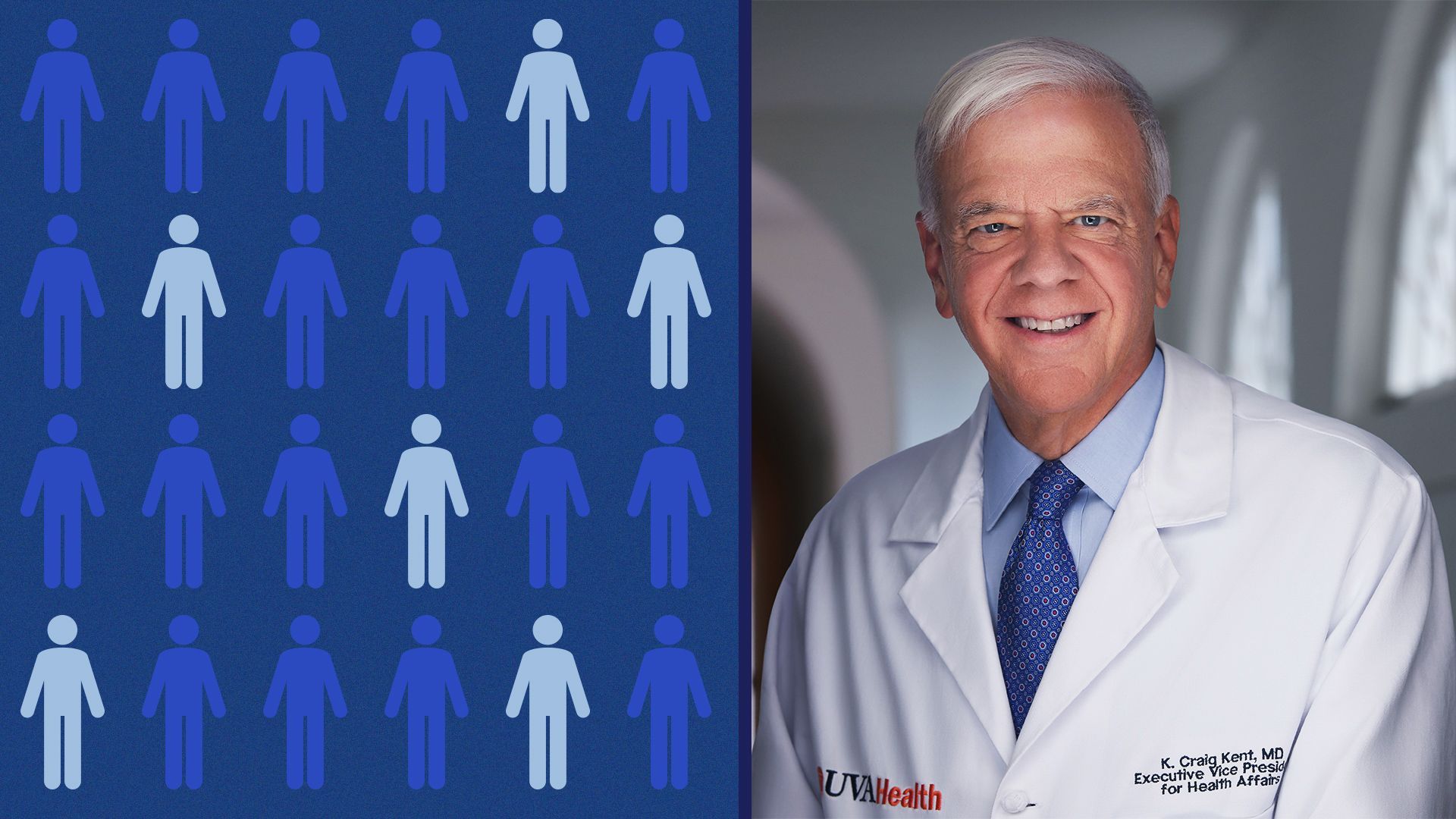
UVA Health CEO Craig Kent a couple of weeks ago trekked to Axios HQ in Clarendon, where he described the system as doing "incredibly well" financially after finding ways to increase efficiencies.
- We talked a lot about staffing, but before we get to the Q&A: He said the hospital's nursing turnover rate is 11%, whereas nationally it's 18-20%.
- "There's little doubt that if you're working more efficiently, the consequence of that could be that people are ultimately working harder," he acknowledged.
- So, he said, "if you're pushing efficiency, on the opposite side, make sure you're caring for your people."
Q: What is transformative about what you are working on?
A: The first would be trying to create health care delivery in a more efficient way so that people can have better access to health care and health care organizations can be more sustainable. ... The second is we're building a biotech institute.
Q: One trend transforming health care that we're not paying enough attention to?
A: I think that innovation around workforce is probably the most important work that we can do, because places that are really, really busy like the University of Virginia … our only limitation now to taking care of more patients is not having enough people in our system.
Q: Biggest challenge health care faces?
A: Staffing shortages. ... In parallel, just the health care economics are just not there.
Q: What about your career so far would most surprise your 18-year-old self?
A: I grew up on a cattle ranch in Nevada. My father never went to college, I was supposed to take over the ranch. So when I was 18, the idea that I would either be a physician or a health system CEO is like — nobody was thinking about that.
Q: When/where do you do your best thinking?
A: When I'm exercising. I do a lot of bike riding.
Q: What's the best job you've ever had?
A: When my father hired me to be a ranch hand. I loved every moment of that — outdoors, a free spirit, the ranching life is an incredible life.
1 fun prediction: Tell us something about what health care is going to be like in 5-10 years that's different from today.
A: I think we are going to have, in 10 years, cures for many diseases that are common diseases that we don't have now.
Thanks to Nicholas Johnston and Jason Millman for editing and Matt Piper for copy editing.
Sign up for Axios Future of Health Care