Axios Future of Energy

May 27, 2026


🚀 Off we go! Today's edition opens with the latest moves to weave clean tech into the data center boom, then we've got news on...
- The energy dimensions of last night's primary races
- The scope of stalled onshore wind projects
- Federal nuclear support, New York's climate law changes, and more, all in 1,600 words, 6 minutes.
🙏 Thanks to David Nather and Chris Speckhard for editing and to our brilliant Axios visuals team.
🎸 This week in 1992, groundbreaking roots rockers Los Lobos released the album "Kiko," which provides today's intro tune...
1 big thing: Tech giants back new data center climate initiative

Microsoft, Google, Amazon and Meta are teaming up with a nonprofit investor to accelerate new technologies using data centers as test cases.
Why it matters: The initiative, led by Elemental Impact, is among the clearest attempts yet to turn the massive buildout of AI infrastructure into a proving ground for new technologies rather than just a new source of emissions.
Driving the news: The initiative aims to use data centers to test emerging technologies such as advanced cooling, energy storage and low-carbon building materials.
"We see data centers as really important customers for entrepreneurs to commercialize technologies that we've been working on for a long time," said Dawn Lippert, CEO and founder of Elemental Impact, the nonprofit investment firm spearheading the initiative.
The big picture: The AI boom is driving a historic surge in electricity demand, increasing fossil fuel use and putting climate goals — including those of major tech companies — on the back burner.
- Opposition to data centers is also growing, fueled by concerns about rising power prices and AI displacing jobs.
"This initiative is coming at the most perfect time because the priorities they have are literally the same priorities that you're hearing from communities," said Ryan Panchadsaram, a top advisor to venture capitalist John Doerr at Kleiner Perkins.
- Panchadsaram, whose firm is not involved in the initiative, said those include Elemental Impact's focus on community engagement and supporting technologies that enable more efficient use of energy and water.
Follow the money: Elemental will invest between $500,000 and $5 million in up to 10 startups through 2027 to support pilot projects in data centers.
Yes, but: That investment range is relatively small in the world of cleantech. Lippert said the group settled on that amount partly to move quickly over the next year — and because the initiative's value extends beyond funding.
The intrigue: The initiative also includes philanthropic backing from organizations including the Bill Gates-backed Breakthrough Energy and Builders Vision Philanthropy, backed by Lukas Walton, an heir to the Walmart fortune.
- The groups are providing multi-year grant funding to Elemental to support its investment into startups, though grant sizes were not disclosed.
How it works: Today's announcement of the initiative will also kick off a request for proposals from startups.
- Technologies under consideration include cleaner materials such as green cement and steel, alternatives to copper wiring, energy storage and new cooling methods, Lippert said.
The bottom line: "There are plenty of promising technologies that exist, but they do struggle to move from the pilot to large scale deployment," said Melanie Nakagawa, chief sustainability officer at Microsoft.
- "There's a real need right now to apply the pace and agility of an [investment] accelerator and the venture funding," she added.
2. 🗳️ The energy fallout of Trump's Senate power play

Texas Sen. John Cornyn's (R) primary loss last night and Louisiana Sen. Bill Cassidy's (R) May 16 defeat will reshape the Senate delegation of two states vital to the U.S. energy economy.
What we're watching: Texas AG Ken Paxton — who bested Cornyn with Trump's endorsement — has aggressively gone after banks and investment firms like BlackRock over their ESG policies.
- Wall Street, partially due to pressure from conservatives including Paxton, has slowed its roll on climate standards and targets.
- If he wins the general election, watch to see if Paxton carries his opposition into the Senate, especially if climate regains cachet on Wall Street in the years ahead.
Friction point: The nomination of Paxton — who has a long history of legal and ethical troubles — could make the general election more competitive.
- The nonpartisan Cook Political Report last night moved the race from "likely Republican" to "lean Republican."
- Democratic nominee James Talarico's campaign says he supports an "all of the above" energy strategy that embraces oil, gas, nuclear, and renewables. He's also been pushing for a gasoline tax holiday.
- Last night, the Republican National Committee highlighted coverage of Talarico's 2021 comment that "By teaching climate change in our schools, we can inspire a new generation of climate activists."
The intrigue: Cassidy has long carried the GOP torch for import fees on industrial goods — think metals, for instance — to prevent unfair advantage for countries with high CO2 manufacturing.
- His loss after opposition from Trump could make the uphill battle for facing the Foreign Pollution Fee Act — which he floated multiple times over the years — even steeper.
The bottom line: The oil and gas industry is losing two very known quantities on Capitol Hill.
***
👀 In another race to watch, far-right Bo French looks en route to victory in last night's GOP primary for a seat on the powerful Texas Railroad Commission, which regulates oil and gas in the country's largest producing state.
- "French spent much of the campaign working with grassroots Republican groups who were receptive to his focus on social issues, including the purported danger of Muslims and China in the oil patch," E&E News reports.
3. 💵 The rising stakes of the onshore wind stall
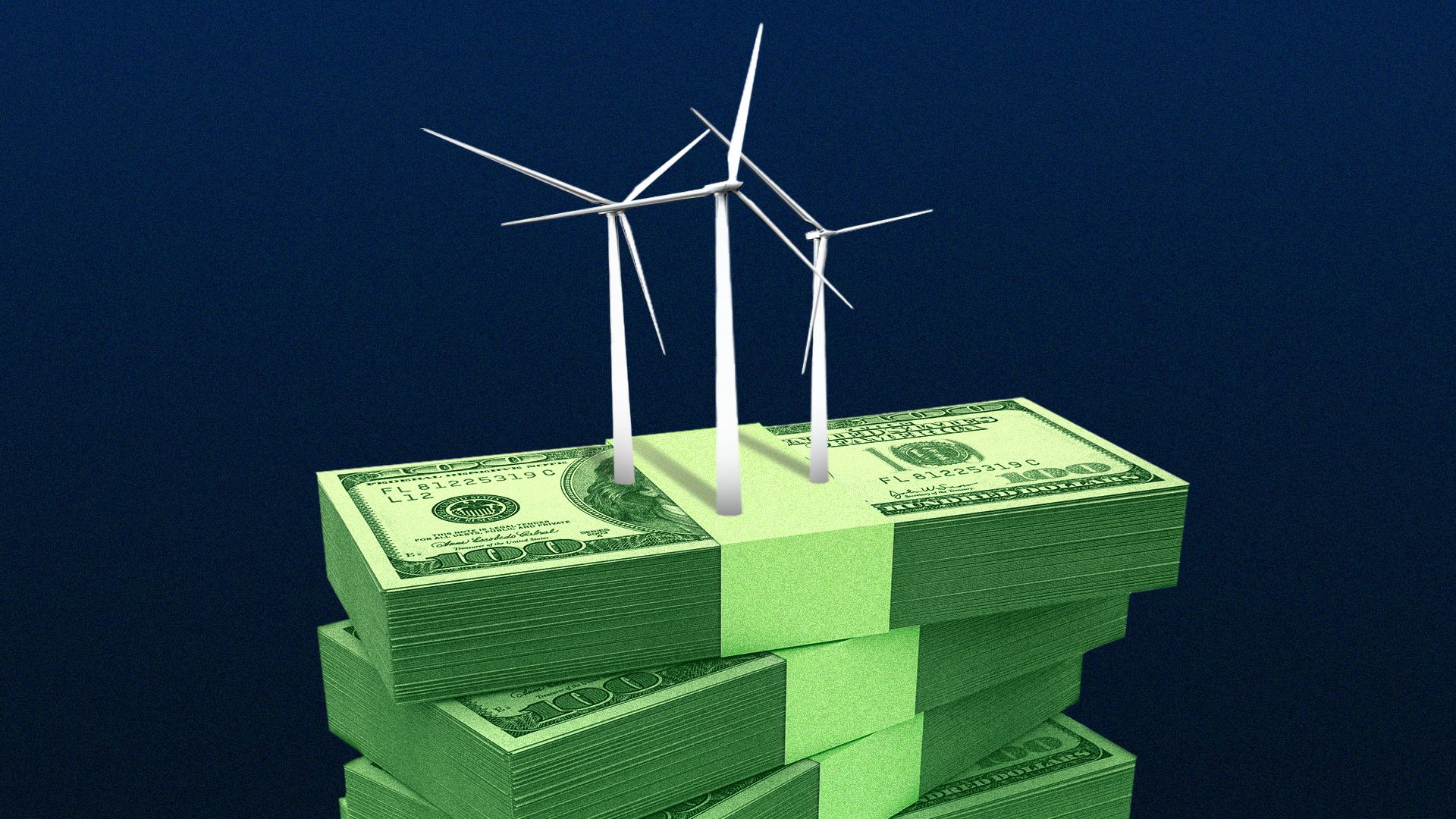
Pentagon restrictions are putting about 130 planned onshore projects and $50 billion worth of investment at risk, per industry estimates.
Why it matters: Once-routine federal reviews are now a chokepoint for wind, the renewables tech most in Trump 2.0's crosshairs.
Driving the news: Projects require Federal Aviation Administration sign-offs, called "no hazard determinations," that are typically based on military reviews.
- The military has "stopped transmitting review determinations" back to FAA, per an American Clean Power Association document.
- The summary — viewed by Axios and earlier reported by Bloomberg — claims projects across 24 states are affected, representing at least 30 gigawatts of power and about 150,000 "associated jobs."
Threat level: These are "conservative preliminary estimates," the document prepared for the trade group's members states.
- The Pentagon did not respond to a request for comment.
Catch up quick: The scale of projects bottled up has expanded since Amy first reported on the delays in March, when at least 30 projects were affected.
- For many years, the military dealt with radar and airspace concerns with "standardized mitigation measures and routine coordination with developers," the document states.
What we're watching: Trump's restrictions on renewables are a sticking point in permitting overhaul talks on Capitol Hill.
- The document floats options for Congress, such as statutory timelines on military reviews, and "deemed approved" provisions that allow projects to proceed if the Pentagon doesn't act within specific timeframes.
4. 🧁 Bonus policy notes: Nuke fuel and New York climate retreat

⚛️ The Energy Department has selected five nuclear companies for "advanced negotiations" to receive surplus federal plutonium for transformation into reactor fuel.
- Why it matters: Trump officials are pulling several levers to try to jumpstart domestic nuclear industries. The Surplus Plutonium Utilization Program will "help companies unlock the next level of private funding to broaden domestic nuclear fuel supplies," the department said yesterday.
- Driving the news: The companies selected are Oklo, Inc. (in partnership with the firm Newcleo); Exodys Energy; Shine Technologies; Standard Nuclear; and Flibe Energy. DOE has identified 19.7 metric tons of material for the current solicitation.
- The big picture: "If finalized, it would mark the first time the U.S. government has made weapons-grade plutonium available to private companies," per the NYT, which reports "unease among nonproliferation experts."
🌎 New York Gov. Kathy Hochul (D) reached a deal with state lawmakers to ease requirements in the state's 2019 climate law, per published reports and summaries from green groups upset about the changes.
- Why it matters: Aggressive climate goals and clean energy mandates are under pressure in multiple states as target dates loom and affordability politics take center stage.
- State of play: One change ends the 2030 requirement to cut emissions by 40% from 1990 levels. The state is not on pace. There's a new 60% by 2040 target, if it's "feasible and cost effective," per City & State New York and others.
- Friction point: Hochul spokesman Ken Lovett, in a statement, said Hochul "has made clear her top priority is keeping the lights on and costs down for all New Yorkers." Her office also pointed to post-COVID inflation and supply chain problems that raised renewable project costs, and Trump policies.
5. 🚗 What they're saying: Ferrari EV backlash edition
"If I were to say what I think, I would be hurting Ferrari. There is a risk of destroying a legend."— Former Ferrari chairman Luca di Montezemolo, translated in various outlets on the automaker's controversial new EV
Ferrari's new $640,000 electric car is drawing lots of colorful backlash, with comparisons to the Nissan Leaf (which is less than a tenth of the price) and a mousepad.
- The company's stock fell 5.3% yesterday.
The intrigue: Hannah Elliott, a Bloomberg auto writer, says the car is filling a particular strategic goal — and it's not actually large sales.
- "At the end of the day, this is a compliance car," she told the Bloomberg Businessweek podcast.
- "Ferrari made this car so that they will meet emissions and other regulations in Europe and globally, and they can keep making the other cars that everybody loves to drive," she said.
6. ⚛️ Number of the day: $2.4 billion
Nuclear power developer Newcleo is going public via a SPAC merger that values the company at about $2.4 billion, the WSJ reported this morning.
- The company says the deal would support its entry into the U.S. power market, the paper reports.
📫 Did a friend send you this newsletter? Welcome, please sign up.
Sign up for Axios Future of Energy