Axios Future of Energy

January 08, 2026

👀 President Trump's priorities are on full display this morning: deeper forays into Venezuelan oil, exiting UN climate groups.
- We break all that down and much more in just 1,548 words, 6 minutes.
🙏 Thanks to Chuck McCutcheon and Chris Speckhard for edits to today's newsletter, along with the brilliant Axios Visuals team.
🎶 This week in 1977, the late great Donna Summer released today's lovely intro tune...
1 big thing: The stakes and future of Trump's UN climate exit

President Trump's decision to yank the U.S. from UN climate change agencies will set back international progress on addressing the climate, observers say.
Why it matters: The U.S. is the world's second-largest emitter of greenhouse gases after China and provides much of the scientific heft addressing the problem.
- Climate scientists and activists predicted it will further isolate the U.S. on the global stage.
Driving the news: Trump last night announced a pullout from the United Nations Framework Convention on Climate Change (UNFCCC), the foundation of most global climate work, and the Intergovernmental Panel on Climate Change, which regularly assesses climate science.
- "The UNFCCC underpins global climate action," EU Climate Commissioner Wopke Hoekstra said in a post on X. "It brings countries together to support climate, reduce emissions, adapt to climate change, and track progress."
- The U.S. "has some of the world's best climate scientists (and more of them than anywhere else) & has contributed disproportionately to understanding the climate system," University of Hawaii climate scientist David Ho said in a Bluesky post.
Zoom in: Climate advocates were dismayed after Trump withdrew a second time from the Paris Agreement upon taking office. But they said the latest move still stings.
- "Pulling out of the UNFCCC is a different order of magnitude from the Paris Agreement," said Jean Su, energy justice director at the Center for Biological Diversity.
- "It removes the U.S. completely from the global climate framework and negotiations."
- Avoiding climate talks "will only isolate the United States further, undermine our global stature with allies around the globe, and cede the field to China," said Kaveh Guilanpour, vice president for international strategies at the Center for Climate and Energy Solutions.
Context: In all likelihood, U.S. scientists can't be fully barred from participating in IPCC reports. But those working for federal agencies could face repercussions if they do.
The other side: Secretary of State Marco Rubio said on X that the organizations are "anti-American, useless, or wasteful international organizations. Review of additional international organizations remains ongoing."
What's next: Potential challenges to Trump's action.
- Legal experts questioned whether Trump's move is legal, though the existence of laws hasn't stopped other moves of his.
- It also may hand Democrats a new political issue for the November midterms. Rep. Jared Huffman (D-Calif.) called Trump's move "a betrayal of every community on the frontlines of climate disaster."
2. 🛢️ Taking stock of an oil earthquake
Five days after the toppling of Nicolás Maduro, let's take stock of knowns and unknowns about Venezuela's oil and White House plans.
Why it matters: The White House sees control of Venezuela's oil as a pillar of its hemispheric strategy — and a big U.S. business opening.
A few big takeaways after a wild week...
🛢️ Control of oil is the story. Trump officials revealed yesterday that they plan to directly handle Venezuelan oil sales and revenue "indefinitely" via U.S.-controlled accounts in major global banks.
- Trump's lieutenants claim this will benefit both Americans, and Venezuelans who haven't shared in resource wealth under the Maduro regime.
💵 Trump's business aim is not subtle. Venezuela is "going to be purchasing ONLY American Made Products, with the money they receive from our new Oil Deal," Trump said on social media yesterday.
- This includes farm products, medical equipment and medicine, and power infrastructure.
🤐 A muted oil industry speaks volumes. The biggest U.S. firms have said little about the White House vision of domestic players rebuilding Venezuela's broken-down oil infrastructure.
- Analysts say companies will be hesitant to invest billions of dollars amid huge legal and financial uncertainties and modest prices.
📊 Markets aren't reaching firm conclusions. Oil price movements have been modest, suggesting traders don't predict large new Venezuelan flows anytime soon.
- Slight declines show that Maduro's ouster seems slightly bearish in what's already a soft market. Shares of big U.S. oil companies haven't seen huge changes.
- But shares of oilfield services heavyweights — Baker Hughes, Halliburton, and SLB — are sharply up. This suggests traders see nearer-term opportunities for them in working over existing wells.
🕵️ Dems want info on Big Oil. Top Senate Democrats on several committees penned joint letters to oil giants seeking info on communications with Trump officials.
- It previews what's to come if Democrats retake the House or Senate.
What we're watching: Oil execs' huddle with President Trump tomorrow.
- The FT reports they will seek "strong legal and financial guarantees" before committing capital.
3. ⛏️ AI, defense, robots: Copper's emerging global needs
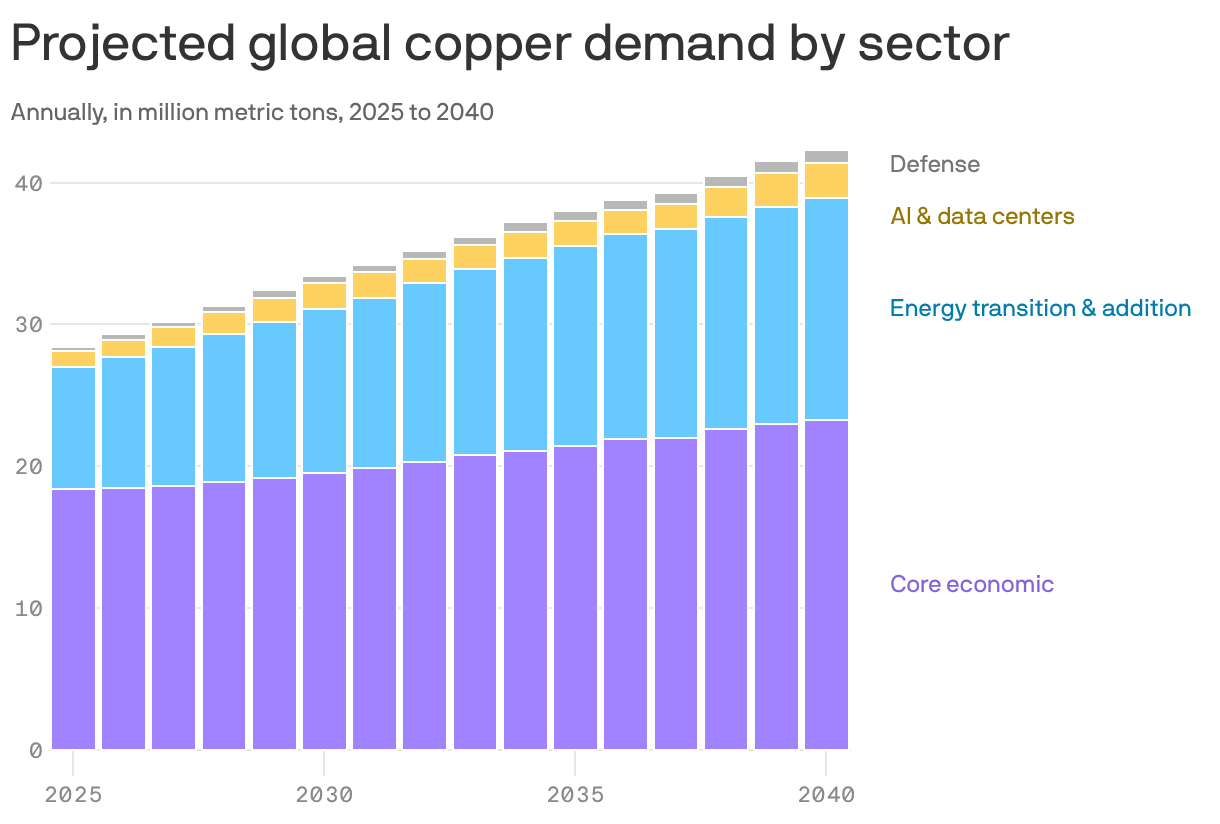
AI and military needs could worsen what's already shaping up as a looming copper supply gap in coming decades, new analysis finds.
Why it matters: Copper supply is foundational to energy transition including EVs and renewables — even as traditional uses like construction and machinery grow, as you can see above.
- The S&P Global study is a granular look at the market that includes incremental additions from AI data centers and increased power to fuel them.
The big picture: "We live in a world of electrification," S&P Vice Chairman Dan Yergin said in an interview.
- "Copper is either the enabler or the obstacle to electrification, because it is the metal of electrification," he said.
The intrigue: The AI boom is an important but hardly dominant driver, the report notes.
- "AI and data centers is a key new demand vector given data centers' electricity intensity, direct copper use, and rapid growth in the industry," it states.
- Over the very long term, development of humanoid robots "heavily wired with copper" are another "demand vector."
Threat level: The report dives into the need for more investment in mining and recycling — and barriers to making that happen.
- "Without improvement in above ground risks and significant new investment, a 10 million metric ton supply shortfall is projected by 2040, as existing mines decline and new projects lag behind demand," the study states.
- These "above ground" risks include long permitting timelines, workforce challenges, shifting regulations, tariffs and more.
What we're watching: It offers various recommendations for avoiding a supply shortfall, touching on areas like permitting, diversifying smelting and refining capacity and lots more.
4. 🏃 Catch up quick on policy: Sanctions and permitting
🛢️ President Trump has "greenlit" a bipartisan bill to impose huge tariffs on buyers of Russian oil and gas, Sen. Lindsey Graham (R-S.C.) said in a statement.
- Why it matters: The bill is aimed at curbing Kremlin petro-revenues that fund its war on Ukraine.
- Catch up quick: President Trump has previously signaled support, but only if the bill offers wide executive discretion. Graham's office did not respond to a request for a current version of the plan.
- What we're watching: Graham said the bill, which has wide bipartisan buy-in, could get a vote next week. But it has stalled repeatedly in the past.
⚔️ Want fresh evidence that a Capitol Hill permitting deal is a massive lift? The Senate's top Democrat on energy offered it on the floor last night.
- Friction point: "Any permitting deal is going to have to guarantee that no administration of either party can weaponize the permitting process for cheap political points," Sen. Martin Heinrich said in a speech.
- The bottom line: Dems want firm language that would remove Trump's ability to block previously approved wind projects and other renewables.
5. 🙏 Nuke industry pushes overhaul of Reagan-era law
Nuclear industry officials implored Congress yesterday to overhaul the 44-year-old law governing radioactive waste disposal if it's serious about helping the burgeoning industry.
Why it matters: The 1982 Nuclear Waste Policy Act was the product of an era when lawmakers envisioned spent fuel from nuclear power plants being buried deep underground and not put to other uses, as several companies are exploring.
Driving the news: "The Nuclear Waste Policy Act did not envision commercial spent fuel recycling," Idaho National Laboratory director John Wagner told a House & Energy Commerce subcommittee. "And therefore, I would suggest it needs to be revised to incentivize and support recycling."
- Nuclear Energy Institute President Maria Korsnick agreed that the law "needs to be sort of refreshed with a look at what's really needed today."
Catch up quick: Companies including Oklo, Curio and SHINE Technologies are gaining attention from — and influence with — the Trump administration as well as other companies for their differing approaches to recycling.
The other side: Critics of recycling say it's extremely expensive and offers the potential for terrorists to get their hands on radioactive materials.
What's next: Lawmakers may seek to update the law this year.
- One bipartisan bill, sponsored by Reps. Bob Latta (R-Ohio) and Scott Peters (D-Calif.), would streamline advanced nuclear development while making it easier to recycle spent fuel.
- Leftover fuel from the San Onofre Nuclear Generating Station just outside Peters' San Diego district "is within 100 feet of the Pacific Ocean, sits near dense population centers, an active military base and multiple fault lines," he said. "It's definitely not an ideal place for it to be."
6. 🛢️Quote of the day: Profane uncertainty edition
"No one wants to go in there when a random f—king tweet can change the entire foreign policy of the country."— An unnamed private equity investor to the FT on oil industry caution about Venezuela
📬 Did a friend send you this newsletter? Welcome, please sign up.
Sign up for Axios Future of Energy